Website Design

Design Subscription Plans: Costs, Tiers, and How to Choose (2026)

Blog Author
Maniruzzaman Jubayer
Publish date:
30 Sep 2026
Single Blog Image

A design subscription plan is a monthly service where you pay one flat fee, typically $300 to $1,500 for small businesses, for unlimited design requests and revisions through a shared request board instead of per-project quotes.

It works best for teams needing five or more design pieces a month; a single one-off project is usually cheaper through a freelancer.

A design subscription plan is a monthly service where you pay one flat fee for unlimited design requests, instead of paying per project or hiring a full time designer.

It's become the default way small businesses and SaaS teams get consistent creative work done without the overhead of an agency retainer or the guesswork of freelancers.

We've run Wolfpixel's own subscription model for a while now, and honestly, most of what gets written about this topic online is either a thinly disguised "best of" list pushing one vendor, or a wall of marketing copy with no real numbers in it.

This guide skips both. You'll get straight answers on cost, process, and how to actually pick the right plan, plus the parts most guides leave out, like what "unlimited" doesn't mean, when a subscription is the wrong call, and the red flags that separate a legitimate provider from a bait and switch.

What Is a Design Subscription Plan?

A design subscription plan is a recurring service, billed monthly, that gives you ongoing access to a designer or design team for a fixed price rather than a per project quote.

You submit requests through a shared board, app, or Slack channel, and the team works through them one at a time (or in parallel on higher tiers) until you're happy with the result.

The model borrows from streaming services. You're not paying for one deliverable, you're paying for access. That's the whole appeal: no negotiating a new scope every time you need a banner ad or a landing page tweak, no waiting on a freelancer's availability, no signing a new contract for every project.

Most plans include:

  • Unlimited design requests, submitted whenever you need them
  • Unlimited revisions until the work is approved
  • A dedicated designer or small team, not a rotating pool
  • No long term contract, pause or cancel most months

Most design subscription plans are structured to make ongoing creative work simple and predictable. Instead of paying separately for every task, you get continuous access to design support.

The exact limits vary by provider, but the model typically focuses on flexibility, consistent collaboration, and fewer administrative steps between requesting a design and getting it completed.

Why This Model Keeps Growing

The specialized design services market is on track to be worth around $177 billion in 2026, and it's still expanding at roughly 6 to 8 percent a year as more companies outsource design instead of hiring for it. Two things are driving the shift toward subscriptions specifically.

AI tools now handle a lot of the repetitive production work, background removal, basic layout variations, resizing assets for different platforms, which lowers the cost of running a subscription model and passes some of that savings on to you.

At the same time, demand for specialized, strategic design (product design, UX, conversion focused work) is growing faster than demand for generic graphic design, which is why the better subscription providers have shifted their higher tiers toward that kind of work rather than just churning out social graphics.

Need Affordable, Ongoing Design Support?

Skip the cost and hassle of hiring an in-house designer. Wolfpixel gives startups and growing businesses a dedicated creative team, unlimited design requests, and predictable monthly pricing all under one subscription.


Free 30-min call
primary-btn__arrowprimary-btn__arrow

How Does a Design Subscription Plan Actually Work?

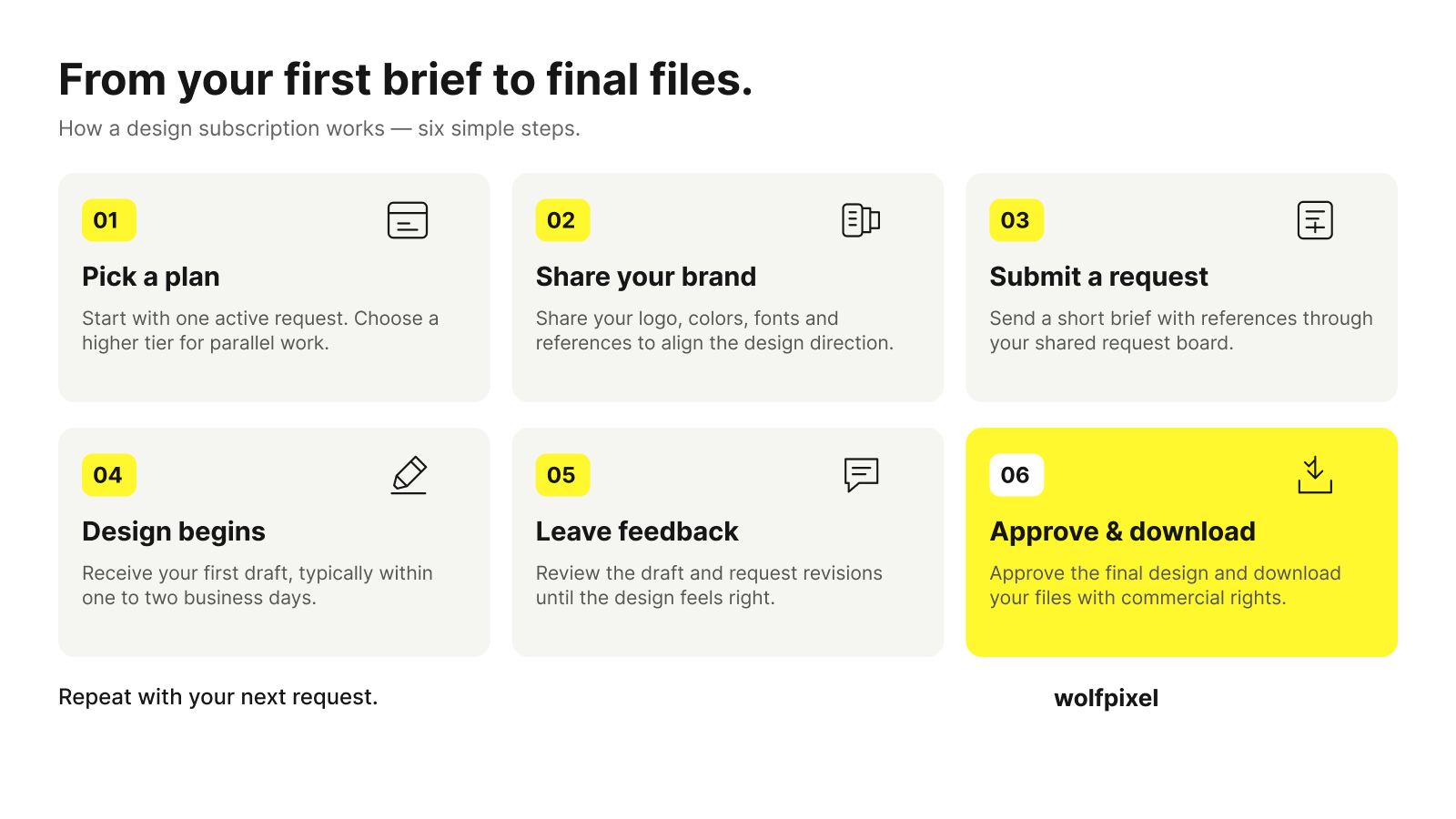
Here's the process, based on how we run it at Wolfpixel and how most reputable providers structure it:

  1. You pick a plan. Entry level plans usually cover one active request at a time. Higher tiers let two or three requests run in parallel.
  2. You do brand onboarding. You share your logo, brand colors, fonts, and a few examples of work you like. This is the step most people rush, and it's the one that determines how many revision rounds you'll actually need.
  3. You submit a request. A short brief with references, through a board, an app, or a chat channel, whatever the provider uses.
  4. The designer works on it. Most providers deliver a first draft within one to two business days.
  5. You leave feedback. Revisions are unlimited on most plans, so you keep iterating until it's right, not until you run out of budget.
  6. You approve and download. Once approved, the files are yours. Full commercial rights, no licensing string attached.

Then the queue moves to your next request, and the cycle repeats for as long as your subscription is active.
Process Design Subscription Six Steps

What "Unlimited" Doesn't Mean

This is the part most sales pages gloss over, so we'll say it plainly. Unlimited requests means you can add as many items to your queue as you want. It does not mean a full team is working on all of them at once.

On most base plans, one request is active at a time and completed before the next one starts. If you need real parallel output, you pay for a plan that allows two or more active requests.

That's not a downside, it's just the mechanic you should understand before you subscribe, so a busy month doesn't catch you off guard.

What's Usually Included at Each Tier

Scope changes a lot between providers and price points, so this is the honest breakdown of what to expect:

Typically included even on entry plans

Usually gated behind mid or higher tiers

If a plan seems cheap for what you need, check the scope page, not the homepage headline. That's where the real limits show up.

How Much Does a Design Subscription Plan Cost in 2026?

Pricing in this category spans from around $150 a month up to $6,000 a month, depending on scope, turnaround speed, and whether you're getting a shared designer pool or a dedicated one. Broadly, it breaks into three bands:

Option Cost Speed Best for
Freelancer $65 to $125+ per hour Depends on availability One-off or highly specialized work
Agency Several thousand dollars per project, often with contracts Slower, more process Major brand overhauls, big campaigns
In-house designer $50,000 to $70,000+ per year, plus benefits Fastest for internal priorities Companies with constant, varied design needs
Design subscription $300 to $6,000 per month, flat 24 to 48 hours typical Ongoing, recurring design needs without the overhead

A few things worth knowing before you compare providers on price alone:

  • Promotional pricing is common. Several well known providers advertise a discounted rate for the first three or four months, then jump to double or triple that price. Always check the regular rate, not just the intro offer.
  • "Unlimited" plans are priced on speed, not volume. A $400 plan and a $1,500 plan might both say unlimited, the difference is how many requests move at once and how fast they turn around.
  • Cheaper isn't always cheaper. A $150 plan that scopes every task to 30 minutes of work will cost you more in the long run if your projects are complex, because you'll end up splitting one job into five requests.

A design subscription is built for businesses that need ongoing creative support without repeatedly hiring or managing different designers.

You can submit requests as they arise, receive revisions until the design meets your expectations, and maintain consistent brand quality through dedicated support.

Flexible billing also makes it easier to scale design resources up or down as your workload changes.

Design Subscription vs Freelancer vs Agency vs In-House Designer

Choosing a design model depends on your workload, budget, speed, and how much ongoing design support you need. A design subscription offers predictable monthly access to design services, while freelancers are flexible for individual projects, agencies provide broader expertise and resources, and in-house designers offer dedicated internal support.

Option Cost Speed Best for
Freelancer $65 to $125+ per hour Depends on availability One-off or highly specialized work
Agency Several thousand dollars per project, often with contracts Slower, more process Major brand overhauls, big campaigns
In-house designer $50,000 to $70,000+ per year, plus benefits Fastest for internal priorities Companies with constant, varied design needs
Design subscription $300 to $6,000 per month, flat 24 to 48 hours typical Ongoing, recurring design needs without the overhead

If you need five or more design pieces a month, a subscription almost always beats paying freelancers project by project. If you need one logo and you're done, a freelancer is probably cheaper and simpler.

Need Affordable, Ongoing Design Support?

Skip the cost and hassle of hiring an in-house designer. Wolfpixel gives startups and growing businesses a dedicated creative team, unlimited design requests, and predictable monthly pricing all under one subscription.

Free 30-min call
primary-btn__arrowprimary-btn__arrow

Self-Check: Do You Actually Need a Design Subscription?

Before you compare providers, answer these four questions honestly. We use a version of this same checklist internally when a lead asks if a subscription is the right fit for them, so it's not just a marketing quiz.

  1. Do you need design work more months than not? If design needs are occasional (one campaign a quarter), a subscription will sit half used. A freelancer or a single project quote is more efficient.
  2. Do your requests vary in type, social graphics one week, a landing page the next, a deck after that? Subscriptions are built for exactly this kind of variety. A single specialist freelancer isn't.
  3. Can you tolerate a queue? If everything you submit is urgent and same-day, check a provider's real turnaround time and active-request limit before signing up, don't assume "unlimited" means "instant."
  4. Do you have (or can you write) a clear brief? Subscriptions reward clear direction. If you need someone to define your brand strategy from scratch, an agency or a strategist is a better first step, you can move to a subscription once that foundation exists.

If you answered yes to the first two, a subscription plan is very likely the more cost-effective choice. Talk to our team and we'll tell you honestly if it's not, even if that means recommending a freelancer instead.

How to Choose the Right Design Subscription Plan

Five things actually matter here, everything else is marketing.

  1. ‍Check the scope at your price point, not the homepage promise. "Unlimited design" often excludes web design, illustration, or motion graphics at the base tier. Read the actual scope page.
  2. ‍Confirm turnaround time, and what it's measured against. A "24 hour turnaround" sometimes means 24 hours to a first draft, not a finished, approved design. Ask directly.
  3. ‍Look for a trial or money back guarantee. Most reputable providers offer 7 to 15 days. If a service has no trial and asks for a long commitment upfront, treat that as a warning sign.
  4. ‍Ask whether you get a dedicated designer or a shared pool. A dedicated designer who learns your brand over time produces more consistent work than a rotating pool that starts fresh on every request.
  5. ‍Read the fine print on file ownership. You should own every approved file outright, no licensing restrictions. This should be stated clearly in the terms, not buried.

Common Mistakes We See Businesses Make

  • Judging a plan by price alone, then discovering the scope doesn't cover half of what they actually need.
  • Skipping brand onboarding, which leads to more revision rounds and slower turnaround than the plan promised.
  • Submitting vague briefs. A one-line request produces a rough first draft. A brief with references, copy, and context produces something close to final on the first pass.
  • Not asking what happens during a busy month. If you'll regularly need two or three things at once, an entry level "one active request" plan will frustrate you fast.

Red Flags to Watch For

A handful of warning signs show up across the industry, worth checking for before you commit to any provider, including us.

  • No visible scope or exclusions list. If a site only says "unlimited design" with no page explaining what's out of scope, that's usually intentional. Legitimate providers publish exclusions clearly.
  • No trial period and a long minimum commitment. A provider confident in its work will let you test it for a week or two before asking for a quarterly or annual commitment.
  • Vague turnaround language. "Fast turnaround" with no number attached usually means it varies a lot in practice. Look for a stated business-day range.
  • Portfolio that's all templates. Ask to see examples in your industry or a similar one. A portfolio full of generic stock-style graphics is a sign you'll get generic stock-style graphics.
  • Pricing that jumps sharply after an intro period, with the higher recurring rate hard to find on the pricing page itself. Check the cancellation and rebilling terms before your card is charged the second time.
  • No named point of contact. You should know who's handling your account, not just a generic support inbox.

None of these are automatically disqualifying on their own, but two or more together are a reason to ask harder questions before you subscribe.

Is a Design Subscription Plan Worth It?

For businesses with ongoing, recurring design needs, marketing teams, SaaS startups, agencies handling client overflow, yes, it's usually the most cost effective option available. You get professional output at a predictable monthly cost without hiring overhead.

It's a weaker fit if you need one specific deliverable and nothing after it (a freelancer is simpler), or if you need deep strategic brand direction and long term creative partnership rather than production work (an agency retainer fits better there).

Not sure which camp you're in? Send us your typical month of design requests and we'll tell you plainly whether a subscription makes sense, no pitch deck required.

Bonus: Designing Your Own Subscription Plan Page

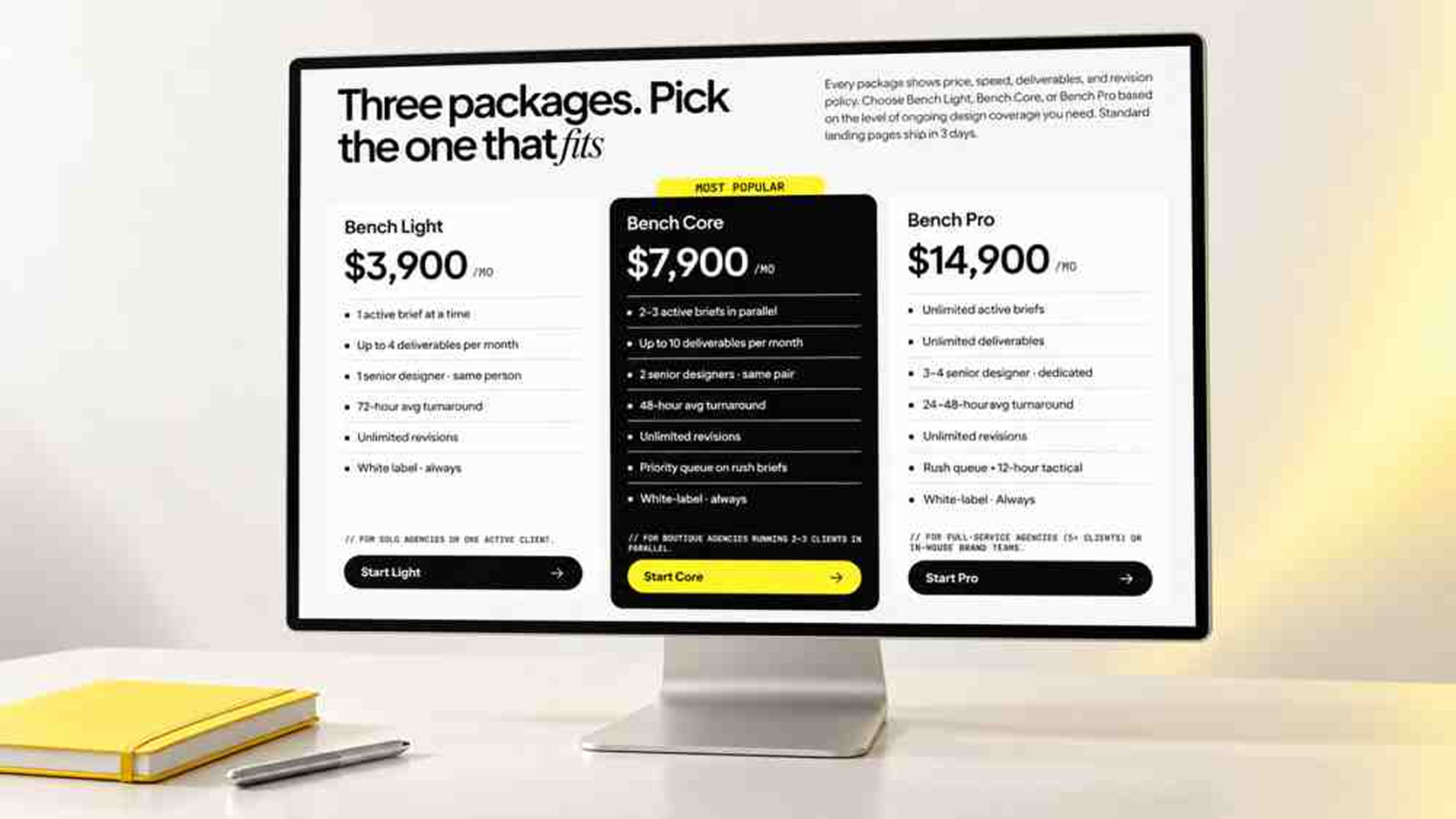
If you landed here because you're building a subscription plans UI, not buying a design subscription, a quick note. Subscription plan page design (the pricing tables SaaS products show visitors) follows different rules than general web design.
Mockup Wolfpixel Bench Pricing Desktop

The best performing ones usually stick to three tiers, highlight the recommended plan visually, and keep the price the single largest element on the card. If that's what you're working on, our SaaS and UI/UX team builds subscription plan pages as part of our regular product design work, worth a look if you want examples.

Why Businesses Choose Wolfpixel's Design Subscription Plan

We built Wolfpixel's subscription around one flat monthly fee, unlimited requests, and a dedicated team that actually works inside SaaS and startup constraints, not generic marketing collateral. A few things we've learned from running it:

Onboarding matters more than people expect. The accounts that get the most value out of a subscription are the ones that spend thirty minutes upfront sharing brand guidelines and examples. It saves everyone two or three revision rounds down the line.

Fixed pricing removes the anxiety, not the effort. One flat monthly fee means no surprise invoices, but it doesn't mean less thought goes into each request. We still treat every brief like it's the only one on the board.

We focus on SaaS and growing businesses specifically, so design decisions are made with conversion and product context in mind, not just visual polish.

If you want to see whether it fits your workload, book a free 30 minute call and we'll walk through your actual design needs before you commit to anything.

Frequently Asked Question

What is a design subscription plan?

A design subscription plan is a monthly service that gives you unlimited design requests and revisions for one flat fee, instead of paying per project. You submit briefs through a shared board or app, and a designer works through them on a set turnaround, usually 24 to 48 hours.

How much does a design subscription plan cost?

Most plans range from $300 to $1,500 a month for small businesses, with high-end team-based plans running $2,000 to $6,000 a month. Entry pricing depends heavily on scope, so always check what's included before comparing by price alone.

Is a design subscription cheaper than hiring a freelancer?

Yes, for ongoing work. If you need five or more pieces a month, a subscription is almost always cheaper than paying freelancers per project. For a single one-off piece, a freelancer is usually the simpler and cheaper option.

Does unlimited really mean unlimited requests?

Yes for the number of requests you can submit, but no for how many are worked on at once. Most entry plans complete one request at a time in order. Higher tiers allow two or more requests to run in parallel.

Can I pause or cancel a design subscription anytime?

Most reputable providers, including Wolfpixel, let you pause or cancel month to month with no long-term contract. Always confirm the cancellation terms before subscribing, since a few providers require notice before the next billing cycle.

Do I own the designs from a design subscription?

Yes. Full commercial rights should transfer to you once a design is approved, with no ongoing licensing fees. Confirm this is stated clearly in the provider's terms before signing up.

What's the difference between a design subscription and a design agency?

A subscription is production focused: fast, flat rate, ongoing output for recurring needs. An agency is strategy focused: deeper brand work, bigger campaigns, higher cost, and usually a project-based contract rather than a monthly one.

Is a design subscription plan good for a small business or startup?

Yes, it's often the most practical option at that stage. It gives you professional design output without the cost of a full-time hire, which typically runs $50,000 or more a year including salary and overhead.

What are the biggest red flags when choosing a design subscription provider?

The three most common are no visible list of what's excluded from a plan, no trial period paired with a long minimum commitment, and turnaround language with no actual number attached. Any one of these is worth asking about directly before you sign up.

Can I switch design subscription providers without losing momentum?

Yes, most of the switching cost is in re-onboarding, not in the design work itself. Export your brand assets and past files from the old provider, then spend the same thirty minutes on brand onboarding with the new one that you would with any first request.

Is the design subscription market actually growing, or is this a trend?

It's growing. The specialized design services market is projected to reach roughly $177 billion in 2026, and outsourced, on-demand models are taking share from traditional hiring as AI handles more routine production work.

Single Blog Author Img
Maniruzzaman Jubayer
COO & Co-founder

Maniruzzaman Jubayer is the COO & Co-founder of Wolfpixel, where he leads operations and helps the senior team deliver conversion-focused UI/UX, SaaS, web, and brand design for startups and growing businesses worldwide.