




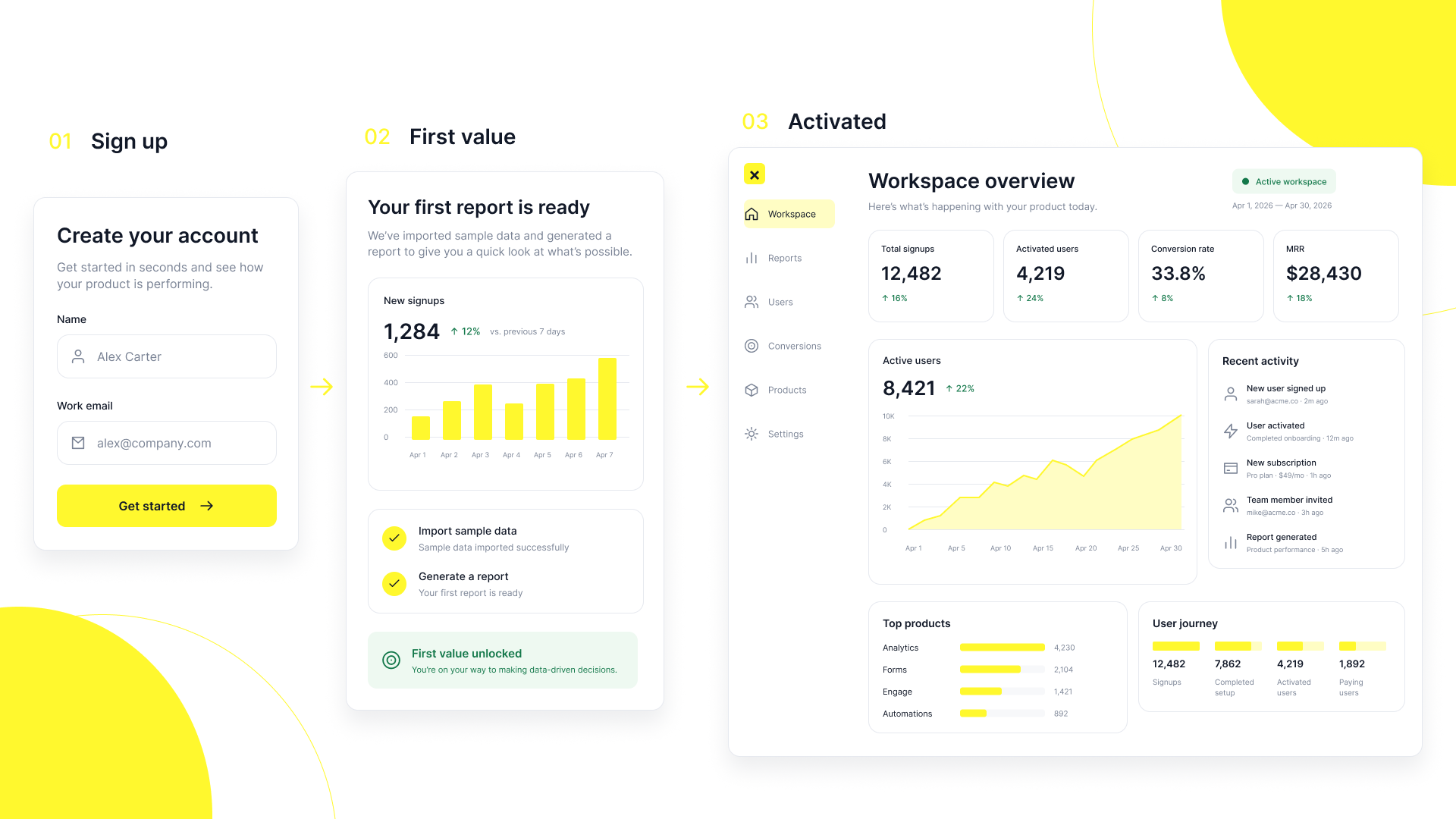
01 Oct 2026
UI/UX
SaaS User Onboarding: How to Turn Signups Into Activated, Paying Users


If your SaaS product isn't converting, the problem is almost never the product itself. Most of the time it is what happens before someone decides to pay, the messaging, the signup, the first five minutes inside the app. People do not abandon software for no reason. They leave when something is confusing, slow, or harder than it should be, and every extra bit of friction quietly costs you a customer.
Here is the uncomfortable part. SaaS has the lowest conversion rate of any major industry. The median SaaS landing page converts at just 3.8 percent, well below the 6.6 percent median across all industries, according to Unbounce. So a low number does not automatically mean you are failing. It means you are in a category where clarity and experience decide who wins, and small fixes move real revenue.
I run a SaaS design studio, so I see the same leaks over and over. This guide walks through what the numbers should look like, the real reasons products stall, and the fixes that actually work, including how product led growth turns signups into paying users.
Conversion is not one number, it is a chain, and your product can leak at any link. A visitor becomes a lead, a lead becomes a signup, a signup becomes an activated user, and an activated user becomes a paying customer. When people say their SaaS is not converting, they usually mean one specific link is broken, they just have not found which one yet.
That matters because the fix is different at each stage. A messaging problem shows up as visitors who never sign up. An onboarding problem shows up as signups who never reach value. A pricing or trust problem shows up as active users who never pay. Use this quick map to spot your likely leak before you read on.
Naming the stage is the first real step, and the benchmarks below tell you whether that stage is actually underperforming.
A good B2B SaaS conversion rate depends on the stage, so compare yourself to the right benchmark, not a generic average. Here is what the 2026 data looks like across the funnel.
Two numbers are worth sitting with. Free trials convert to paid at roughly double the rate of freemium, and product qualified leads, the users who hit a real value moment, convert at 25 to 30 percent versus single digits for everyone else. In other words, the score is decided inside the product, not on the pricing page.
Your pricing model also sets the ceiling. A free trial creates urgency and tends to convert about twice as well as freemium, while freemium pulls in far more signups at a lower rate, so it suits products with a slower path to value. A growing middle option, the reverse trial, gives full access for a short window and then drops users to a free tier, blending the reach of freemium with the urgency of a trial. Pick the model that matches how fast your product delivers its first win.
Most conversion problems trace back to five causes, and almost none of them are about the product being weak. The pattern is remarkably consistent across the products I audit.
Your message is not clear. If a visitor cannot tell what you do, who it is for, and why it beats the alternative within about five seconds, they leave. Feature lists lose to plain outcome language every time.
You ask for too much, too soon. Long signup forms and credit card walls make people hesitate before they have seen any value. Notion and Slack get users in with an email and let them explore, and their numbers show it.
Onboarding buries the value. New users should reach a real win fast, yet most products drop them onto an empty dashboard with no next step. That gap is where trials quietly die.
The experience feels slow or clunky. Speed is trust. Every extra second of load time costs roughly 7 percent of conversions, and a laggy dashboard makes even a great product feel unreliable.
Trust signals are missing. No testimonials, no recognizable logos, no proof. B2B buying is a committee sport, often 6 to 10 people, and without proof the quiet doubters win the argument.
The single most common leak I find is onboarding, not the homepage everyone obsesses over. Founders spend weeks polishing the hero section while the real drop off happens minute two inside the app, when a new user cannot figure out the first step.
The fix has a name, time to value. Companies that define a clear activation moment, the point where a user feels the product actually working, see trial to paid rates around 2.5 times higher than those that do not. Slack used a team sending its first messages. Dropbox used a file syncing across devices. Your job is to find that moment and remove everything between signup and reaching it.
Stop guessing and let the data show you where users bail, because the leak is almost always narrower than it feels. You can find it in an afternoon with a short, honest audit.
Start with your funnel analytics to see which stage drops hardest, visitor to signup, signup to activation, or activation to paid. Add a heatmap and session replay tool like Hotjar or Microsoft Clarity to watch where people hesitate and rage click. Run the five second test on your landing page by asking someone unfamiliar what you do and who it is for. Then watch five real users move through signup and onboarding while thinking out loud. Analytics tell you what is happening, and watching people tells you why.
Once you know where the leak is, these are the fixes that move the number, and they beat tweaking button colors every time. Each one targets a real point of friction rather than a cosmetic detail.
1. Talk to your users, not just your analytics. Analytics show what people do, but conversations reveal why they hesitate. Pull insight from exit surveys on your pricing page, trial cancellation feedback, onboarding drop off surveys, and recorded sales calls, then listen for the objection that keeps repeating. When Preply added a tutor availability calendar that answered a recurring concern, trial conversion rose by 31 percent, according to Paddle.
2. Test what matters, not button colors. Most teams run experiments on headlines and colors while the real problems sit in the value proposition, pricing, onboarding, and checkout. Start there instead. Track micro conversions like feature clicks and video plays alongside macro conversions like trial starts and paid upgrades, so you can see which small wins actually feed revenue.
3. Build a page for each audience, not one page for everyone. Your homepage cannot speak to every visitor, so create intent matched landing pages for each core use case or industry you serve. A project tool selling to construction teams, agencies, and developers needs three different pages with three different pain points, and social proof that matches each one. Intent matched pages routinely convert several times better than a generic page.
4. Get users to first value in minutes. Every step between signup and the first real win costs you conversions, so map your onboarding and cut anything that is not essential. Move optional fields later, and add a simple progress marker like step two of three, since people commit to finishing short tasks. This is the highest leverage fix for most products.
5. Remove friction from pricing and payment. People are ready to pay, so do not make it hard. Offering local payment methods can lift conversion from about 4.3 percent to 6.5 percent, and showing local currency drives around 25 percent more conversions on average, according to Paddle. Surfacing the right mobile wallet first adds a few more points, and steering users toward annual plans can raise lifetime value several times over.
6. Let AI predict where users will drop. Most analytics tools now include AI, so use it to move from reporting to prediction. Look at which early actions your best customers took in their first week, find where qualified trials stall, and fix that friction point before you touch anything cosmetic.
7. Put a product demo where intent is highest. A short demo video answers objections faster than any paragraph, so place one on your pricing page and key landing pages rather than burying it in resources. Give technical buyers a feature walkthrough and business buyers an outcome focused overview.
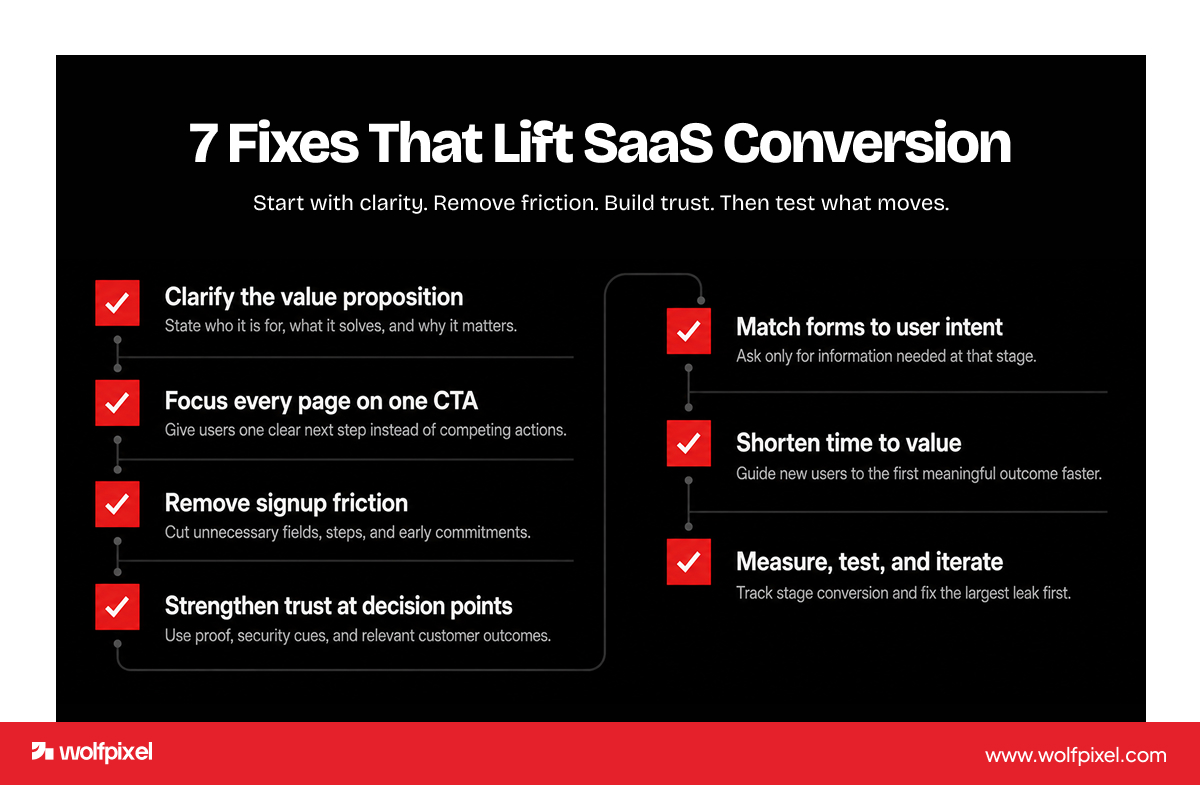
Before your next redesign, run this quick check. Does onboarding reach value within minutes? Are you testing pricing and onboarding rather than just headlines? Do you offer local payment methods and currencies? Are you tracking trial to paid and checkout conversion separately? Are you collecting real friction feedback from users? A no on any of these is usually a conversion leak worth fixing first.
Product led growth fixes conversion by letting the product prove its value before anyone is asked to pay, which is why 58 percent of SaaS companies now run some form of it. Instead of a demo and a sales pitch, the user experiences the win first, then upgrades on their own. When the product does the selling, conversion stops depending on a perfect pricing page.
Making that work usually means leaning on a few product led growth platforms, and they fall into clear categories. Onboarding and in app guidance tools such as Userpilot, Appcues, Chameleon, and Product Fruits get users to value faster. Product analytics tools such as Mixpanel, Amplitude, PostHog, and Pendo show exactly where users drop off. Feedback, A/B testing, and messaging tools close the loop. The tools matter, but they only pay off once the experience underneath them is clear, which is where design does the heavy lifting.
Wolfpixel is a SaaS only design studio built to turn signups into paying users, not just to make screens look nicer. Since 2021 we have worked with SaaS founders who are past the early stage, companies with traction that need the experience to match, and every brief lands on a senior designer with five or more years of experience. See how we redesigned the onboarding and dashboards for ZapMail and Crimino.
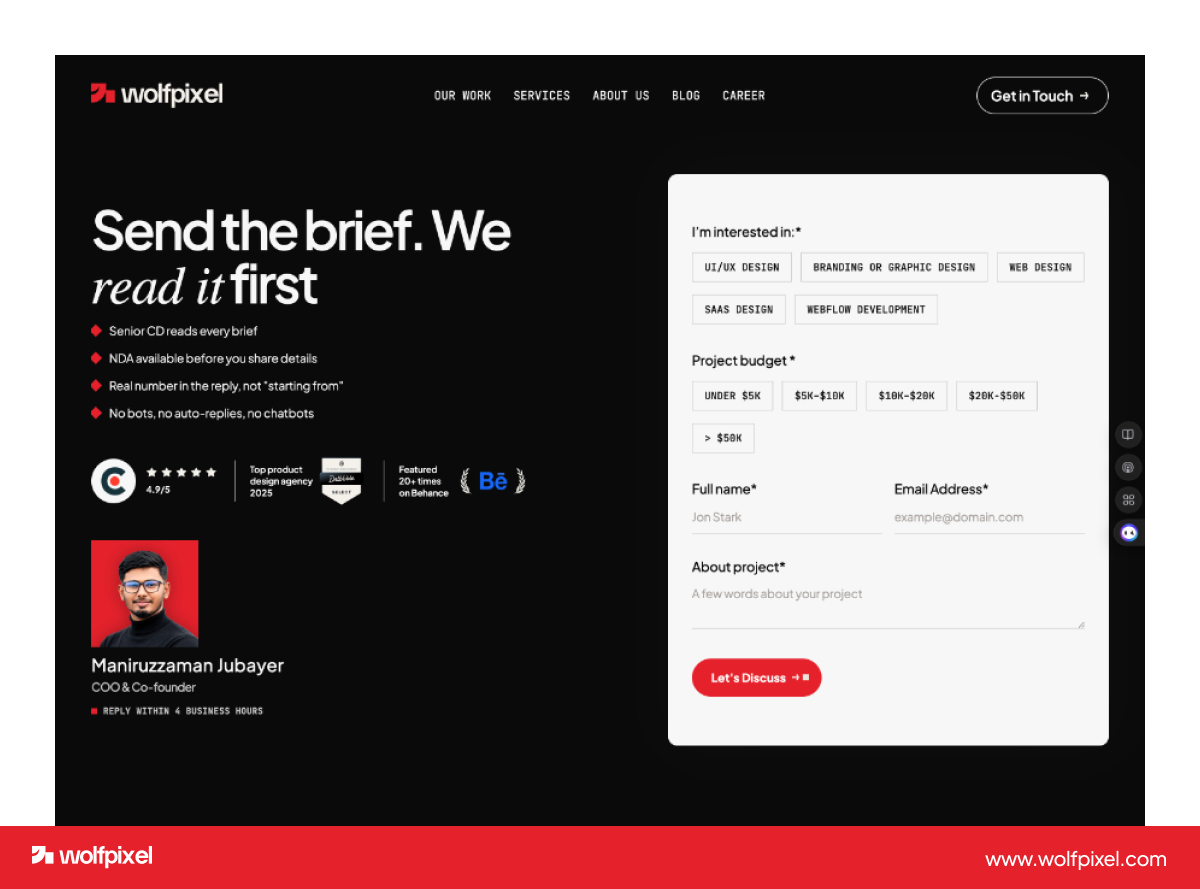
Here is the part I am proud of. Before we ever get on a call, our free AI audit tool scans your product and shows where visitors and users drop off, with no meetings and no fluff. From there we start with one question, where is value getting lost, and the answer usually points to onboarding, not the homepage. Between 2022 and 2026 the team earned more than 25 design badges and awards, with live work on Dribbble and Behance and reviews on Clutch. Clients tell us the same thing in those reviews, that we took a confusing flow and turned it into one users move through without thinking. If your product is not converting the way it should, that is exactly the problem we exist to fix.





.svg)



.svg)

.svg)

.svg)

.svg)

.svg)
.svg)
