



01 Oct 2026
UI/UX
SaaS User Onboarding: How to Turn Signups Into Activated, Paying Users


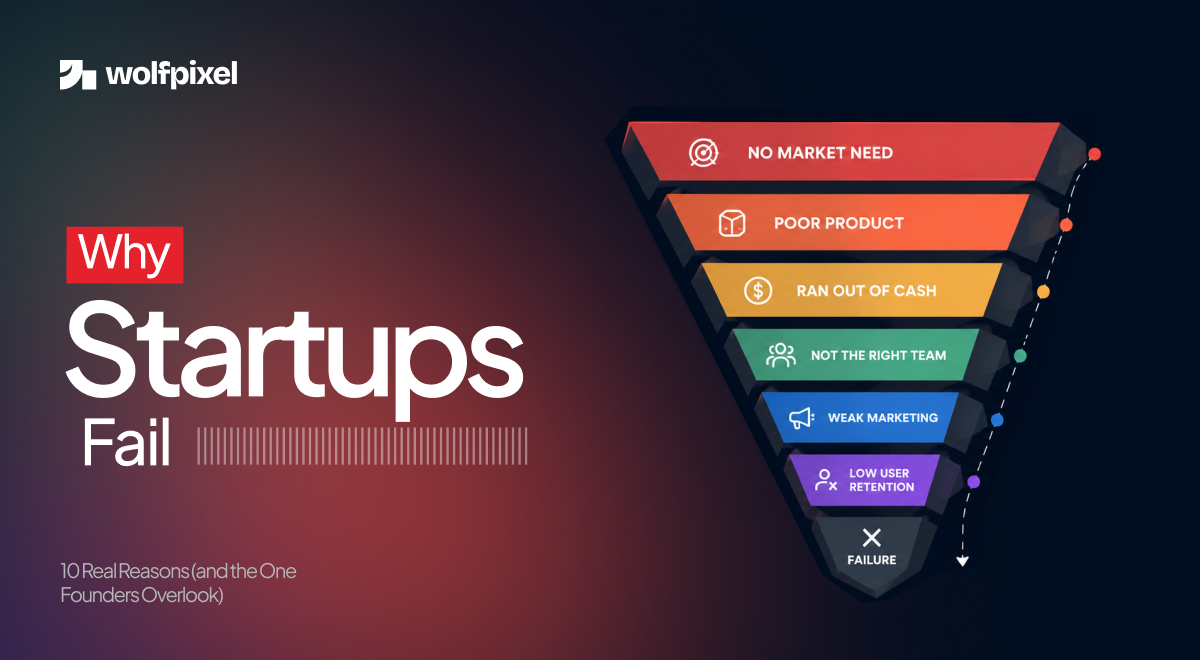
Most startups fail because there is no real market need for what they built, not because they ran out of cash. Running out of money is where the story ends. Building something not enough people wanted is usually where it started. That single distinction is the difference between founders who read failure statistics and founders who actually avoid becoming one.
We work with early stage startups every week as a design partner, so we see this pattern up close, well before a company runs out of runway. Below are the ten reasons startups fail, ordered roughly by how often they show up in the data, each with a fix. We have also added one cause that founder surveys almost never name directly, but that we watch sink otherwise promising products from the front row: how the company presents itself to the market.
The short version
Roughly 90 percent of startups fail eventually, and about two thirds never return a profit to investors, though the widely repeated "9 out of 10 fail in year one" line is a myth. The more grounded figure comes from U.S. Bureau of Labor Statistics survival data: close to 1 in 5 new businesses close within their first year, and only about a quarter survive to the fifteen year mark. Harvard Business School professor Tom Eisenmann, who wrote the book on this, frames it plainly: more than two thirds of startups never deliver a positive return.
.png)
So failure is common. The useful question is not "what percentage fail" but "what specifically kills them," because those causes are surprisingly predictable.
Your product may have real demand, but a confusing website or onboarding flow can hide it. Book a free 30-minute call with Wolfpixel to identify where users lose interest and get practical, prioritized improvements, no pressure, just useful feedback.


Roughly 90 percent of startups fail eventually, and about two thirds never return a profit to investors, though the widely repeated "9 out of 10 fail in year one" line is a myth. The more grounded figure comes from U.S. Bureau of Labor Statistics survival data: close to 1 in 5 new businesses close within their first year, and only about a quarter survive to the fifteen year mark. Harvard Business School professor Tom Eisenmann, who wrote the book on this, frames it plainly: more than two thirds of startups never deliver a positive return.
So failure is common. The useful question is not "what percentage fail" but "what specifically kills them," because those causes are surprisingly predictable.
The single biggest reason startups fail is that they build something not enough people actually want. In CB Insights' 2026 analysis of 431 venture backed companies that shut down, poor product market fit was cited in 43 percent of failures, and two thirds of those were early stage companies that never found a market at all. Wilbur Labs' 2026 survey of 200 founders landed in the same place: 54 percent said the most important lesson from their failure was understanding product market fit sooner.
The trap is that building feels like progress and validation feels like stalling. Founders code features they can show off instead of asking the one question that matters: does anyone want this enough to pay for it.
The fix: validate willingness to pay before you build. "Would you use this" and "would you pay for this" produce completely different answers. Get to real signal, pre sales, deposits, or a waitlist that converts, before writing much code.
Startups run out of cash, but that is almost always a symptom rather than the root cause. CB Insights found 70 percent of failed companies ran out of capital, yet the same report calls this the final event, not the disease. The median company in that study died 22 months after its last raise. Money extends runway; it cannot buy a market that does not want your product.
The fix: treat cash as a countdown, not a cushion. Know your runway in weeks, tie every major spend to a validation milestone, and have a break even plan even if profitability is years out. As the old line goes, revenue solves most known problems.
A large share of startups fail because the founding team is wrong for the job, not because the idea was bad. Roughly 23 percent of failures trace back to team issues. In Wilbur Labs' 2026 data, 49 percent of founders wished they had hired key people sooner, and 35 percent wished they had let underperformers go earlier. In a company of ten, one bad hire is ten percent of the company.
The fix: hire slowly for fit and act quickly on a misfit. Eisenmann calls one of his six failure patterns "Bad Bedfellows," good idea, wrong people around it, including investors and partners who do not add value beyond their check.
Some startups fail simply because a competitor does it better, cheaper, or faster. Around 19 percent of failures involve being outcompeted, often after a larger player copies the feature that made the startup special. Tilt raised over 60 million dollars before Venmo added the same group payment functionality, and network effects did the rest.
The fix: know your real differentiator and defend it. If a bigger competitor can copy your entire value in one sprint, you do not have a moat, you have a head start that is already running out.
A startup can have real demand and still fail if the business model never makes the math work. This shows up as unsustainable unit economics: spending more to acquire and serve a customer than that customer will ever be worth. Around 18 percent of failures involve pricing and cost problems.
The fix: model your unit economics honestly before you scale. If you lose money on every customer, more customers is not growth, it is a faster path to the ending in Reason 2.
Poor management sinks startups when founders scale operations, spending, or headcount faster than they can actually run them. This is less about a single decision and more about losing the plot as complexity grows. Eisenmann's later stage failure patterns, including the "speed trap," describe exactly this, companies that grow faster than their systems and leadership can support.
The fix: build operating discipline before you need it. Clear priorities, honest metrics, and a habit of killing what is not working matter more than raw hustle once you are past the earliest stage.
Ineffective marketing kills startups that have a good product but never get it in front of the right people the right way. Poor marketing contributes to roughly 14 percent of startup failures. The failure here is rarely "not enough ads." It is targeting the wrong audience, or being unable to explain the product clearly enough for anyone to care.
The fix: treat messaging as a core product, not an afterthought. If you cannot explain what you do and who it is for in one clear sentence, no amount of ad budget will save it.
Startups fail when they arrive too early or too late for the market to carry them. About 29 percent of failures involve bad timing. Whole categories, alternative protein, certain crypto plays, raised at a peak on a trend that never fully materialized, then folded when the market did not follow. In Wilbur Labs' 2026 report, half of founders now name technological disruption, including AI, as a top threat.
The fix: you cannot perfectly time a market, but you can build resilience. Keep runway flexible, watch adoption signals rather than hype, and be honest about whether the demand is real yet or just anticipated.
Startups fail when they pour fuel on a fire that is not yet burning, scaling before they have real product market fit. Startup Genome research has pointed to premature scaling as a factor in a large majority of high growth startup failures. Hiring a big sales team, spending on paid acquisition, or expanding to new markets before the core product proves itself just burns cash faster.
The fix: earn the right to scale. Prove that customers stick, that acquisition pays for itself, and that the model holds at small scale before you add pressure.
Startups lose the customers they worked hardest to win when the product itself is too confusing to use in the first session. A founder watches people sign up and leave and reads it as weak demand, when the demand was real and the product was simply too hard to figure out. In Wilbur Labs' 2026 data, 44 percent of founders pointed to product or technology issues as a primary cause of failure, and a clumsy interface is one of the most common versions of that. A new user who cannot find the one action that delivers value never comes back, and that quietly caps retention, which every other metric depends on.
The fix: design the first session around a single clear action that delivers value fast, then remove everything in the way of it.
How Wolfpixel fixes it: we redesign your onboarding and core flow around the one moment that delivers value, cutting the steps and friction that make new users stall. We map where real users drop off, rebuild that path, and hand back a UI that gets people to the payoff in the first session, so retention stops leaking before you spend more on acquisition. [See how we did exactly this in this product redesign.]
Startups quietly fail when their website and brand undermine the product before a prospect ever tries it, and founder surveys almost never name it. A founder blames "no market need" or "ineffective marketing," when the traffic actually arrived and the site converted almost none of it. Weak conversion looks exactly like weak demand from the dashboard.
Three patterns do the most damage:
The fix: treat your website as a conversion instrument, not a brochure. Lead with a clear value proposition, add real trust signals, and make it fast.
How Wolfpixel fixes it: we rebuild your site as a conversion instrument. We lead with a value proposition a visitor understands in seconds, add the trust signals a young brand needs to earn credibility fast, and ship a page that loads quickly and holds up on mobile, where most launch traffic lands. Because founders in a runway countdown cannot wait months, we publish our turnaround times and pricing openly, so the presentation layer stops hiding your real numbers.
Runway is the one thing you cannot raise more of. If real traffic is arriving and almost none of it converts, the problem may be your first impression, not your market. Book a free 30-minute teardown of your site and onboarding → — you leave with a prioritized fix list whether or not we work together.
The strongest research on why startups fail converges on a clear hierarchy: market problems first, money and team second, execution and timing after that. Here is the short version so you can weigh the sources yourself.
The throughline across all of them: most causes are downstream of one root, building or scaling something before proving people want it.
Your product may have real demand, but a confusing website or onboarding flow can hide it. Book a free 30-minute call with Wolfpixel to identify where users lose interest and get practical, prioritized improvements, no pressure, just useful feedback.






.svg)



.svg)

.svg)

.svg)

.svg)

.svg)
.svg)
