


15 Oct 2026
UI/UX Design
Design Agency vs Freelancer: Which Is Right for Your Product?


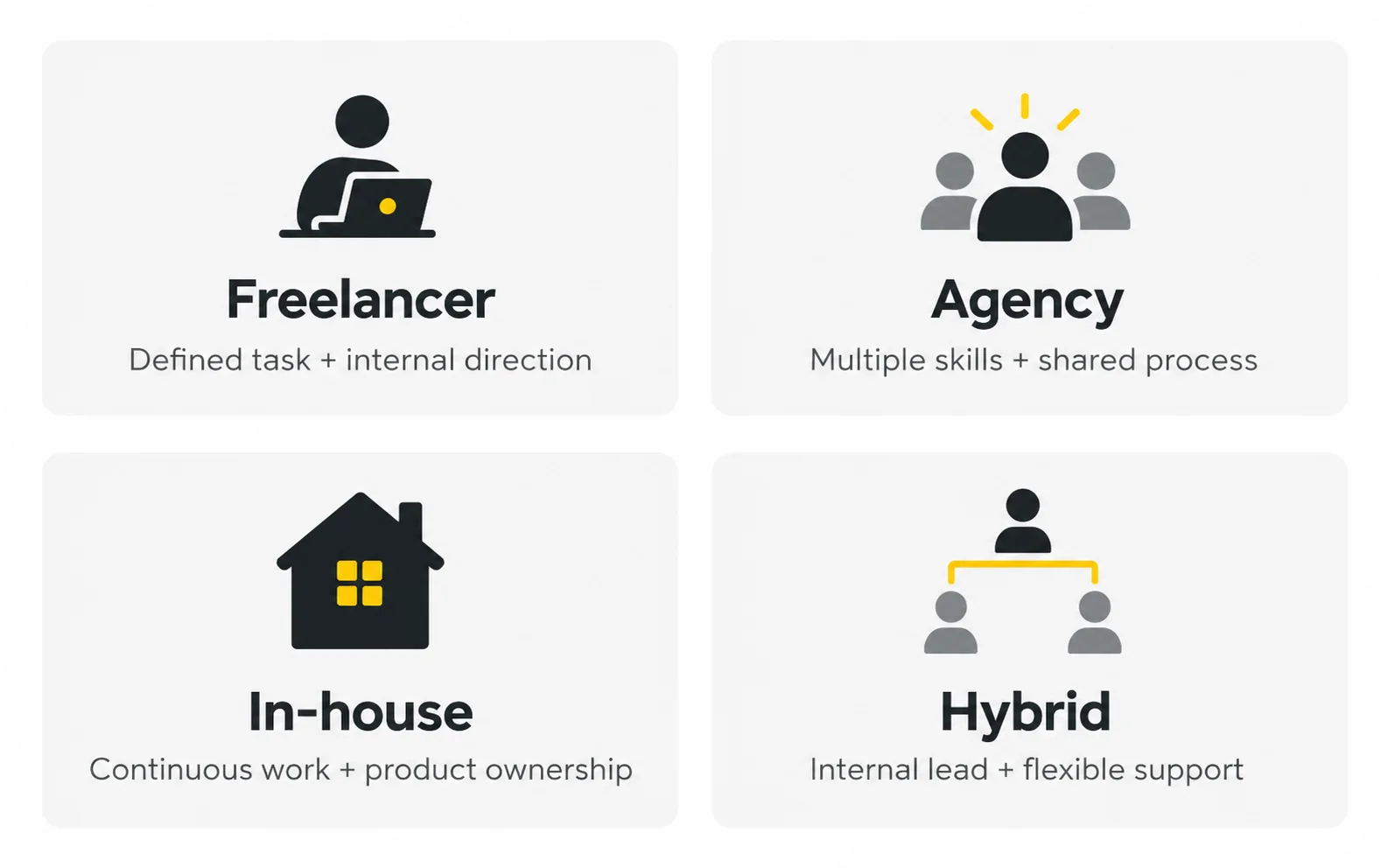
Hire a freelancer for well-defined, lower-risk work where you already know what you need and can manage the process yourself. Hire a design agency when the work is strategic, cross-functional, or time-critical and you need a full team (research, UX, UI, design systems) plus accountability for outcomes. Build in-house when design is a continuous, core part of your product and you can support a designer with steady work and leadership. Many growing teams end up with a hybrid: an in-house lead supported by an agency or white label design partner.
Most "agency vs freelancer" articles treat the choice like picking a vendor from a price list. In practice, the decision shapes how fast you ship, how coherent your product feels, and how much management time your team spends on design instead of on the business.
I'm Maniruzzaman Jubayer, a Design Lead with 6–7 years of hands-on UX/UI experience. I've worked on the agency side, collaborated with freelancers, and embedded with in-house product teams. The pattern I see most often is not "they hired the wrong type of designer." It's that the team hired a model that didn't match its stage, the problem it was actually solving, or its ability to manage design work.
This guide is written for founders, product leaders, and growth teams who are about to spend real money on design. It covers:
You'll finish with a decision framework you can apply to your own situation this week.
At its simplest, the difference is scope of responsibility. A freelancer is responsible for their own output. An agency is responsible for a team's output and the process that produces it. An in-house designer is responsible for the product's design over time, alongside your product and engineering teams.
| Factor | Freelancer | Design Agency | In-House Designer |
|---|---|---|---|
| Best for | Defined tasks, single-skill needs | Strategic projects, launches, redesigns, multi-skill work | Ongoing product design as a core function |
| Skill range | Usually one or two specialties | Research, UX, UI, brand, design systems, sometimes dev | Depends on the hire; often generalist early on |
| Speed to start | Fast | Moderate (onboarding and discovery) | Slow (hiring, onboarding, ramp-up) |
| Capacity | Limited to one person | Scalable across a team | Fixed until you hire more |
| Management load on you | High: you direct the work | Lower: agency manages process | Moderate to high: needs design leadership |
| Cost structure | Hourly or per project | Project, retainer, or subscription | Salary plus benefits, tools, and overhead |
| Continuity risk | High if they become unavailable | Lower: team coverage | Moderate: knowledge leaves if they do |
| Product context | Builds per engagement | Builds per engagement, deepens with retainers | Deepest over time |
| Accountability | For deliverables | For deliverables and process | For long-term product quality |
Key takeaway: Freelancers optimize for flexibility and cost per task. Agencies optimize for breadth, capacity, and reduced management overhead. In-house optimizes for depth of product context over time.
From the Design Lead's desk: Before comparing options, write one sentence describing the problem you're hiring design to solve. "We need a new dashboard UI" and "Trial users aren't activating" lead to very different hires. The first is a deliverable; the second is a product problem that needs research and UX thinking, not just screens.
These are common engagement patterns, not rankings of talent. A senior freelancer can lead strategy, an agency may have limited capacity, and an in-house team still needs support. Confirm who owns research, critique, coverage and delivery in the actual proposal.
Choose the model around the problem and your ability to lead the work.
Share your product, roadmap and team capacity. We can discuss which design model fits your current needs and next stage.


A good freelancer can be excellent value. The key is matching them to work where you can provide direction and where the risk of one person being unavailable is acceptable.
From the Design Lead's desk: Many strong freelancers do excellent work. When a freelance engagement fails, it's rarely talent. More often, the client expected the freelancer to also act as product manager, researcher, and project lead, without saying so or paying for it.
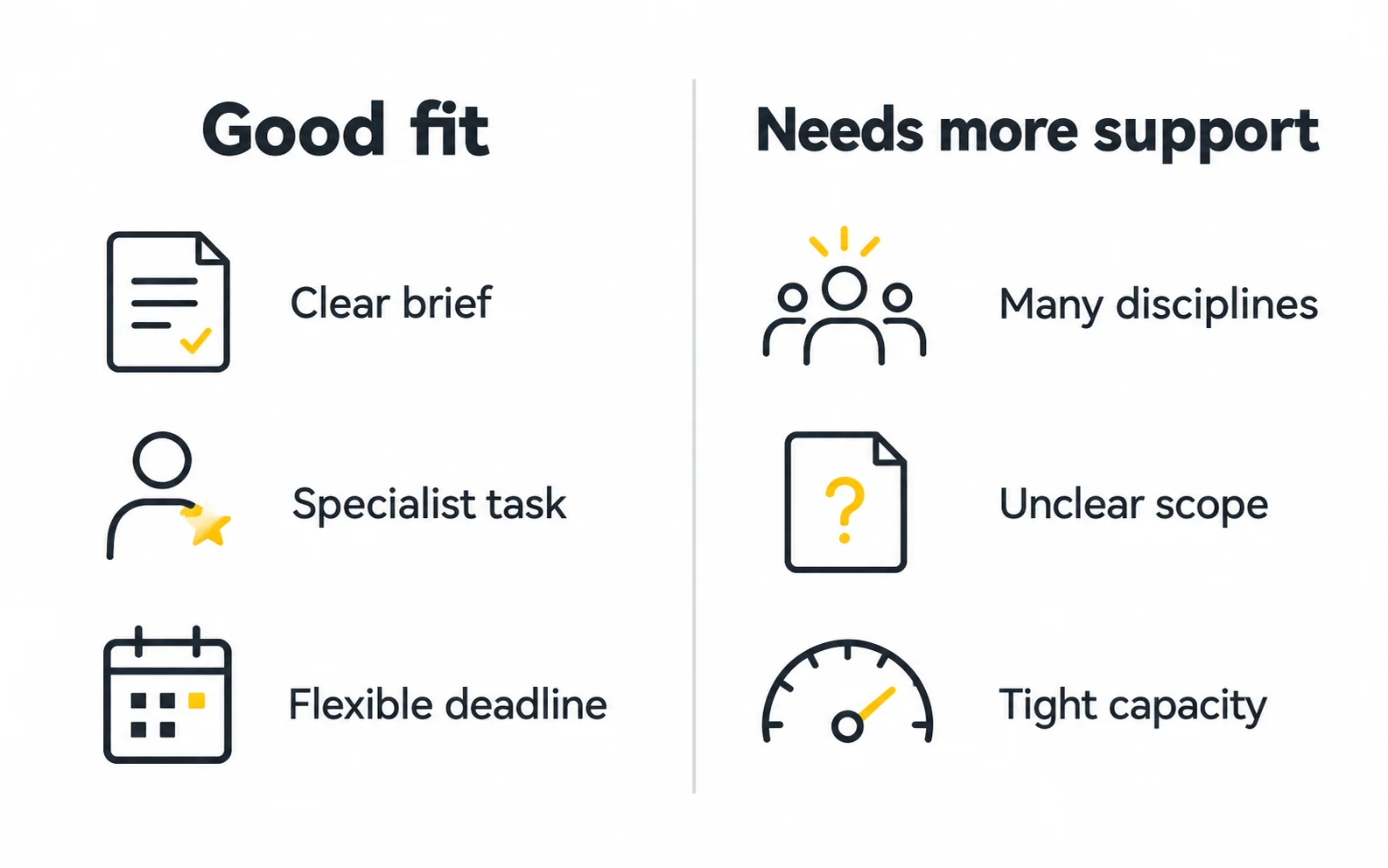
Match the specialist to a clear brief and realistic capacity.
The question of when to hire a design agency usually comes down to three signals: the work is strategic, multi-disciplinary, or deadline-driven, and you don't have design leadership in-house to orchestrate it.
If you need a few social graphics a month or a quick update to an existing page, an agency's process and pricing may be more than the work requires. A freelancer or a design subscription is usually a better fit for that.
From the Design Lead's desk: The best agency engagements I've been part of had one thing in common: a decision-maker on the client side who showed up to reviews and gave clear, timely feedback. An agency can bring the process, but it can't make product decisions for you. Budget time for that, not just money.
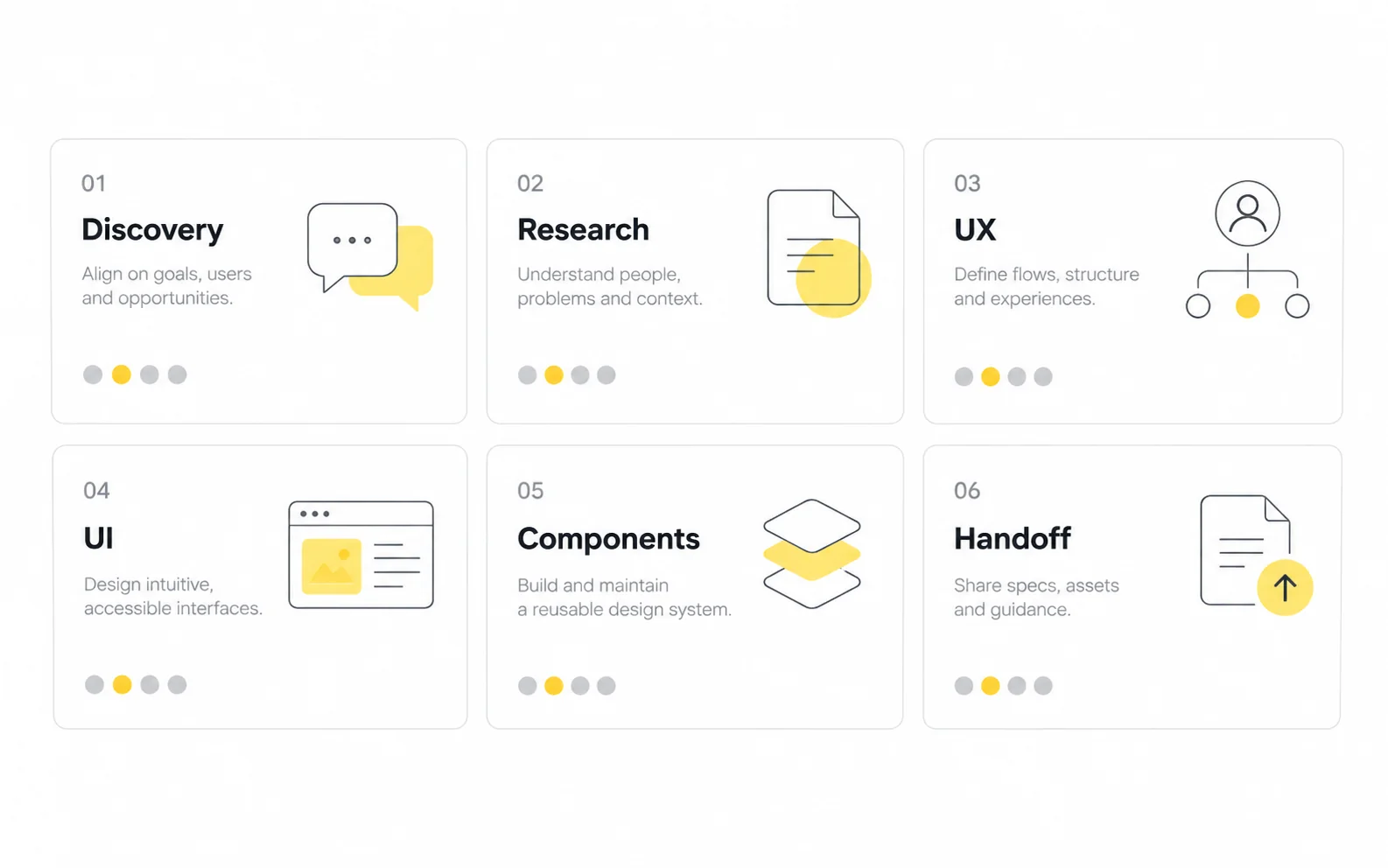
Explore our SaaS product design services when the brief spans workflows, interface design and shared components.
Ask how the team provides coverage and accountable delivery.
The in-house vs agency design decision is less about which is "better" and more about whether you have consistent, long-term design work and the leadership to support it.
Salary is the most visible number, but it's rarely the full cost. When you compare the cost of an in-house designer with agency or freelance pricing, build a fully loaded estimate:
| Cost Component | What to Include |
|---|---|
| Base salary | Benchmark using current local salary data for the role and seniority |
| Benefits and payroll taxes | Health coverage, retirement contributions, and employer taxes where applicable |
| Recruiting | Recruiter fees, job board costs, and interview time from your team |
| Tools and equipment | Design software seats, prototyping and research tools, hardware |
| Onboarding and ramp-up | Weeks or months before a new hire is fully productive in your product context |
| Management and leadership | Someone must review work, set direction, and support career growth |
| Attrition risk | Cost and delay of replacing them if they leave |
| Idle or mismatched time | Periods when the workload doesn't match their skills or capacity |
A simple way to compare:
If you only have a few months of concentrated design work, an agency or freelancer usually wins. If you have steady work all year, in-house often becomes more cost-effective over time.
One in-house designer rarely covers everything. A strong product designer may not be an expert brand designer, researcher, and design system architect. Expecting a single early hire to be all of these is one of the most common reasons first design hires struggle.
Many teams find that combining models works better than choosing one:
From the Design Lead's desk: If your first design hire is a junior designer with no one senior to learn from, you're asking them to set standards they haven't had the chance to develop yet. Either hire senior first, or pair a junior hire with an experienced external partner who can provide structure and critique.
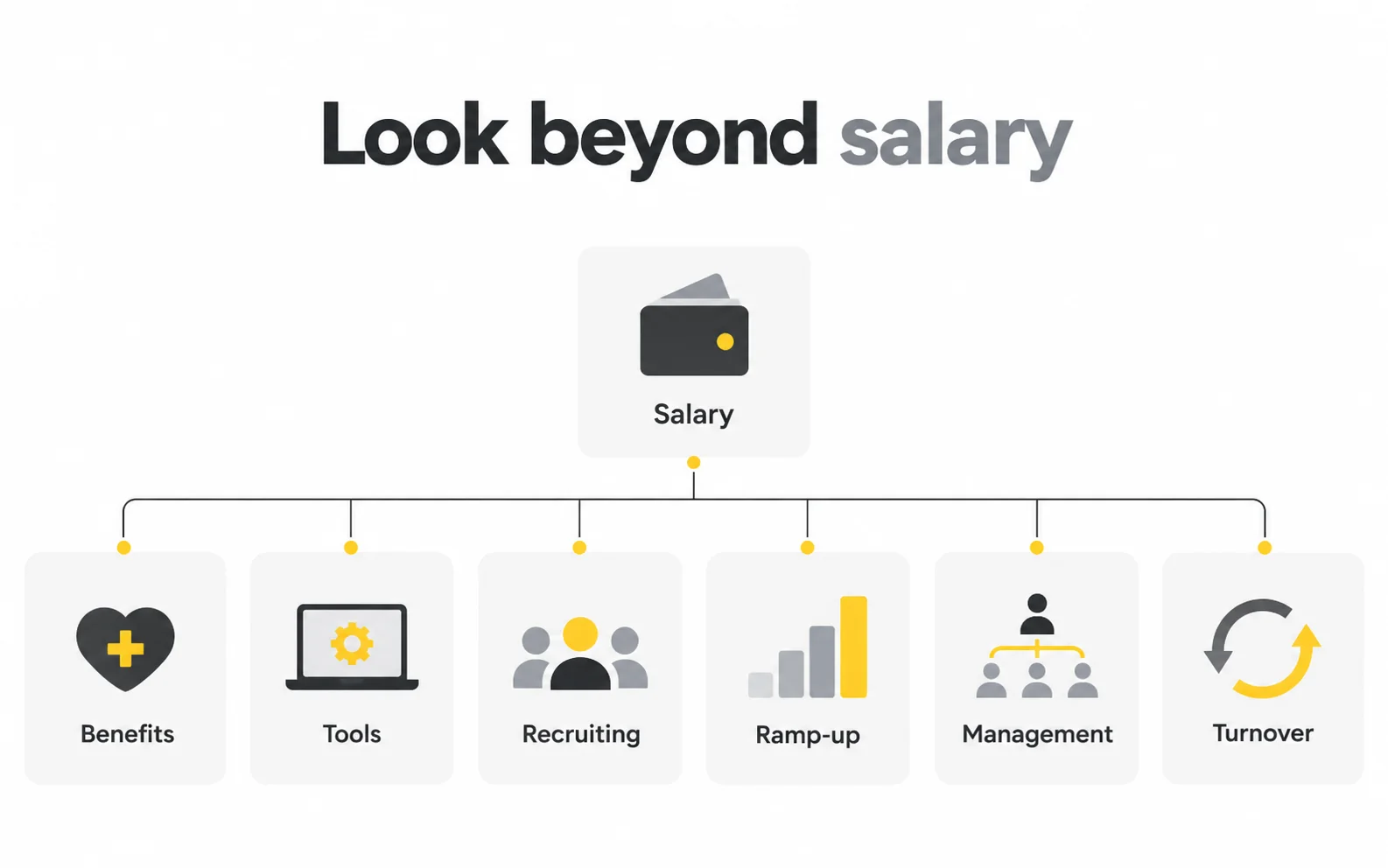
Compare fully loaded costs using your own local numbers.
Once you've decided to work with an external partner, the next question is how you pay for and structure the work. The engagement model affects cost predictability, flexibility, and the kind of results you can expect.
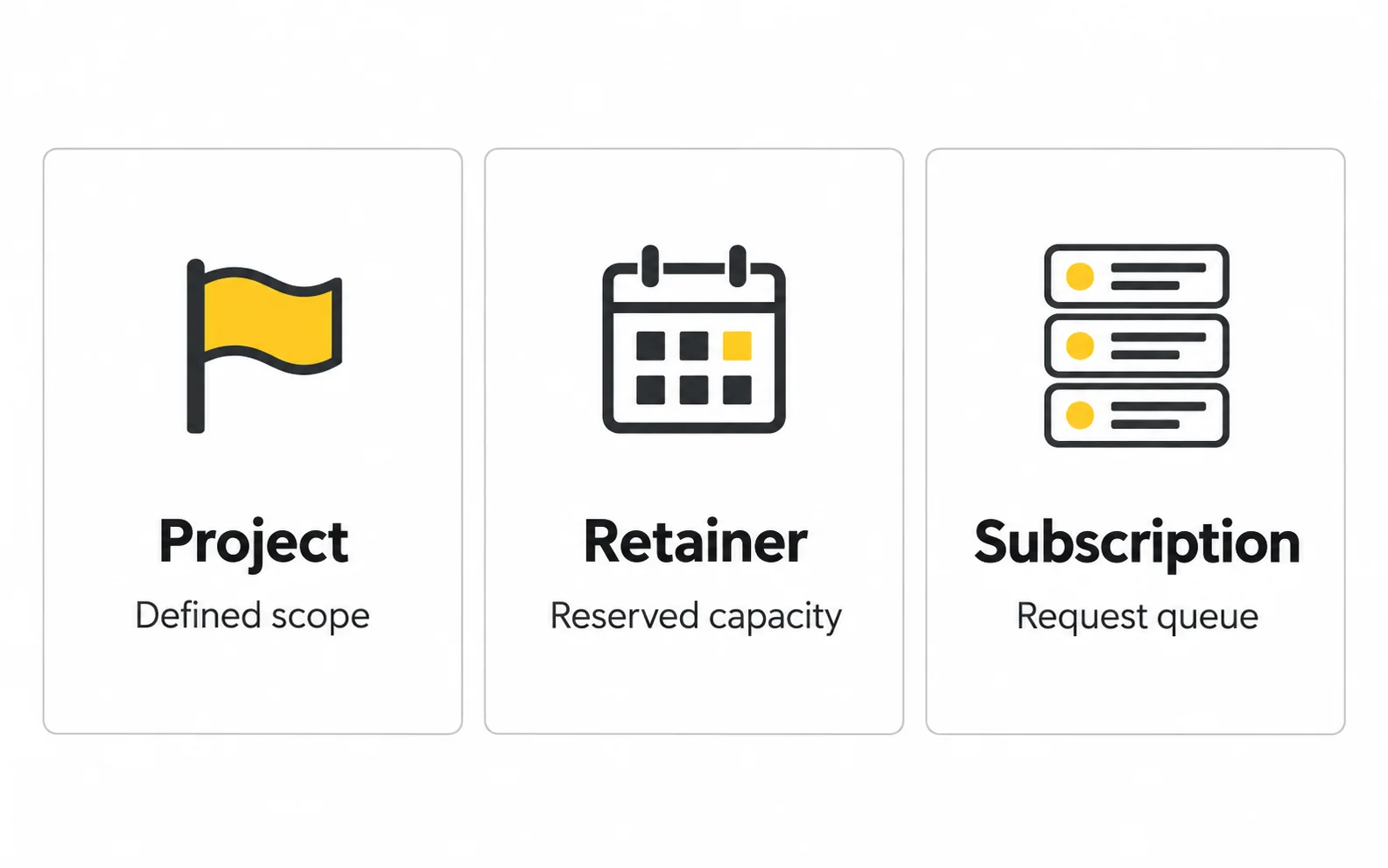
You agree on a defined scope, timeline, and set of deliverables, typically for a fixed fee or estimate.
You reserve a set amount of design capacity each month (often a block of hours or a dedicated team allocation).
A flat monthly fee where you submit requests into a queue and the team works through them, often one or a limited number at a time.
A subscription is a commercial model, not a guarantee of narrow task work or lower strategic depth. Some agencies sell subscriptions that include research and product strategy; others focus on a request queue. Compare the agreed scope, staffing, access to senior review and delivery process.
| Aspect | Project | Retainer | Subscription |
|---|---|---|---|
| Cost predictability | High per project | High per month | High per month |
| Flexibility | Low (fixed scope) | Medium to high | High for small tasks |
| Strategic depth | Depends on the agreed scope | Depends on the agreed scope | Depends on the agreed scope |
| Context over time | Depends on continuity and documentation | Builds continuously | Varies |
| Ideal work | Launches, redesigns | Continuous product design | Ongoing smaller requests |
Ask yourself: "Will we still need this team's help in three months?"
A white label design partner works behind the scenes for another company, usually a development agency, marketing agency, or consultancy, and delivers design under that company's brand.
This model is useful if you:
What to check in a white label partner: clear confidentiality and non-solicitation terms, the ability to adapt to your process and tools, reliable turnaround, and a portfolio that shows range beyond one visual style.
From the Design Lead's desk: Retainers work best when the client keeps a prioritized backlog of design work. Without one, reserved hours often go to whatever feels urgent that week instead of what matters most. A short monthly planning session with your design partner fixes most of this.
Review our design retainer plans and partner coverage, including the scope and terms of Wolfpixel’s white label design team.
Read the scope and terms; the model name does not define quality.
If you've decided an agency is right, here's how to choose a SaaS design agency without relying on polished portfolio shots alone. SaaS design has its own challenges: complex workflows, data-heavy interfaces, onboarding and activation, permissions, and scaling UI across many screens.
Write down what success looks like. For example, "Reduce confusion in onboarding so more trial users reach first value," or "Build a design system so engineering can ship features faster." This helps agencies propose the right approach and helps you compare proposals fairly.
Marketing sites and SaaS applications are different disciplines. Look for:
Ask them to walk you through a past project from start to finish:
A strong agency can explain why a design decision was made. A weak one can only show what it looks like.
For SaaS products, handoff quality directly affects engineering speed. Ask:
Senior people often lead the pitch. Ask who will be on your project day to day, what their experience level is, and how much time the senior lead will actually spend on it.
Ask for references from clients with similar projects. Useful questions: How did they handle scope changes? Were deadlines met? Would you hire them again, and for what kind of work?
Make sure you understand:
A short, paid discovery or pilot engagement lets you see how the agency works (communication, thinking, quality) before committing to a large project. It's a low-risk way to test the fit.

Evaluate SaaS design case studies alongside SaaS onboarding UX and dashboard design best practices. Ask how the partner documents decisions and reusable components through design system development and UI/UX delivery.
For accessibility requirements, consult the W3C WCAG overview and agree which criteria will be reviewed and tested.
Most wasted design budgets come from avoidable mistakes, not bad designers. Here are the ones I see most often.
The cheapest option can become the most expensive if the work needs to be redone, doesn't match what engineering can build, or doesn't solve the actual problem. Compare value per outcome, not cost per hour.
If users are confused, dropping off, or not finding value, a fresh coat of paint won't fix it. Make sure your partner can diagnose usability and flow issues, not just restyle screens.
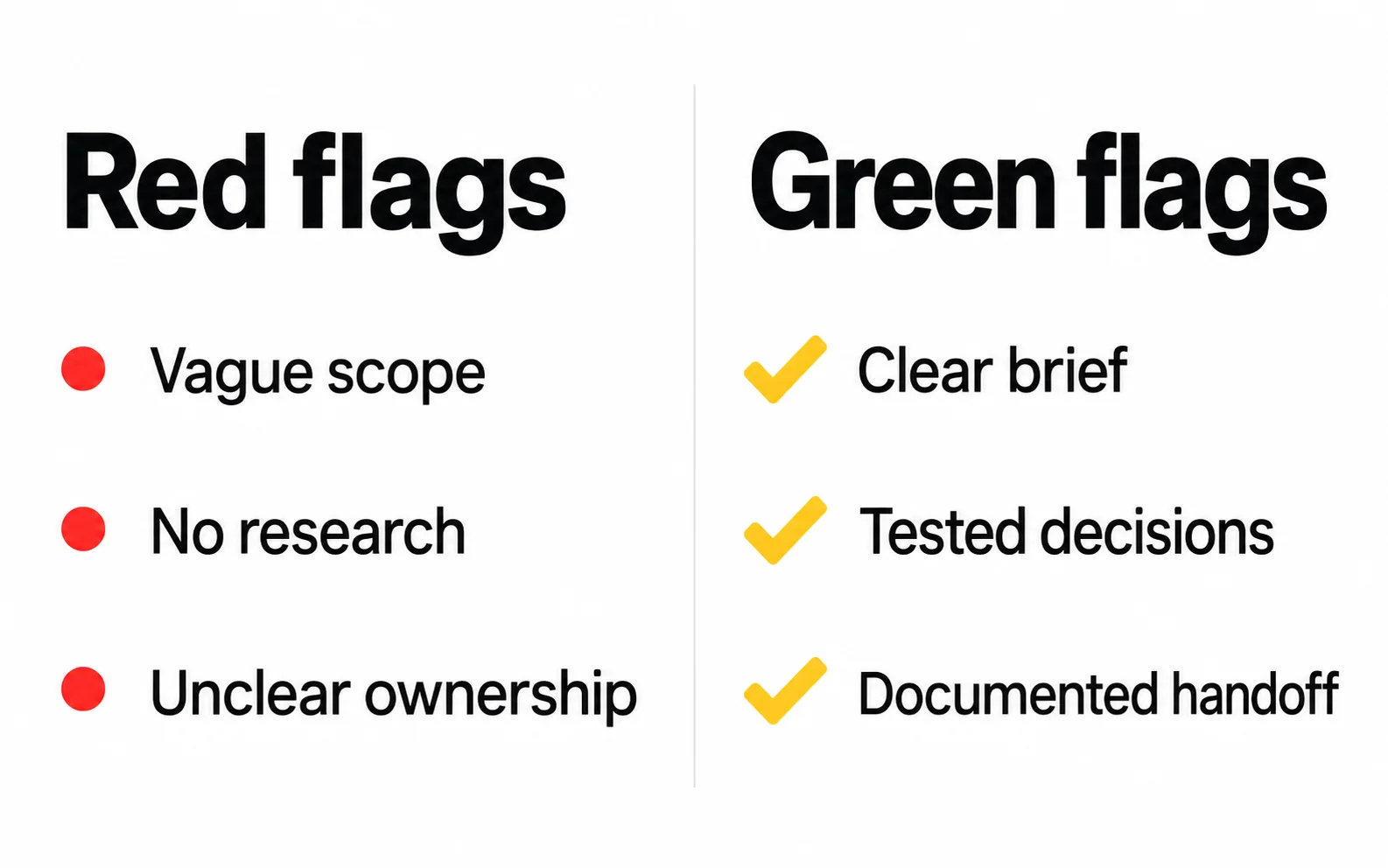
Design needs a decision-maker. Without one, feedback arrives late, contradicts itself, or comes from too many people. Name one person who has the authority to approve direction.
Jumping straight to high-fidelity UI feels fast, but it often leads to rework once assumptions meet real users or technical constraints. Even a short discovery phase reduces that risk.
Beautiful designs that are hard to build slow everything down. Involve engineering early, and make sure files are organized, components are reusable, and interaction states are documented.
Products evolve. If you redesign once and then stop, inconsistencies creep back in. Plan for ongoing iteration, whether through a retainer, an in-house hire, or a hybrid.
Make sure you own and have access to all design files, source assets, and documentation. Losing access to your own design system is a painful, avoidable problem.
Portfolio images show the final polish, not the thinking. Ask to see process: research notes, early explorations, and the reasoning behind key decisions.
From the Design Lead's desk: One of the clearest predictors of a smooth project is how an agency or designer handles the first "no." If you push back on a direction and they respond with curiosity and evidence rather than defensiveness or instant agreement, you've probably found a good partner.
A focused UX audit can establish whether the problem is visual polish, task usability or the wider product journey.
Define ownership, review and handoff before work starts.
There's no universal winner in the design agency vs freelancer debate. The right choice depends on your stage, the type of work, and how much design leadership you already have.
| Stage | Typical Design Needs | Often the Best Fit |
|---|---|---|
| Idea / pre-MVP | Prototype, early validation, basic brand | Freelancer or small agency discovery sprint |
| MVP to early traction | Core product UX, onboarding, marketing site | Agency project or experienced freelancer |
| Growth / scaling | Redesigns, design system, conversion work, faster shipping | Agency project or retainer, possibly first in-house hire |
| Established product team | Continuous iteration across many features | In-house team, supported by agency or specialists |
| Agencies and consultancies | Client design work without an internal design team | White label design partner |
From the Design Lead's desk: The right choice today may not be the right choice in a year. Revisit your design model at major milestones such as a funding round, a major launch, or a significant team expansion. Switching models isn't a failure; it's a sign your needs have evolved.
If you are weighing the options, book a discovery call to discuss your product, roadmap and internal capacity.
Revisit the model as your product and team evolve.
Some do. Agencies may bring in freelancers for specialist skills or extra capacity. This isn't necessarily a problem, but it's fair to ask who will be working on your project and how the agency maintains quality and confidentiality across contributors.
Ownership depends on your contract. Many agreements transfer ownership to the client after final payment, but this isn't automatic everywhere. Confirm in writing that you'll receive the source files, component libraries, and any fonts or assets you need licenses for. For legal specifics in your jurisdiction, consult a lawyer.
Yes, and for SaaS products it's often the best setup. Ask the agency how they collaborate with engineering, whether they join sprint rituals or design reviews, and how they handle questions during implementation.
It varies widely with product complexity, the number of flows involved, whether research is included, and how quickly your team gives feedback. A reliable agency should give you a phased timeline after discovery rather than a fixed number before understanding the scope.
Not if the handoff is planned. Ask your agency for a documented design system, organized files, and a handover session. A well-structured system makes onboarding your first in-house designer much easier.
Design investment should match the stage. Early on, the focus is usually on clarity and usability for core flows rather than extensive visual polish. A focused engagement on your most important user journey is often more valuable than a full brand and product overhaul.





.svg)



.svg)

.svg)

.svg)

.svg)

.svg)
.svg)
