October 20, 2026
Web Design
Website Design Services for Aesthetic Clinics: What a Patient-Ready Site Needs in 2026



Website design services for aesthetic clinics plan, design, write and build a site that helps prospective patients understand your clinic and arrange a consultation. A complete brief covers strategy, treatment information, booking, responsible galleries, search visibility, performance and the rules that apply to your services.
I’m Maniruzzaman Jubayer, Co-founder & COO and Product Design Specialist at Wolfpixel, with 7 years of experience. I personally oversee website, app, dashboard and digital product design. This guide focuses on patient journeys, treatment-page clarity and mobile consultation booking.
They are specialist web design packages built around how aesthetic patients research, compare and book elective treatments. A general web designer builds pages. A clinic-focused team builds a patient journey.
A complete service usually includes:
Check whether the quote includes content, booking integration, migration, accessibility checks and ongoing support. A template can be a sensible starting point, but its purchase price is not the full cost of launching a clinic website. Compare scope using our website design package checklist.
Aesthetic patients may spend time comparing practitioners, reading reviews and weighing an elective decision. Design should help them understand the service, the clinician and the next step without pressure. Research your own patients rather than assuming that every clinic has the same journey.
That changes the design brief in four ways:
Discuss your clinic’s content, booking journey and website requirements with Wolfpixel.


Use these nine features as a review checklist. Prioritize gaps through patient research and task testing; a missing-feature count alone cannot tell you how many consultations a site loses.
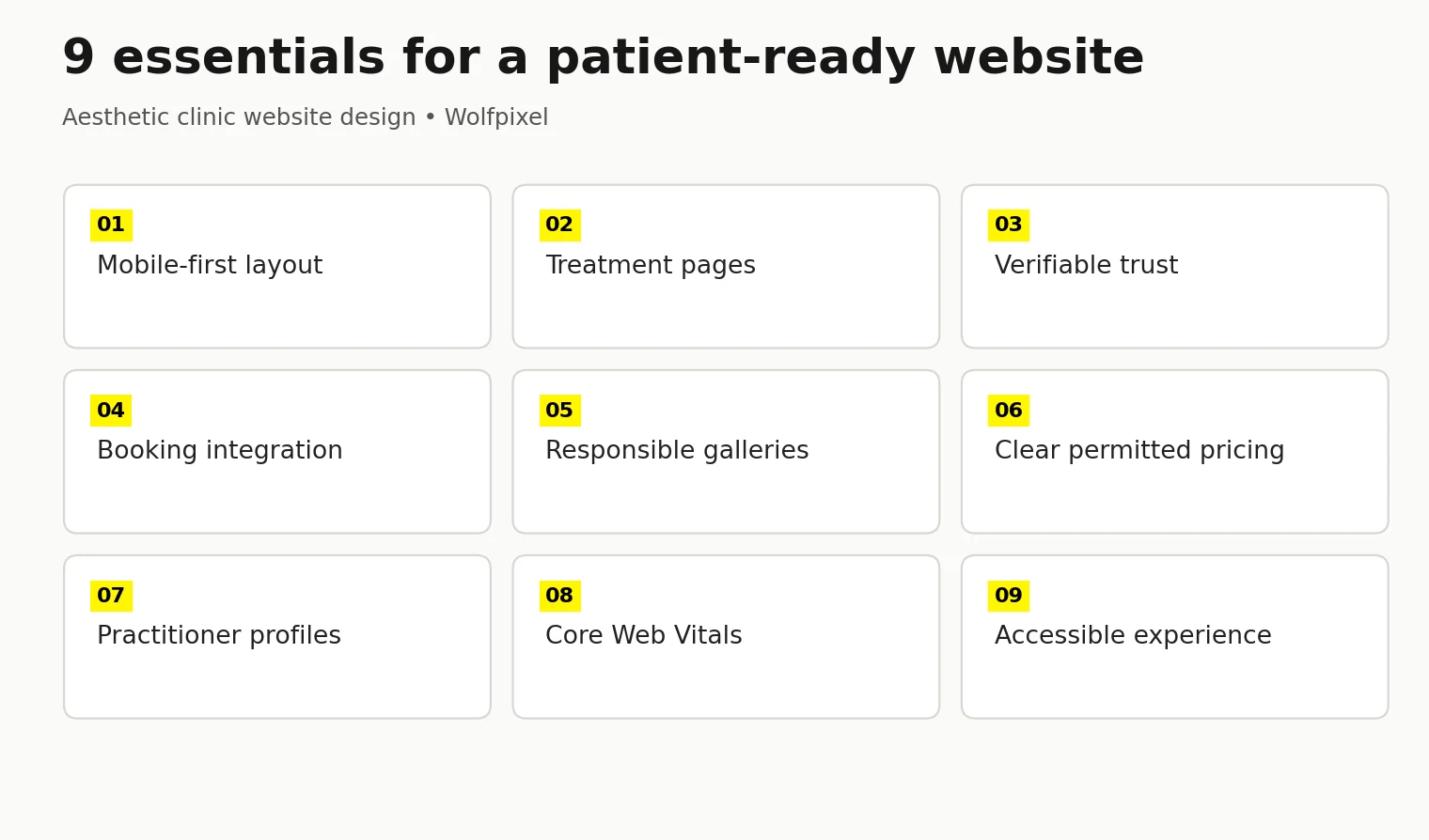
Design for the phone first, then scale up to desktop. In practice that means:
Test the complete booking journey on realistic mobile connections. A fast homepage is not enough if a scheduling widget, consent step or confirmation page is slow.
Give each genuinely distinct, lawfully advertised service a useful page. Someone researching a permitted skin consultation should find clear information about that consultation rather than an unexplained list of services. Avoid duplicate pages created only for keywords. Public promotion of prescription-only medicines requires particular care in the UK; changing a product name to “anti-wrinkle” does not automatically make advertising acceptable.
Put proof where people see it without scrolling:
Real team and clinic photography can help visitors understand who and what they will encounter. Stock imagery is not evidence of dishonesty, but it should never imply that a model is an actual practitioner or patient.
Connect booking in a way that makes service selection, availability, fees and confirmation understandable. Embedded and hosted booking can both work. Judge the full journey through patient testing, privacy requirements and operational fit rather than an arbitrary click count.
| Booking tool | Evaluation focus | Check before choosing |
|---|---|---|
| Jane App | Scheduling, intake and charting | Clinical workflows and regional availability |
| Mindbody | Wellness bookings and memberships | Classes, fees and integration requirements |
| Boulevard | Client booking and management | Fit for your service mix and market |
| Zenoti | Multi-location operations | Rollout, reporting and integration scope |
| Pabau | Clinic management and forms | Consent workflows and relevant contracts |
| GoHighLevel | CRM and follow-up automation | Suitability for clinical data and scheduling |
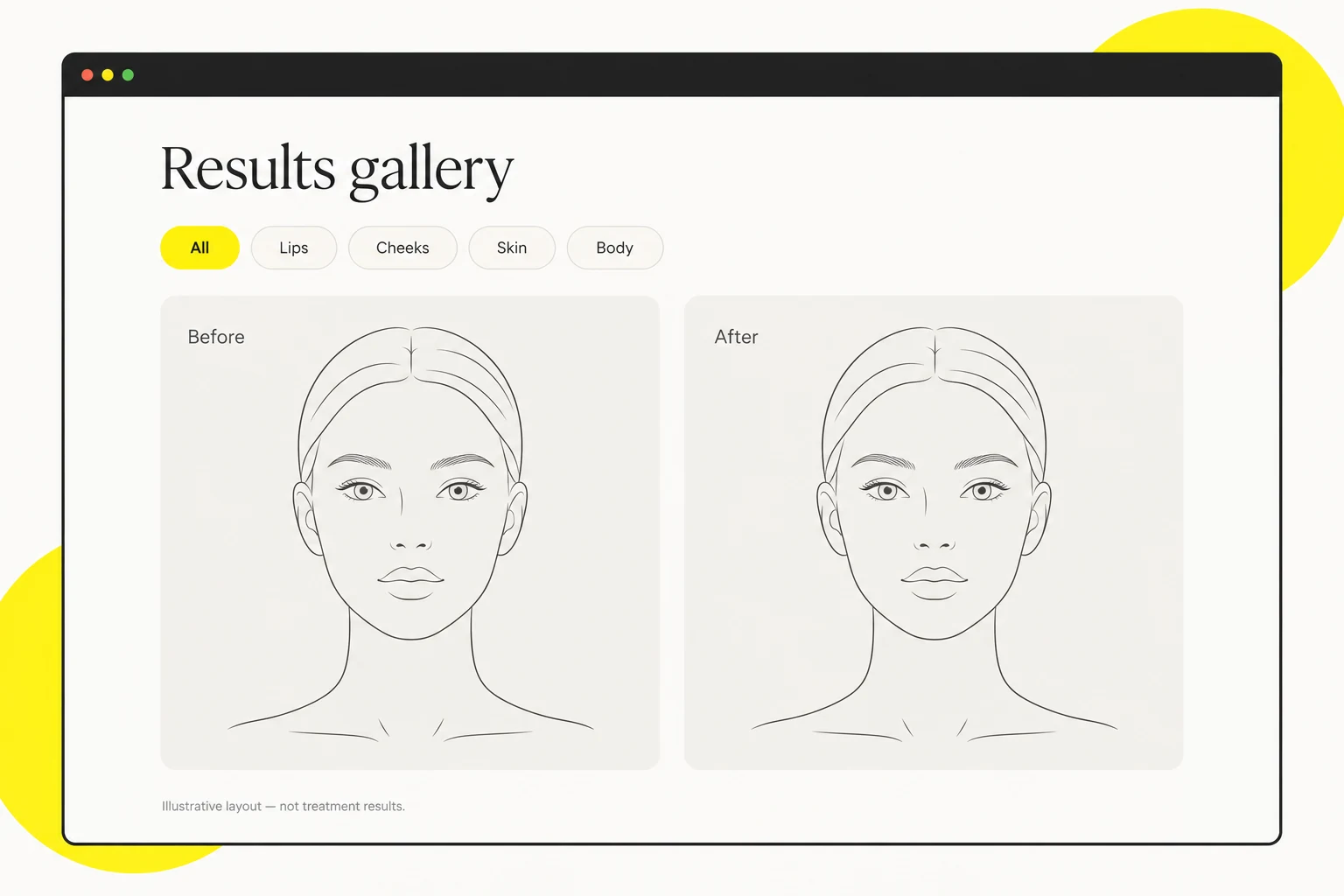
Where a results gallery is permitted, organize it by relevant service and provide truthful context. Obtain appropriate patient permission or authorization, protect privacy and check the applicable advertising rules. Use consistent photography conditions; do not retouch or alter an outcome, including through lighting changes that exaggerate results. Consent alone does not make every image or claim permissible.
Use descriptive filenames and meaningful alt text without unnecessarily identifying a patient or exposing sensitive details. The example below uses matching illustrations to explain a gallery layout; it does not show treatment outcomes.
Where lawful and appropriate, explain consultation and service fees, what a starting price includes, what could change it and when the final price will be confirmed. Do not use pricing content to promote prescription-only medicines to the UK public. Treat improved enquiry quality as a hypothesis to measure, not a guaranteed result.
Give each injector or doctor a short profile: qualifications, years of experience, treatments they focus on, and a link to their public register entry. Patients do look these up. Make it easy.
Core Web Vitals describe loading, responsiveness and visual stability. Google’s web.dev guidance defines the following “good” thresholds. Assess them at the 75th percentile of field visits, separately for mobile and desktop.
| Metric | What it means in plain English | Good target |
|---|---|---|
| LCP (Largest Contentful Paint) | How fast the main image or headline appears | 2.5 seconds or less |
| INP (Interaction to Next Paint) | How quickly the page reacts when someone taps | 200 milliseconds or less |
| CLS (Cumulative Layout Shift) | Whether things jump around while loading | 0.1 or less |
Set an image and script budget before visual design. Compress photography, reserve image dimensions and load nonessential media carefully. Measure the booking integration as well as the page. A Lighthouse score is a useful diagnostic, not proof that real-user Core Web Vitals pass.
Aim to meet all applicable WCAG 2.2 AA criteria, including readable contrast, text resizing, labelled forms, keyboard access and appropriate media alternatives. Legal obligations vary by jurisdiction. Test the actual palette and booking controls, including focus states and errors; a visually calm palette can still have inadequate contrast.
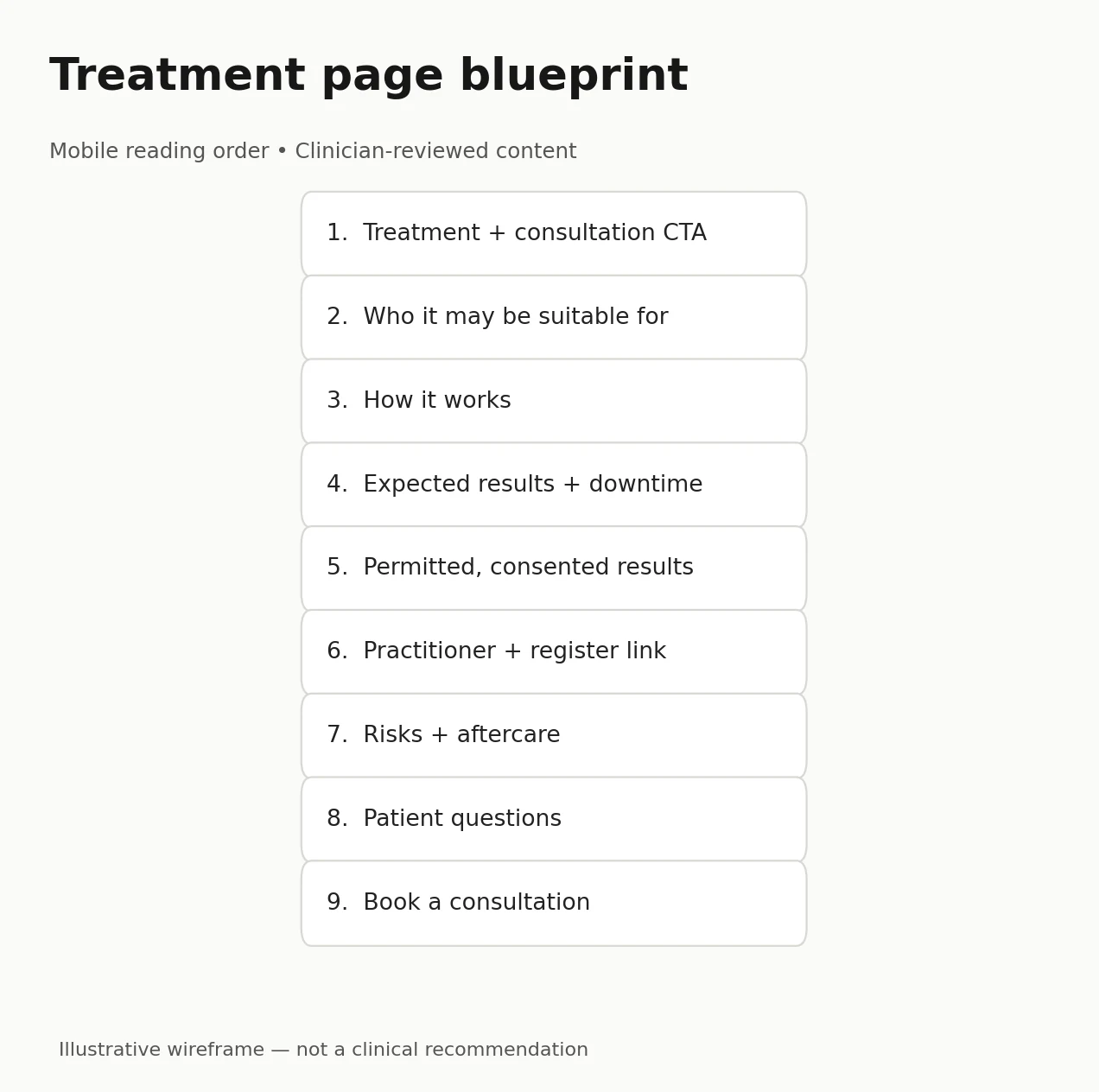
Start with the questions a prospective patient needs answered, then adapt the structure to the service and applicable advertising limits. A qualified clinician should review clinical information. This is a content-planning blueprint, not treatment advice.
| Section | Content to plan | Purpose |
|---|---|---|
| Hero | Permitted service name, consultation context, fee information and booking action | Make the page purpose clear |
| Who it may suit | Clinician-reviewed suitability and limitations | Support informed questions |
| How it works | Procedure steps, time in clinic | Reduces fear of the unknown |
| Results and downtime | Clinician-reviewed expectations and variability | Avoid unrealistic promises |
| Results, if permitted | Genuine, appropriately authorized images and context | Explain without misleading |
| Your practitioner | Photo, credentials, register link | Trust |
| Risks and aftercare | Clinician-reviewed risks, limits and aftercare information | Support understanding; not a substitute for consent |
| FAQs | 5 to 8 real patient questions | Captures long tail searches |
| Final CTA | Book a consultation, call, or WhatsApp | Conversion |
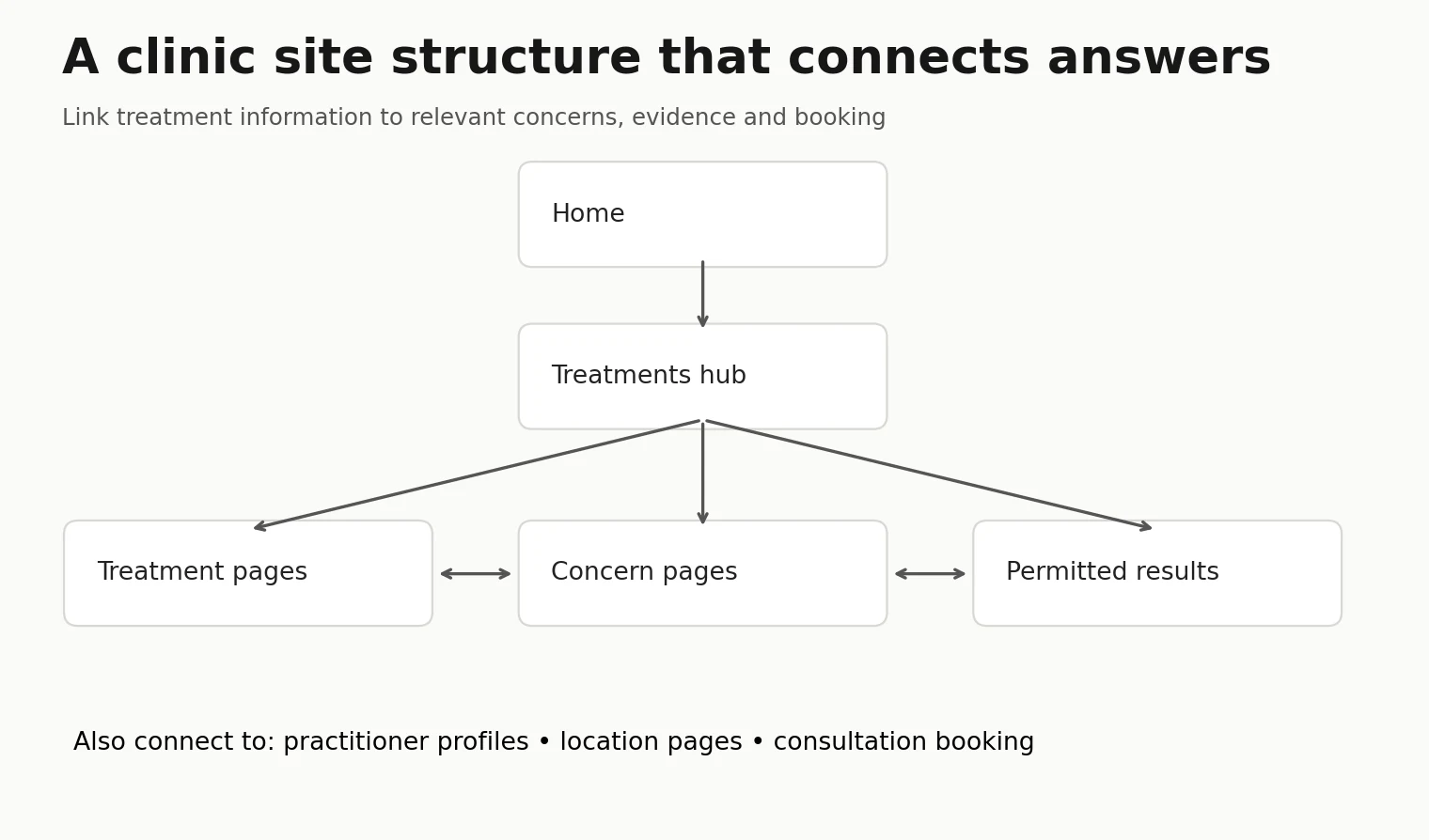
A clinic’s sitemap may include Home, a Treatments hub, useful service and concern pages, permitted results, pricing, team profiles, genuine reviews, helpful articles, location details and booking. Add privacy, complaints and other policies appropriate to the organization. Include only pages that serve a real purpose. Our landing page best practices explain how to connect this information to a clear next step.
Public clinic pages can be advertising, and the exact requirements depend on location, treatment, professional status and data handling. The table is a starting checklist, not a complete legal assessment. Have a qualified adviser review the services, claims, images, forms and booking journey before launch.
| Topic | United Kingdom | United States |
|---|---|---|
| Prescription treatments | No public promotion of prescription-only medicines; limited website references require careful review. | Assess FDA, FTC and applicable state rules; product and service claims need specialist review. |
| Advertising claims | Follow applicable CAP/ASA rules; avoid misleading claims or pressure. | Use truthful, substantiated claims and follow applicable state professional rules. |
| Results photographs | Check permission, privacy, presentation and treatment-specific advertising limits. | Check authorization, privacy and applicable advertising rules; do not alter or misrepresent outcomes. |
| Reviews | Use genuine, nonmisleading testimonials and follow applicable rules. | Follow FTC rules; fake reviews and certain incentives are prohibited. Disclose material connections where required. |
| Patient information | Assess UK GDPR lawful bases, special-category conditions, notices, security and processor terms. | HIPAA depends on entity status and data flow. Assess applicable federal and state privacy rules and required agreements. |
| Registration and licences | Verify practitioner registers and CQC scope for the activities provided. | Verify professional licences, ownership and medical-director requirements under applicable state law. |
In the UK, ASA guidance on advertising Botox explains the prohibition on public promotion of prescription-only medicines and the very limited circumstances for website references. Do not treat alternative wording as a workaround. For US data handling, establish whether the clinic is a HIPAA covered entity or business associate and assess each vendor and data flow. A marketing label does not establish compliance.
Review FTC guidance on endorsements and reviews before using testimonials, and confirm applicable CQC registration requirements for the activities actually provided. CQC registration is not a universal requirement for every cosmetic service.
Clear information architecture helps search engines and people understand the services, practitioners and real locations associated with a clinic. It supports discoverability without guaranteeing rankings or inclusion in AI answers.
Give each real clinic location a useful page with accurate staff, address, hours, accessibility information and directions. Avoid near-identical city pages for places where you do not operate. Google removed FAQ rich results in May 2026, so FAQ markup should not be sold as a current Google FAQ-rich-result opportunity.
Use the following ranges as illustrative planning estimates in US dollars, not verified market averages or a binding Wolfpixel quote. Scope, content readiness, integrations, migration and clinical or legal approvals can change both cost and delivery time.
| Approach | Planning cost (USD) | Planning time | Possible fit |
|---|---|---|---|
| DIY template (ThemeForest, Webflow templates) | $60 to $500 plus your time | 1 to 4 weeks | Small, simple initial site |
| Template customised by a designer | $1,500 to $4,000 | 2 to 6 weeks | Straightforward content and booking |
| Semi-custom clinic website | $5,000 to $9,000 | 7 to 12 weeks | Larger content and integration scope |
| Fully custom website | $10,000 to $25,000+ | 8 to 16 weeks | Complex or multi-location requirements |
Budget separately for hosting, maintenance, photography, booking software and content review. A provisional maintenance allowance of $50–$300 per month is only a planning assumption; security, clinical integrations and support can cost more. Check Wolfpixel’s current pricing and scope or request a project quote. A rapid landing-page service is not a promise to complete an approved, integrated clinic website in 48 hours.
A template can fit a small, straightforward site. Custom design becomes more useful when the patient journey, service structure, brand or integrations require changes a template cannot support economically. Neither route guarantees better bookings.
| A template may fit when | Custom design may fit when |
|---|---|
| Your service structure is simple | Many services or locations need distinct journeys |
| You need to limit initial design scope | Research and tailored flows justify a larger scope |
| An existing layout meets patient tasks | Your requirements do not fit a ready-made layout |
| Available integrations are sufficient | Booking or other integrations need custom work |
Before buying a template, test the mobile layout, booking integration and contrast, and confirm who will maintain it. Use healthcare website design examples for ideas, then evaluate them against your own patients’ tasks. For a Webflow build, discuss CMS setup and booking integration early.
Choose a partner that can show relevant work, explain what it actually delivered and distinguish design work from clinical or legal review. Ask these questions before agreeing to a scope:
Look for specific answers and evidence, including the limits of any reported results. Use our UI/UX design process to understand research and validation, or request a UX audit of the current patient journey before committing to a rebuild. Be wary of guaranteed search rankings or AI citations.
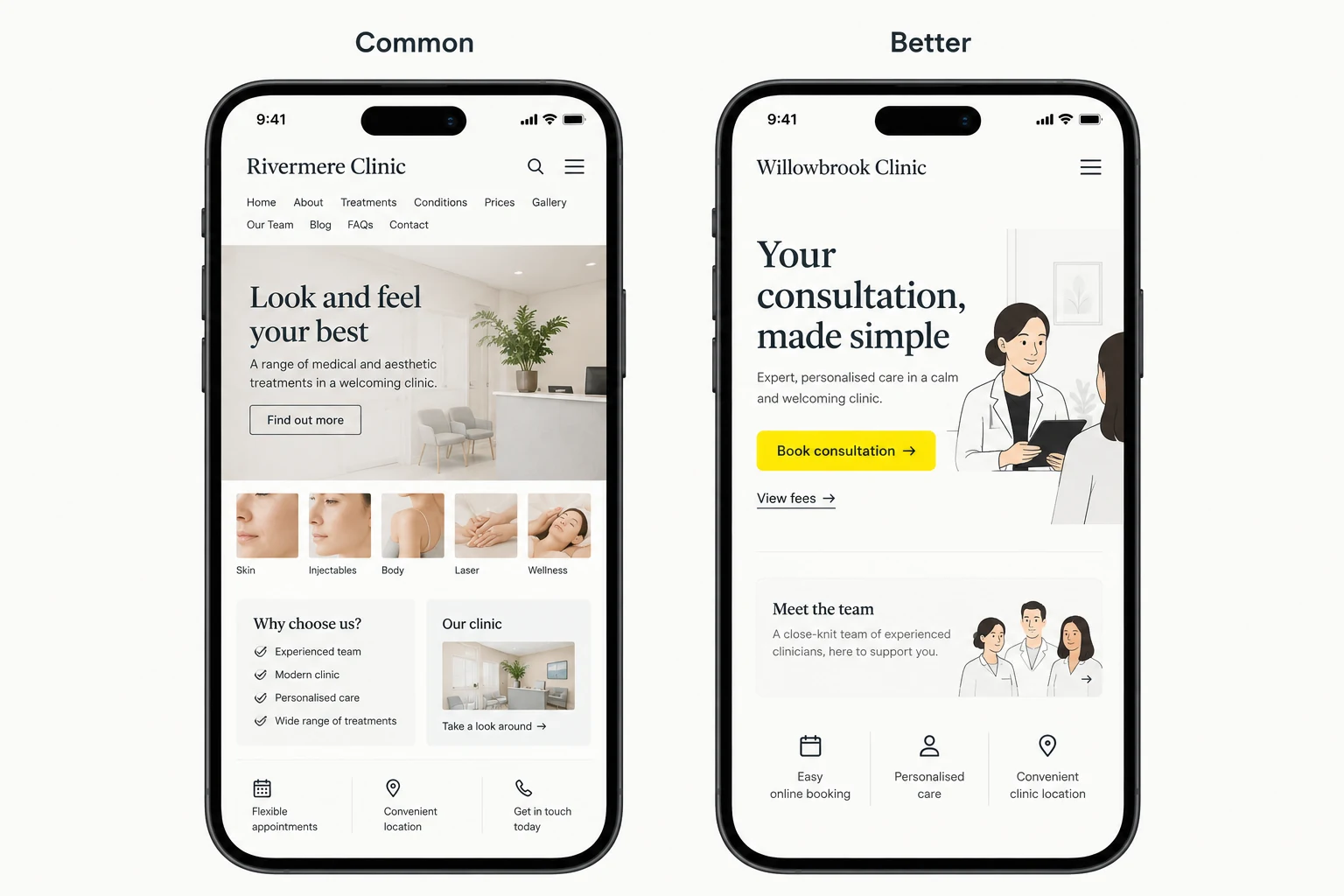
A patient-ready clinic website helps people understand the service, verify the team and choose an appropriate next step. Start with mobile tasks, useful treatment information, verifiable details, clear permitted fees and the rules that apply to your clinic. Then validate the design with real users.
If you are planning a new site or replacing an existing one, talk to Wolfpixel about your clinic website. For a replacement, review our website redesign and migration approach so content and redirects are included in the brief.
The planning examples in this guide range from $60–$500 for a template alone to $1,500–$25,000 or more for designer-led projects. These are illustrative US-dollar estimates, not verified market averages. Content, integrations, approval work, hosting and ongoing support affect the total.
It makes service information, practitioner details, fees and the next step understandable on mobile. It also needs accessible interactions, suitable performance, responsible imagery and appropriate advertising and privacy review.
The illustrative project ranges here run from 1–4 weeks for a small DIY template to 8–16 weeks for a larger custom build. Content preparation, integrations, migration and clinical or legal approvals can extend a schedule.
Where lawful and appropriate, explain consultation and service prices and what any starting price includes. Pricing must not become an unlawful promotion of a prescription-only medicine. The best presentation depends on the service and jurisdiction.
Possibly, but not simply because consent was obtained. Images must be genuine, nonmisleading, appropriately authorized and permitted under the relevant advertising and privacy rules. Some treatments or advertising contexts have additional restrictions. Have the intended use reviewed before publishing.
Botox is a prescription-only medicine, which cannot be advertised to the UK public. ASA guidance allows very limited website references in specific circumstances. Calling it “anti-wrinkle treatment” is not an automatic workaround; obtain an appropriate compliance review.
There is no universal best choice. Compare booking, records, consent workflows, fees, integration, regional availability, contracts and data handling. Jane App, Mindbody, Boulevard, Zenoti, Pabau and GoHighLevel have different scopes; verify the features and terms you need directly.
Either can support a clinic site when implemented and maintained appropriately. Choose based on CMS needs, booking integration, hosting, form handling and who will maintain it. Neither platform automatically makes a website secure, accessible or compliant.
Consider Home, a Treatments hub, useful service pages, practitioner profiles, permitted pricing and results, real location details, booking and suitable policies. Add reviews and educational articles where useful. The right sitemap depends on the actual clinic and services.
Review the site regularly and redesign when evidence shows that its structure, usability, performance or maintenance no longer meets your needs. There is no universal three- or four-year replacement rule.
Design can support crawlable content, useful page structure, mobile use and page experience. It does not guarantee rankings, and time spent on a page should not be treated as a direct ranking promise.
A useful page for each real clinic location can help patients find the correct team, address, hours and directions. Keep the details accurate and specific; do not create location pages that imply a physical presence you do not have.