October 26, 2026
Web Design
Landing Page vs Homepage: Key Differences and When to Use in 2027


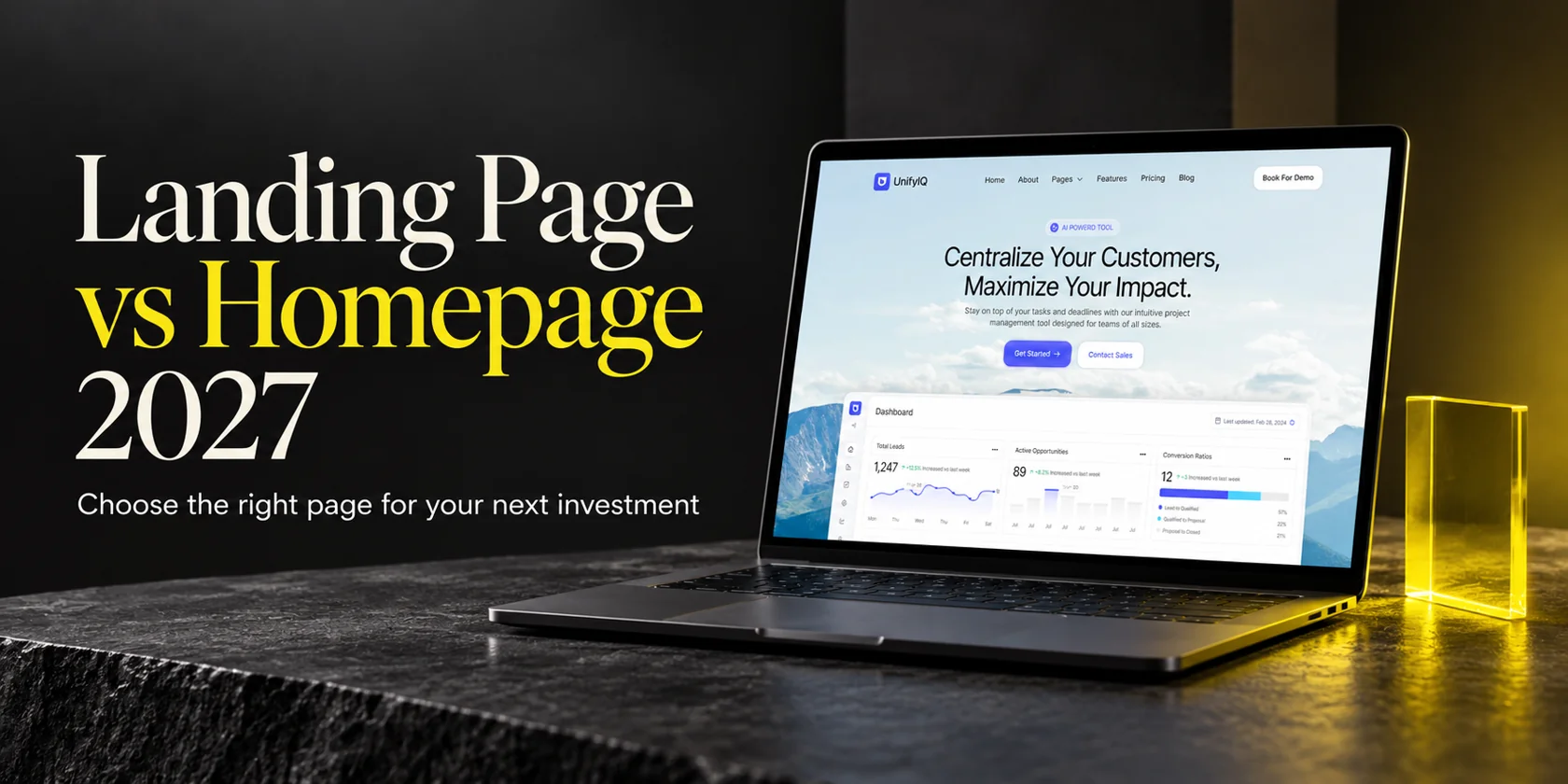
A homepage introduces your business and helps visitors choose a route. A campaign landing page helps a defined audience evaluate one offer and take one primary action. Choose between them by the promise that brought someone to the page—not by whether the click was paid or organic.
For a small business founder, the buying decision is practical: do you need a clearer main website, a focused campaign destination, or both? This guide compares the scope, evidence and ongoing work behind each choice so you can commission the smallest useful project.
I’m Maniruzzaman Jubayer, Co-founder & COO and Product Design Specialist at Wolfpixel, with 7 years of experience. I oversee website, app, dashboard and digital product design. Wolfpixel sells the design and development services discussed here. Our published work is used as design evidence; it is not presented as an independently measured conversion result.
2027 planning note: this guide was prepared in October 2026 for founders planning their next investment. It uses currently verifiable guidance, not projected 2027 benchmarks or claims about future search algorithms.
The difference is the decision each page needs to support. A homepage needs enough breadth to orient several relevant visitors. A campaign page needs enough specificity to resolve one offer. Both can build trust and generate business; neither guarantees a better result simply because of its label.
In analytics, a landing page can mean the first page of a session. The GA4 Landing page report uses that entry-page meaning. In campaign planning, the same term commonly means a focused conversion page. Your homepage can therefore appear in a landing-page report without becoming a dedicated campaign experience.
For a broader introduction to page types, use our landing page definition and uses guide. Here, the question is which destination and delivery scope your business should choose.

Share your current URL, traffic promise and intended action. Define the right page scope before committing to a broader build.


Use your homepage when people need to understand who you are, what you offer and where to go next. A recommendation, branded search or broad introduction often creates this need. An awareness ad can do the same. The traffic source alone does not settle the decision.
A solopreneur offering one clearly defined service may have a main page that already explains the offer, shows relevant work and leads to a suitable inquiry. Creating a duplicate campaign page adds little if the audience, proof and action would be identical. Check for a real mismatch before buying another build.
A homepage can have a strong primary CTA without removing every other route. A buyer comparing your services may need case studies before contacting you. A returning customer may need support. Helping them find those destinations is useful behavior, not necessarily lost attention.
If the wider site is the obstacle, our website redesign buying guide can help you evaluate a broader engagement. Do not commission an entire redesign to solve a single campaign problem unless the evidence supports it.
Choose a campaign landing page when the visitor expects an offer your homepage cannot present clearly without making it worse for everyone else. A webinar, a specific consultation package, a product trial for one use case or an event promotion may justify this focus.
Write down the promise in the ad, email, referral or search snippet. Then ask whether the destination immediately identifies the same offer, audience and next step. If someone clicks “Book a stock-planning demo for independent retailers,” a generic statement about business software leaves them to reconstruct the connection.
Google Ads guidance recommends closely matching the destination to the ad and keywords, while providing useful, original information. That supports relevance; it does not mean buying any standalone page guarantees cheaper leads.
One primary action does not require one button, one screen or a missing footer. Repeat the same action where it helps. Keep the terms, pricing context, privacy information and evidence people need to make an informed choice. Reduce unrelated browsing without making the business harder to verify.
If the appropriate destination already exists as a service, product or category page, improve that page before creating another version. An ad for one product may belong on its product page. A page’s job matters more than the name in your proposal.
Once you have decided a separate page is justified, our landing page best practices guide covers the detailed structure, forms and UX checks.
| Situation | Start with | Check before paying for a new page |
|---|---|---|
| Someone searches your business name | Homepage or the specific page they need | Can they identify the business and find their intended route? |
| An email promotes one workshop | Workshop registration landing page | Do date, eligibility, format and registration match the email? |
| An ad promises one established service | Existing service page or focused campaign page | Does the current page already answer that offer and support inquiry? |
| A new audience needs different proof | Dedicated audience/offer page if justified | Are its objections materially different, and can you maintain it? |
| An ad names one ecommerce product | Relevant product page, or a campaign page when necessary | Can visitors see the right item, availability, terms and purchase route? |
| You are testing a business idea | Accurately labeled concept or waitlist page | Does it explain what exists now and what the signup means? |
| People want to compare several services | Homepage with clear service routes | Would narrowing the page block their comparison? |
| You have a single offer and almost no traffic | Improve the existing page first | What evidence would justify separate versions? |
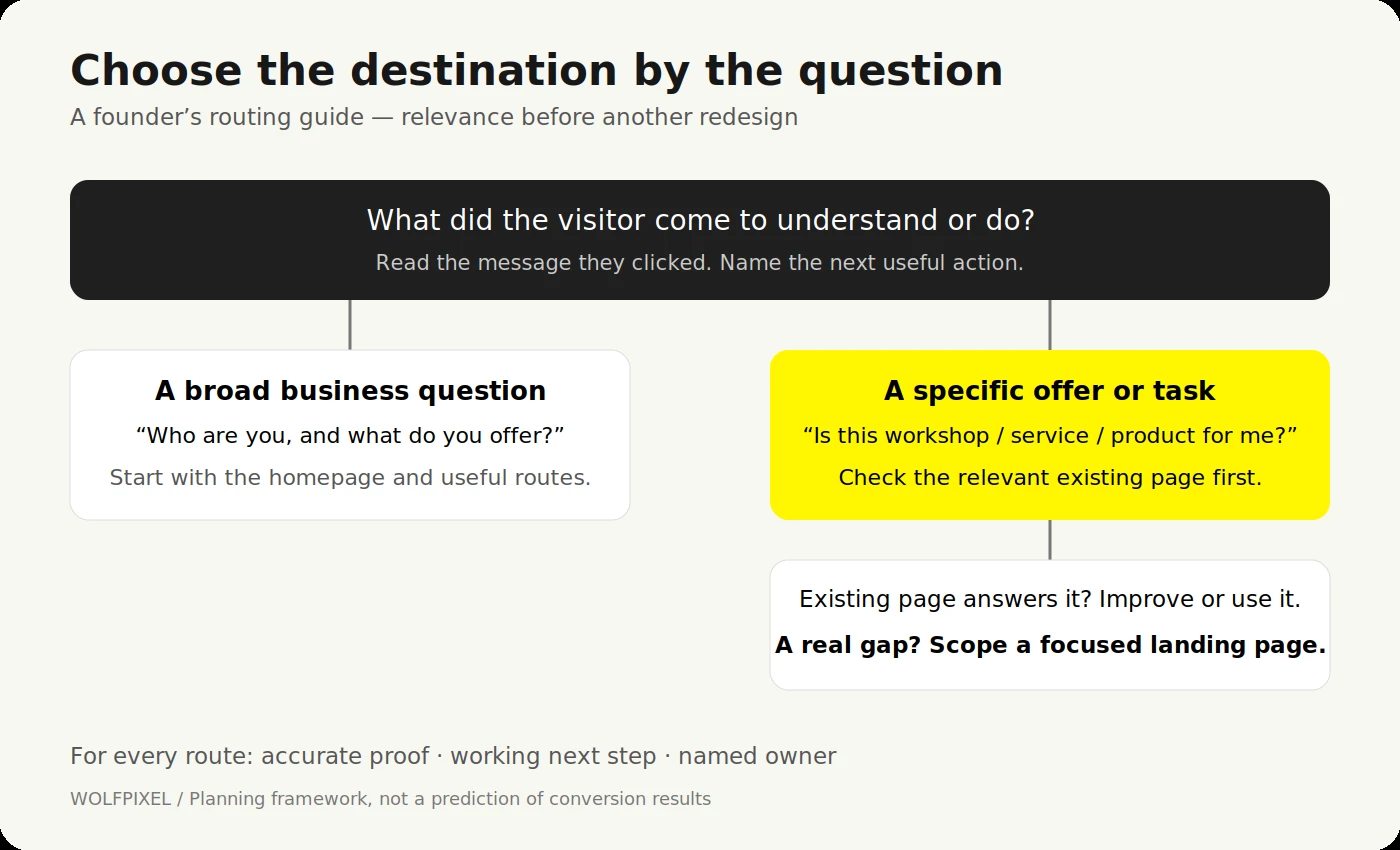
You may eventually need both, but you do not have to fund both at once. Preserve a trustworthy home for the business, then add a focused destination where the current site cannot serve a real campaign. If the offer itself is unclear, clarify it before paying for a more elaborate page.
The most useful comparison keeps the business and offer understandable. A home page of a website can introduce several routes; a dedicated page should make a specific invitation easier to evaluate. Attractive mockups alone do not establish which version will produce better leads.
Open our UnifyIQ website project and the live UnifyIQ Webflow template. The homepage presents the product, product interface and routes to additional information. In the portfolio artwork, the navigation includes features and pricing, while the hero offers “Get Started” and “Contact Sales.” These are observable design choices, not evidence that any particular CTA won a test.
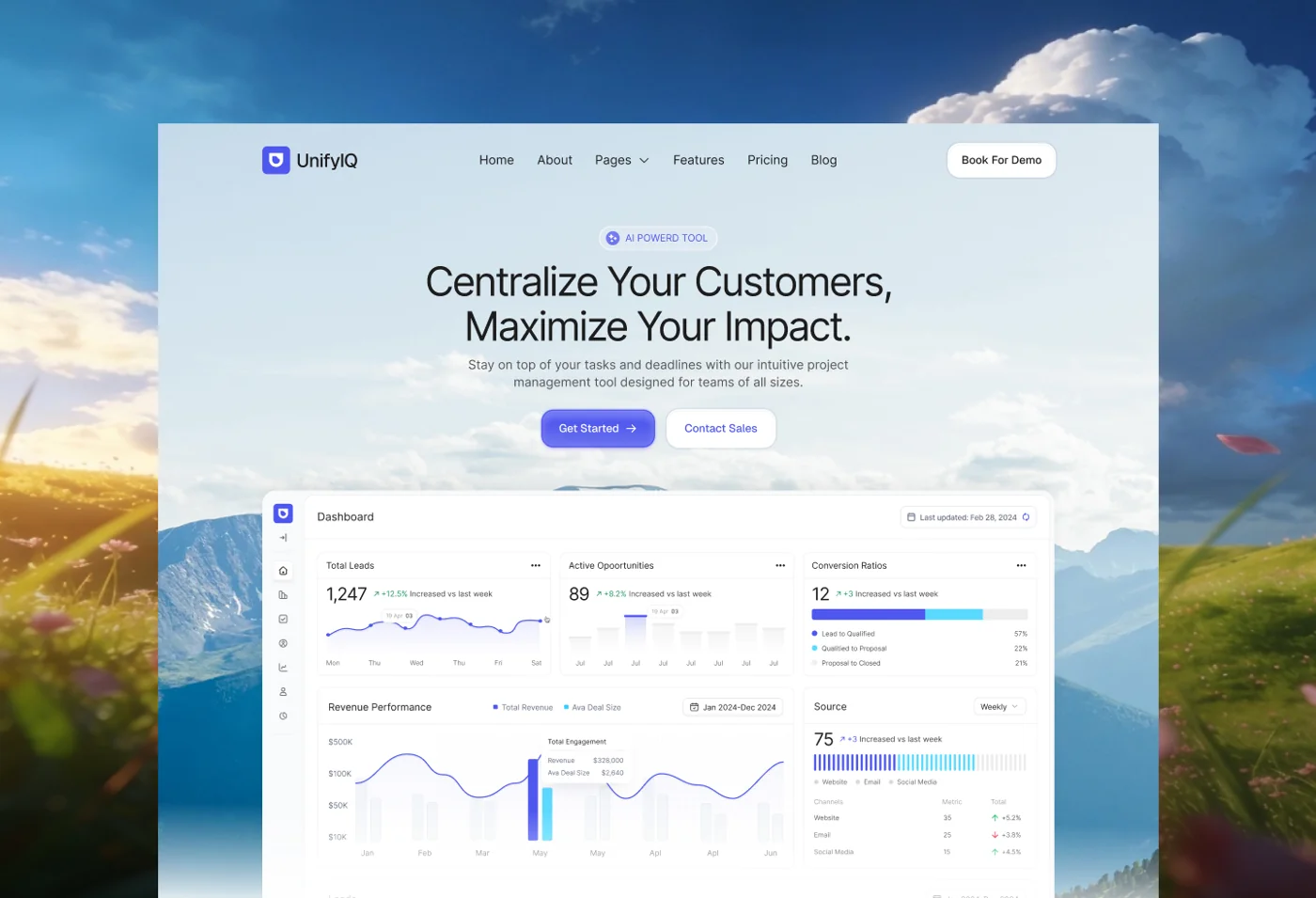
Suppose a sales-software business wants to promote a demo specifically for a small retail team. A focused brief would identify the retail task, show relevant product evidence, explain who the session suits and make the booking expectation clear. It would not simply hide the homepage menu and call the result a new strategy.
That campaign is a hypothetical adaptation, not a second UnifyIQ client deliverable or a claimed experiment. For more design references, our landing page inspiration guide examines published work and how to use references without copying a layout.
A website is the collection of connected pages and functions. Its homepage is one part. A landing page may sit inside that site or stand on its own. A sales page is defined by its persuasive selling purpose; it can also be a campaign landing page. These categories overlap. Ask for the actual journey and deliverables rather than arguing over labels.
A single-page quote can cost more than another single-page quote because the underlying work differs. Research, positioning, copy, original assets, development, integrations and launch support may matter more than the number of sections. No responsible 2027 budget comes from a universal price attached to the page label.
| Scope item | Homepage engagement | Focused landing page engagement |
|---|---|---|
| Inputs | Business positioning, audience priorities and site structure | Traffic promise, intended audience, offer and action |
| Content decisions | Which offers to summarize and which routes to prioritize | Which evidence and objections the offer must resolve |
| Design | Responsive main page and its navigation relationships | Responsive focused journey, including form and feedback states |
| Build | Working CMS page and agreed shared components, if included | Working page, campaign links and integrations, if included |
| Validation | Comprehension, route finding and relevant next steps | Message match, task completion, form delivery and lead quality |
| Handover | Editing instructions and responsibility for shared site areas | Editing, tracking ownership, offer updates and retirement plan |
A template can be a sensible starting point when your offer and copy are ready and you can own the build. An independent designer can fit a defined scope when implementation support is available. A multidisciplinary team may be useful when positioning, copy, design and development need coordination. Ask who actually does each part; the provider label does not guarantee coverage.
Our agency versus freelancer guide compares delivery arrangements. The website design package guide covers wider inclusions. Use a current written quote for your actual scope rather than treating older price examples as a 2027 promise.
For implementation, compare your editing and integration needs with Wolfpixel’s Webflow development service. A builder license does not replace ownership, QA or a clear publishing responsibility.
Neither format has an automatic ranking advantage. A homepage usually explains the business; a focused service or campaign page can answer a more specific need. Decide which URL should serve which search intent. Do not publish near-identical pages for the same query merely to increase your page count.
Separate evergreen search content from short-lived campaign variants. A useful, distinct page may deserve indexing. A duplicate needs an appropriate consolidation decision; a page you deliberately want excluded needs an indexing decision. These are different jobs. Google’s canonicalization guidance explains how to signal a preferred version of duplicate or very similar content. Do not automatically canonicalize every campaign page to the homepage.
A webinar registration and a paid consultation inquiry ask for different commitments. Comparing their raw conversion rates does not establish which page design is better. Agree on the eligible audience, conversion event and time window, then review whether the resulting inquiries or customers are suitable.
| Measure | Define it before launch | Avoid this conclusion |
|---|---|---|
| Primary conversion | For example, completed demo requests from eligible sessions | A CTA click equals a completed booking |
| Lead quality | State the criteria for a suitable inquiry and review follow-up | More form submissions always mean more business |
| Cost per qualified inquiry | Attributed campaign spend divided by qualified inquiries, over a stated period | Lower cost per click proves the destination is better |
| Homepage routing | Track whether relevant visitors reach the service or task they need | A lower immediate form rate means the homepage failed |
| Task reliability | Check mobile forms, confirmation and CRM/email receipt | A successful visual review proves delivery works |
For the deeper calculation and benchmark caveats, see our landing page conversion rate guide. A small sample can help you spot confusion but may not establish a reliable conversion lift. If you test two destinations, keep the audience, offer, event definitions and attribution consistent; record other changes that could explain the outcome.
Both formats need usable performance and accessible interactions. Include loading, responsiveness and layout stability in launch QA using Google’s Web Vitals guidance, and agree accessibility checks against the W3C WCAG quick reference. Neither a mockup nor a builder’s marketing claim proves the live page passes.
Planning ahead should make the page easier to maintain, not merely add a year to its headline. Build your 2027 brief around a stable visitor need, accurate evidence and an owner who can update the offer. Recheck platform capabilities, pricing and relevant policies when you purchase.
If the homepage already works for your audience, keep it and scope the missing campaign journey. If the business remains hard to understand, repair that foundation. If the evidence is unclear, diagnose one recent customer journey before commissioning multiple page versions.
You do not need a speculative conversion promise to choose well. You need a destination that answers the visitor’s question, a proposal that names the work and a way to check whether the finished page does its job. Discuss your current page and next campaign with Wolfpixel when you can share the URL, traffic promise and intended action.
A campaign landing page focuses on one offer and one primary action. For example, a workshop registration page can explain the topic, date, suitability and signup. The page should deliver the promise in the invitation rather than ask visitors to search a general homepage for the event.
Canva is a design platform, not itself a page type. Its website tools can create pages used as landing pages. Check the current publishing, domain, form, analytics and integration options against your brief. A tool-generated page still needs accurate content and a working next step. Canva’s website documentation explains its website offering.
Campaign page, lead capture page or conversion page may describe particular uses. A squeeze page is usually a narrower email-capture page; a sales page emphasizes a purchase decision. Confirm the intended action because these labels are not exact substitutes in every proposal.
It can be a better fit for a focused offer, while a website supports a wider business presence and related information. You can use a landing page within a website. Compare the visitor’s task and your ability to maintain the experience rather than choosing a format in isolation.
Yes. A single-offer business may use its main URL for a focused conversion experience. It is then the homepage by location and a landing page by purpose. Keep the business identifiable and provide the information visitors need to evaluate and contact you.
Choose the page that best answers the specific ad promise. A focused offer often benefits from a dedicated destination, but a relevant existing service, product or homepage may already fit. Paid traffic alone does not prove a new page is necessary.
A landing page is organized around a focused arrival and action; a sales page persuades someone to buy. One page can be both. A webinar signup page is a landing page without being a direct sales page. Specify the journey and deliverables in the brief.