


 12 min read
 Published
In software development, MVP means minimum viable product: the smallest version of a product that real users can use and that still delivers its core value. You release it to learn whether people want the product, before you spend months building the rest.
I’m Maniruzzaman Jubayer, Co-founder & COO and Product Design Specialist at Wolfpixel, with 7 years of experience. Most of the founders we work with come to us at the MVP stage, usually with a long feature list and a short runway. This guide explains what MVP actually means, what it isn’t, and which parts of an MVP deserve design time first, because that is the part most explanations skip.
The short answer: an MVP is a real, working product with the fewest features needed to test your riskiest assumption with real users. “Minimum” limits the scope. “Viable” sets a quality floor: the part you ship has to work and deliver value. Design the core loop and the activation moment first, measure one learning metric, and leave the rest for later.
Key takeaways:
- An MVP is built to learn, not to impress. Eric Ries defines it by validated learning per unit of effort.
- “Viable” is not optional. A broken MVP tests your bugs, not your idea.
- Some of the best-known MVPs had almost no software: a video, a two-page website, photos of shoes.
- Design the core loop, the activation screen and the empty and error states first. Settings and admin can wait.
- Decide your success metric before launch, or every result will look like a reason to continue.
How we wrote this: we reviewed the pages ranking for this question in November 2026, including Atlassian, Wikipedia, the Agile Alliance and several development agencies, and checked every example against an original source. Quotes and figures are linked. The “what to design first” framework is our own, based on MVP projects we have designed, and we label it that way. The full list is in Sources and method.
What does MVP mean in software development?
A minimum viable product is the first release of a product that has just enough functionality for real users to get its core value, so the team can learn from how they actually use it.
The term was coined in 2001 by Frank Robinson and popularized by Steve Blank and Eric Ries, according to Wikipedia. Ries’s definition, quoted by the Agile Alliance, is the version of a product that lets a team “collect the maximum amount of validated learning about customers with the least effort.”
That definition is worth reading twice. It doesn’t say “the smallest product you can ship.” It says the most learning for the least effort. An MVP is judged by what you learn from it, not by how small it is.
Why MVPs matter
Startups rarely fail because they couldn’t build the product. They fail because nobody needed it. In CB Insights’ 2021 analysis of 111 startup post-mortems, 35% of failures were tied to no market need, second only to running out of cash at 38%.
An MVP is the cheapest way to find that out early. If the riskiest question is “will anyone use this?”, every week spent building features before answering it is a bet placed blind.
What an MVP is not
Most MVP mistakes come from treating it as something else. Here is how it compares with the things it gets confused with.
| Prototype | Proof of concept | MVP | Beta | Version 1.0 | |
|---|---|---|---|---|---|
| Purpose | Test if a design works | Test if it’s technically possible | Test if people want it | Find bugs before launch | Sell to the market |
| Real users? | Test participants | Usually internal | Yes | Yes, invited | Yes, everyone |
| Working product? | No, simulated | Partly | Yes, minimal | Yes, near complete | Yes |
| Key question | Can people use it? | Can we build it? | Do people want it? | Does it hold up? | Will it grow? |
The Agile Alliance names the most common pitfall: teams stress the “minimum” part of MVP to the exclusion of the “viable” part. A product so stripped down that it barely works doesn’t test your idea. It tests your bugs. If people leave, you won’t know whether they rejected the concept or the experience.
If you are still at the stage of testing whether a design works, a prototype is the better tool. Our guide on what a software prototype is covers the types and fidelity levels.
Types of MVP, with real examples
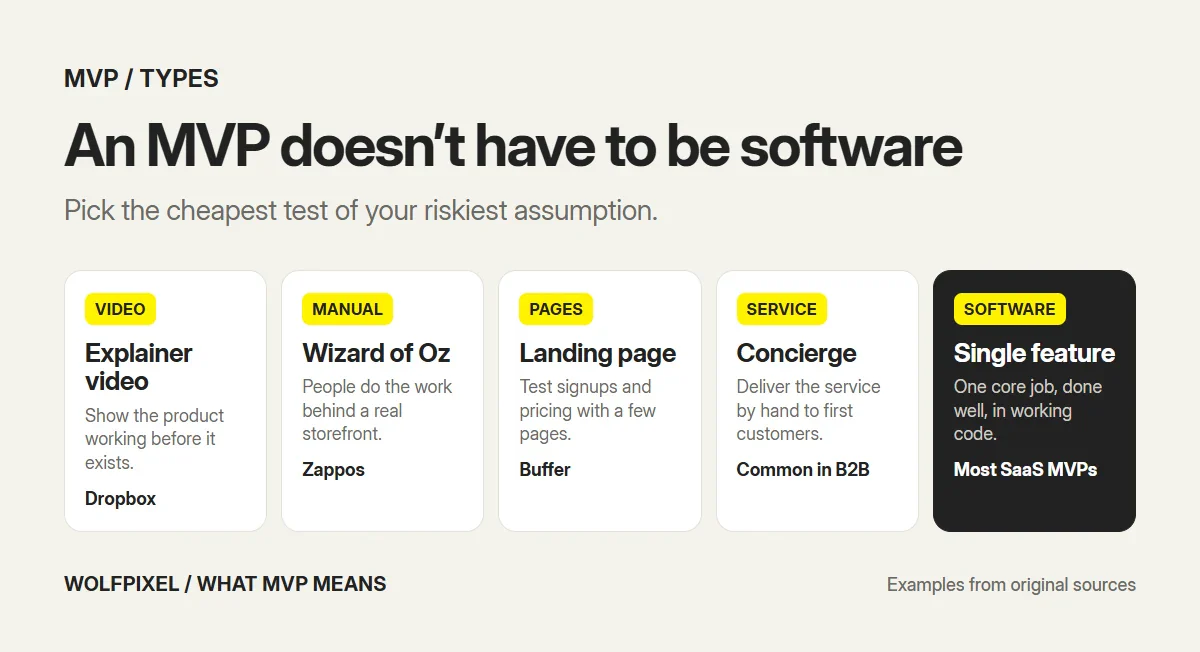
An MVP doesn’t have to be software at all. Some of the best-known ones were a video, a landing page or a manual service that looked automated.
| MVP type | What you build | Real example |
|---|---|---|
| Explainer video | A short video showing the product working | Dropbox |
| Manual or “Wizard of Oz” | A storefront where people do the work behind the scenes | Zappos |
| Landing page | Pages that describe the product and test signups or pricing | Buffer |
| Concierge | You deliver the service personally to the first customers | Common in B2B services |
| Single-feature product | One core job, done well, in working software | Most SaaS MVPs |
The three famous examples, from their original sources:
- Dropbox. Writing in TechCrunch, Eric Ries reported that for Dropbox, “the video was the minimum viable product.” Founder Drew Houston said the beta waiting list went from 5,000 to 75,000 people overnight after it was shared.
- Zappos. Founder Nick Swinmurn told Fortune that in 1999 the business model was going into stores, taking pictures and selling the shoes online. It tested demand for buying shoes online before building any inventory system.
- Buffer. Founder Joel Gascoigne described a two-page MVP, later adding a pricing page in between to test whether people would pay. He had his first paying customer within four days of launching the product.
None of these founders started with a full product. Each one found the cheapest test for their riskiest assumption.
What to design first in an MVP
This is where most guides stop, and where most MVPs go wrong. When everything is “minimum,” the design effort still has to go somewhere. This is the order we use.
- The core loop. The handful of screens a user goes through to get the product’s main value. For a project tool, that is creating a project, adding a task and seeing it move. This gets the most design time.
- The activation moment. The first time a new user gets real value. Every screen before it is a place they can leave, so design signup and setup to reach it as fast as possible.
- Empty and error states on that path. A new account has no data. An empty dashboard with no guidance looks broken. These states decide whether a first session works.
- One clear way to give feedback. A simple feedback link or in-app prompt, because learning is the point.
- Everything else, basic. Settings, admin, billing pages, notifications and secondary features can be plain, default or manual for now.
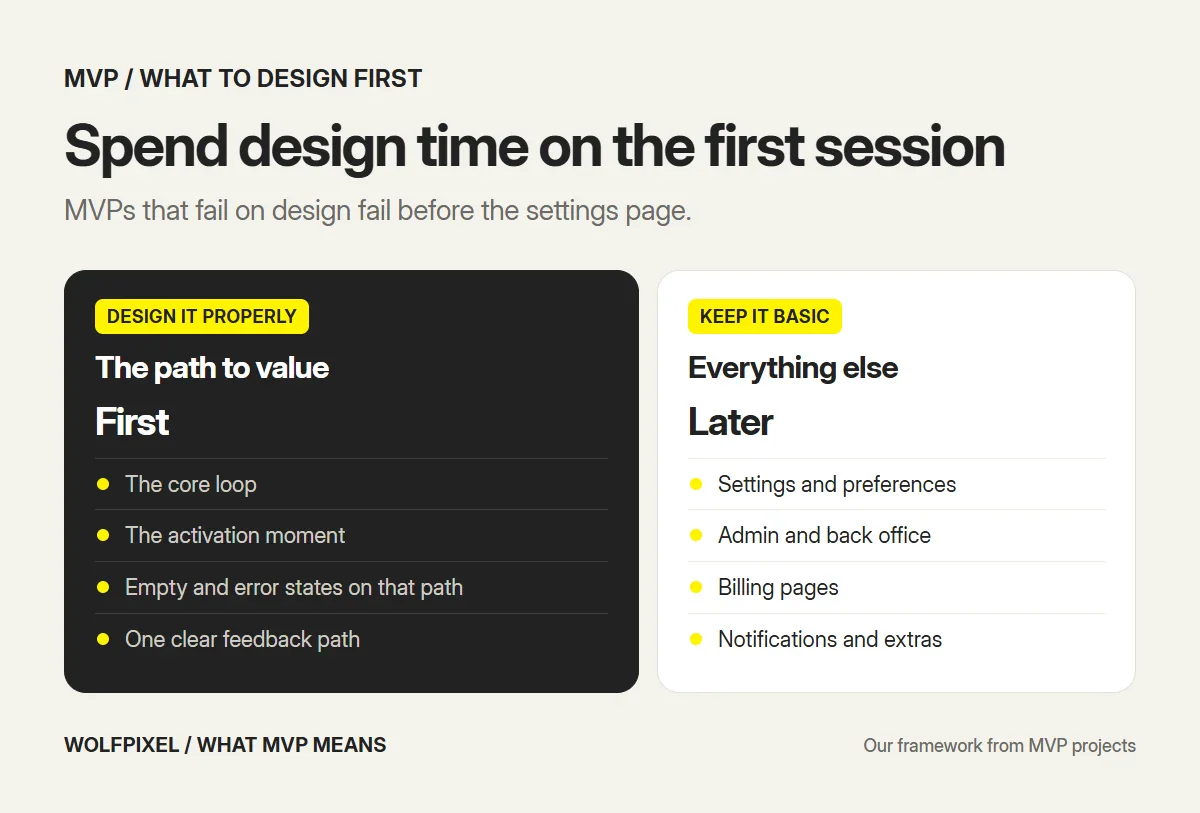
This framework is ours, not an industry standard, but it reflects a pattern we see repeatedly: MVPs that fail on design usually fail in the first session, not in the settings page.
How good does an MVP’s UX need to be?
Good enough that people can complete the core job without help, and trust it enough to come back. In practice that means:
- The core loop works on the devices your users actually use.
- Labels and copy on the core path are clear without explanation.
- Errors tell people what went wrong and what to do next.
- The product looks credible enough for its market. A fintech MVP needs more visual trust than an internal tool.
It does not mean every screen is polished. It means the screens on the path to value are.
How to know if your MVP worked
An MVP without a success metric always looks promising. Before launch, pick one learning metric that would prove or disprove your main assumption, and write down the number that counts as success.
| Your riskiest assumption | Learning metric |
|---|---|
| People understand and want the product | Signup or waitlist conversion from the landing page |
| People can get value from it | Share of new users who complete the core action |
| People keep needing it | Week-2 or week-4 retention |
| People will pay | Trial-to-paid conversion or pre-orders |
This is what the “MVP and KPI” question is really asking. The KPI is how you judge whether the MVP’s hypothesis held. Pick it before you see the data, not after. If you need help talking to users before or after launch, our UX research service runs the interviews.
MVP vs MMF vs MMP vs MLP
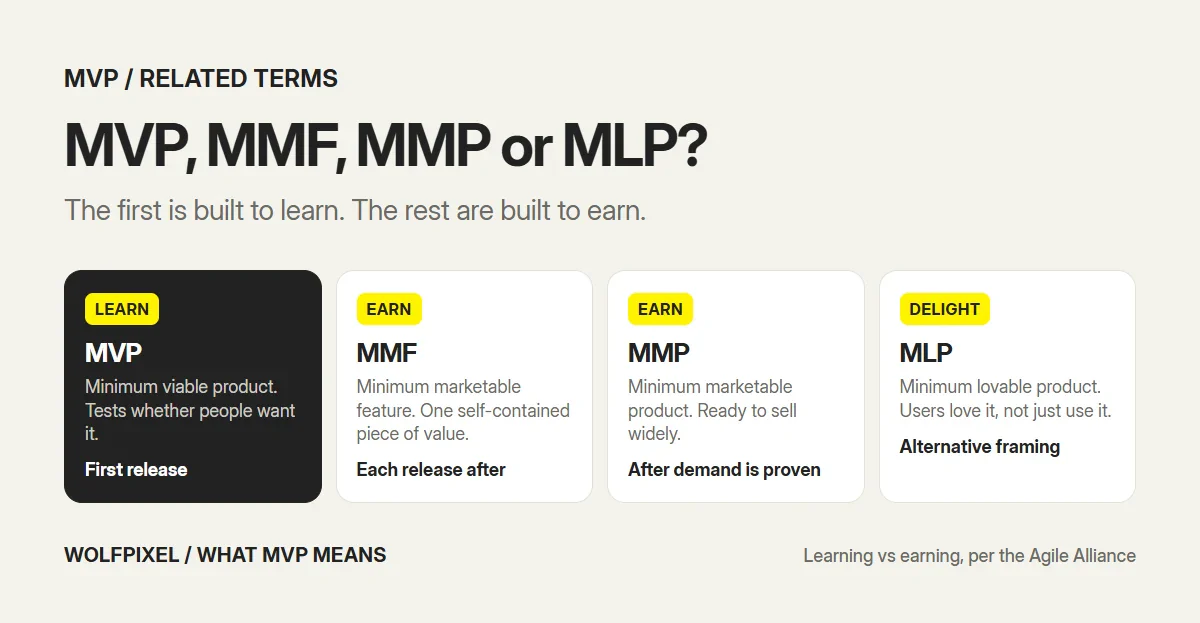
After the MVP come several related terms. The Agile Alliance draws the useful line: the MVP is about learning, while the minimum marketable feature and product are about earning.
| Term | Stands for | Built to | When |
|---|---|---|---|
| MVP | Minimum viable product | Learn whether people want it | First release to real users |
| MMF | Minimum marketable feature | Deliver one self-contained piece of value | Each meaningful release after |
| MMP | Minimum marketable product | Sell to a wider market | Once the MVP has proved demand |
| MLP | Minimum lovable product | Make early users love it, not just use it | An alternative framing to MVP |
Other meanings of MVP in software
Two other uses of the same letters cause confusion in search:
- Model-View-Presenter. In software architecture, MVP is a pattern for structuring user interface code, related to MVC. If a developer says “we use MVP,” they may mean this.
- MCP is not MVP. MCP is the Model Context Protocol, an open standard Anthropic announced in November 2024 for connecting AI assistants to data and tools. It has nothing to do with minimum viable products.
How we design MVPs at Wolfpixel
For founders at pre-seed and seed, our product design service is set up for this stage. We help cut the scope to the flows that prove your idea, then design them so you can test with users or show investors. Product UI covers up to 10 screens, which fits most MVPs, and starts at $3,150. First screens land in your Figma within 7 days.
If you are still deciding what the product should be, start with a clickable prototype. If you already know, design the core loop properly and keep everything else simple. Either way, you can book a free call and we’ll tell you which screens your MVP actually needs. For what the build itself costs, see our guide to MVP development cost.
Sources and method
We reviewed every source below in November 2026.
Definitions and origin
- Wikipedia: Minimum viable product, for the origin of the term.
- Agile Alliance: MVP, for Eric Ries’s definition, the “viable” pitfall and MVP vs MMF and MMP.
Examples
- TechCrunch: Dropbox minimal viable product (2011), for the Dropbox video.
- Fortune: Nick Swinmurn, Zappos (2012), for the Zappos test.
- Buffer: idea to paying customers in 7 weeks (2011), for the Buffer pages.
Data and other terms
- SmartCompany on CB Insights’ 2021 startup failure analysis, for the 35% and 38% figures.
- Anthropic: Model Context Protocol (2024), for MCP.
Our own framework
- The “what to design first” order and the learning-metric table.
- Wolfpixel’s screen count, timeline and starting price, from our product design page.
MVP in Software Development FAQs
What does MVP mean in software development?
MVP stands for minimum viable product. It is the smallest version of a software product that real users can use and that still delivers its core value, released to learn whether people want it before you invest in the full product.
What is the purpose of an MVP?
An MVP tests your riskiest assumption with real users at the lowest cost. It shows whether people want the product, whether they come back and whether they will pay, so you can decide to continue, change direction or stop before building everything.
What is the difference between an MVP and a prototype?
A prototype is a model you test before building, usually without a working backend. An MVP is a real, working product that people use with their own data. A prototype answers whether people can use a design. An MVP answers whether they want the product.
What is MVP, MMF and MMP?
An MVP (minimum viable product) is built to learn. An MMF (minimum marketable feature) is a small, self-contained feature that delivers clear value on its own. An MMP (minimum marketable product) is the first version complete enough to sell widely. The Agile Alliance describes the MVP as being about learning and MMF and MMP as being about earning.
What does MVP stand for in programming?
In product development, MVP means minimum viable product. In software architecture, MVP also means Model-View-Presenter, a pattern for structuring user interface code. The context tells you which one is meant.
What is the difference between MCP and MVP?
They are unrelated. MVP is minimum viable product. MCP is the Model Context Protocol, an open standard announced by Anthropic in November 2024 for connecting AI assistants to data sources and tools.
How do you measure whether an MVP worked?
Pick one learning metric before launch that would prove or disprove your main assumption, such as the share of signups who reach the core action, week-two retention or the share who pay. Set the number that counts as success in advance, so the result can’t be argued away afterwards.
What should you design first in an MVP?
Design the core loop first, the few screens a user goes through to get the product’s main value, then the activation moment, then the empty and error states on that path. Settings, admin tools and nice-to-have features can stay basic or wait.
How many screens does an MVP need?
Most MVPs need fewer screens than founders expect. Many fit in 10 screens or fewer once the product is cut to one core job. At Wolfpixel, Product UI covers up to 10 screens, which fits most MVPs.
How long does it take to build an MVP?
It depends on the product, but MVP design usually takes weeks, not months. At Wolfpixel, first screens land in your Figma within 7 days and a 10-screen product UI usually takes 2 to 3 weeks. Development time comes on top and depends on your team and stack.
Planning an MVP?
Send us the idea and the one thing you need to prove. A senior designer replies within 4 business hours with the screens your MVP needs and a fixed quote.

Was this article helpful?

Written by
Maniruzzaman Jubayer
Co-founder & COO | Product Design Specialist at Wolfpixel
Maniruzzaman Jubayer is Wolfpixel’s Co-founder & COO and a product design specialist with 7 years of experience. He personally oversees website, app, dashboard and digital product design at Wolfpixel, including MVP design for pre-seed and seed founders. This guide explains what MVP means and which parts of an MVP to design first. Wolfpixel offers the product design services discussed in the article.
View all articles