
 20 min read
 Published
MVP development cost is hard to pin down because the same three letters describe a $5,000 no-code test and a $200,000 regulated platform. Both prices are real. If you are a founder trying to budget, the number you need depends on what you put in scope, who builds it and what you forget to include.
I’m Maniruzzaman Jubayer, Co-founder & COO and Product Design Specialist at Wolfpixel, with 7 years of experience. We design MVPs and work alongside the developers who build them, so we see quotes from both sides of the table. This guide compares the prices development companies publish, shows the hours behind a quote, and lists the costs most quotes leave out.
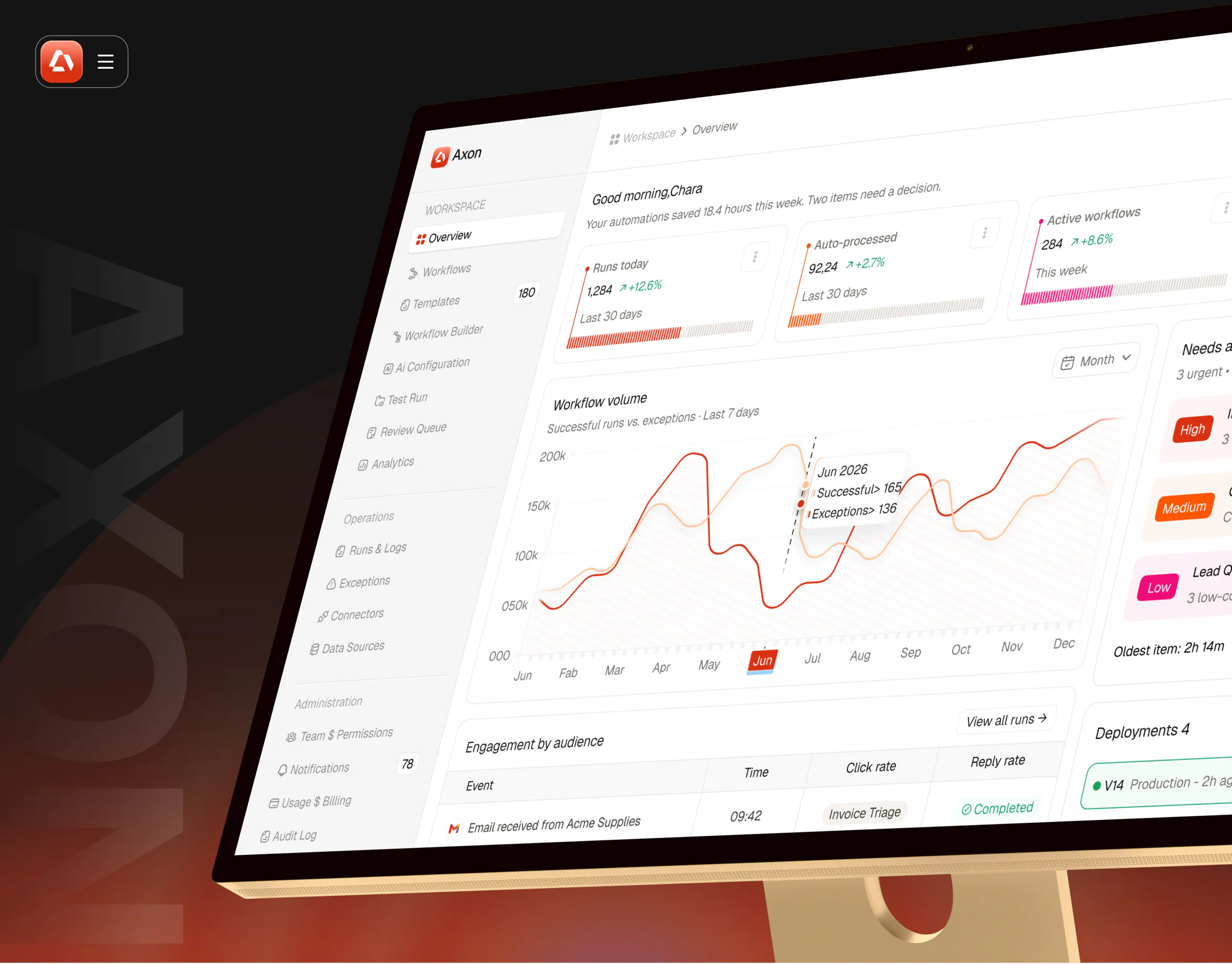
Scoping is where we spend most of our time with founders. On Axon, an AI workflow automation platform, research, personas and end-to-end user flows came before any screen, and they shaped a navigation that keeps daily work, operations and administration apart. Decisions like that are made in design, and they decide how many screens, roles and states a development team has to build.
If you need a refresher on what an MVP is and what to design first, start with our guide to what MVP means in software development. This article is about what it costs.
The short answer: for 2027 budgets, pricing guides published in 2026 put most MVPs between about $15,000 and $150,000. A simple web app with one core workflow costs about $15,000 to $40,000. A typical B2B SaaS MVP costs about $40,000 to $90,000. Marketplaces, native mobile apps, AI products and regulated products run from about $50,000 to $150,000 and beyond. In our illustrative hours model, design is roughly 8 to 20% of the total, and running costs start the day you launch.
Key takeaways:
- A quote is hours multiplied by a rate. Scope sets the hours, and who builds it sets the rate.
- Team location moves the price more than features do. The same build can cost two to three times more with a US team.
- User roles, integrations, platforms and compliance add more cost than screen count does.
- Design is a relatively small part of many MVP budgets, but getting the core user flows right early can prevent expensive development rework.
- Budget for after launch: hosting, tools, fixes and a maintenance guideline of about 15 to 20% of the build each year.
How we got these numbers: these 2027 budgeting ranges are based on publicly available MVP pricing guides reviewed in November 2026. Most source figures were published as 2026 estimates, so treat them as planning benchmarks rather than confirmed 2027 market averages. No independent survey of MVP costs exists, so every published range comes from a development company’s own estimate. We recorded each one with what it covers and linked it. Rate data comes from Clutch and the US Bureau of Labor Statistics. Two kinds of numbers appear below, and we label them. Published figures come from the linked sources. Our estimates are the hours model and the examples, shown with their assumptions so you can swap in your own. The full list is in Sources and method.
How much does MVP development cost in 2027?
Across published guides, MVP pricing falls into these bands by product type.
| MVP type | What it usually includes | Published price range | Published timeline |
|---|---|---|---|
| Early validation project | Customer interviews, a landing page, a clickable prototype or a simple no-code experience | $10,000 to $30,000 | 2 to 6 weeks |
| Simple web app | One user type, one core workflow, login | $15,000 to $40,000 | 6 to 10 weeks |
| B2B SaaS MVP | Roles, a dashboard, billing, a few integrations | $40,000 to $90,000 | 10 to 16 weeks |
| Native mobile app | iOS and Android, backend, push notifications | $50,000 to $110,000 | 12 to 18 weeks |
| Marketplace | Two user sides, payments, matching | $60,000 to $130,000 | 12 to 20 weeks |
| AI-native product | Model integration, data pipelines, review flows | $70,000 to $150,000 | 14 to 22 weeks |
| Regulated (fintech, health) | Compliance, audit trails, security reviews | $80,000 to $150,000+ | 4 to 6 months+ |
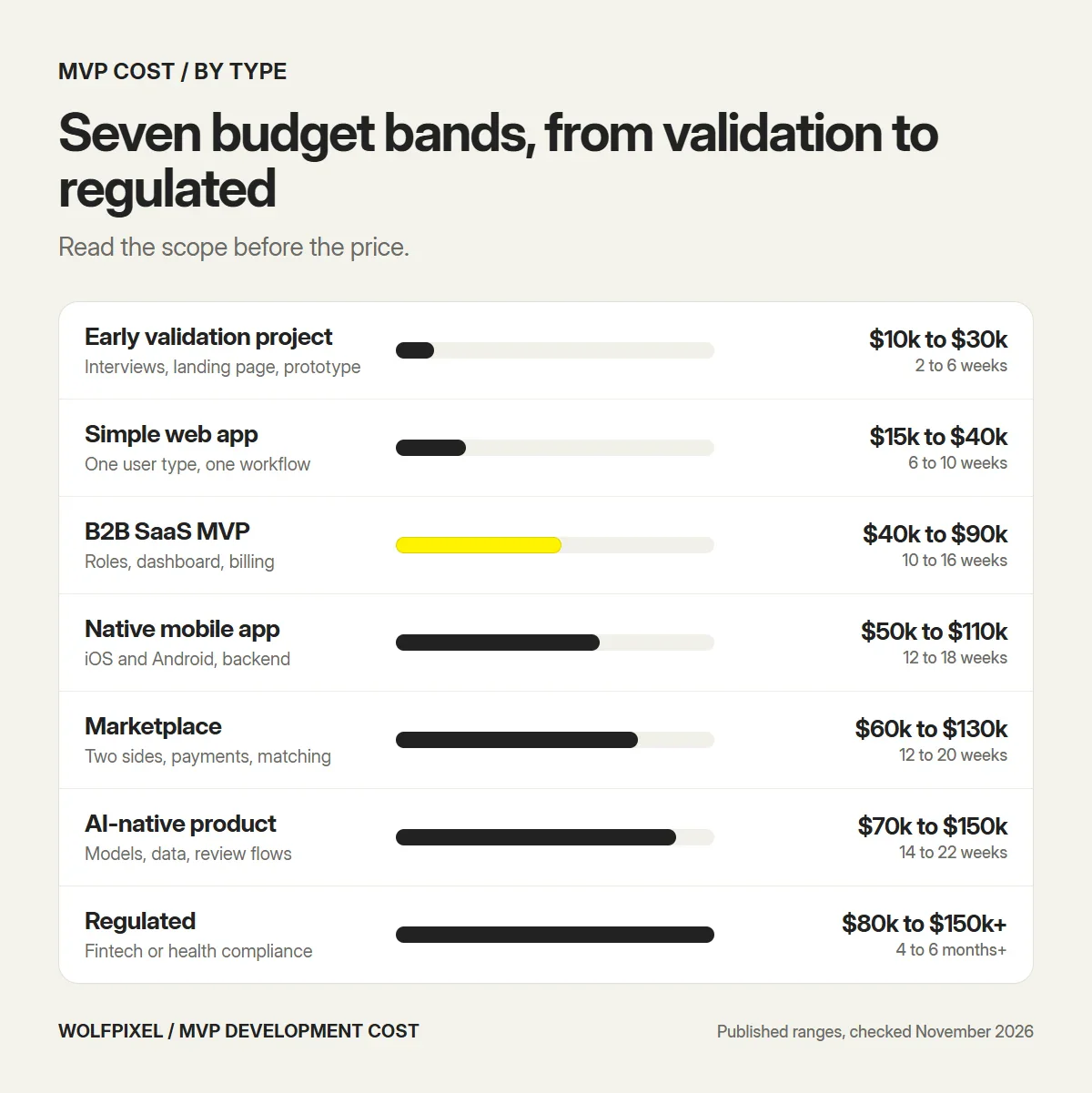
Where those ranges come from:
- By type. Phenomenon Studio publishes $15,000 to $40,000 for a simple web app, $40,000 to $90,000 for a B2B SaaS MVP, $50,000 to $110,000 for a mobile app, $60,000 to $130,000 for a marketplace and $70,000 to $150,000 for an AI-native product, with the timelines above.
- Validation vs product MVPs. Setronica separates a validation MVP at $10,000 to $30,000 from a product MVP at $40,000 to $150,000, and puts fintech MVPs at $80,000 to $100,000. We call the first row an early validation project: it tests demand, but it is not yet a working product that users rely on. Our guide to what MVP means explains where the line sits.
- Regulated products. Techtic puts a fintech MVP with payment-card compliance at $50,000 to $150,000 and more. For the launch paths and compliance work behind those numbers, see how to build a fintech app.
- Offshore pricing. Acorn Globus lists a simple SaaS MVP at $15,000 to $40,000 and notes its ranges assume a South Asian or Eastern European development team, with US-based teams typically costing two to three times more.
The most useful wider benchmark is Clutch, which aggregates verified client reviews. Its software development pricing page reports an average project cost of about $132,000, with most projects between $10,000 and $49,999. Those are all software projects, not only MVPs, but they show where the middle of the market sits.
Why MVP quotes differ by 3x or more
Every quote is hours multiplied by a rate. When two quotes are far apart, one of those two numbers is different, and usually both are.
MVP development cost breakdown by phase
Here is an illustrative model for a B2B SaaS web MVP: one main user type plus an admin, one core workflow, login, billing and two integrations. The hours are our assumptions, set out so you can see what the work consists of. The phases follow the stages in our guide to SaaS product development. This is Wolfpixel’s illustrative model, not an average measured across MVP projects, and the total depends on how the phase ranges combine.
| Phase | What happens | Illustrative hours |
|---|---|---|
| Discovery | Interviews, scope, success metric | 40 to 60 |
| UX and UI design | Flows, prototype, screens, design system | 80 to 120 |
| Front end | Building the screens and states | 160 to 240 |
| Back end | Data, logic, login, billing, integrations | 200 to 320 |
| QA | Testing the core flow, billing and permissions | 60 to 100 |
| Project management | Planning, calls, coordination | 40 to 80 |
| Launch | Hosting, deployment, monitoring | 20 to 40 |
| Total | 600 to 960 |
The rate: what an hour costs by region
Now apply a rate. Clutch publishes typical hourly ranges by agency location, based on its client reviews. These are platform ranges, not a guaranteed rate for every agency in a country, and they run from $25 to $49 an hour in India, the Philippines, Ukraine and Mexico to $50 to $99 in the US, Poland and Spain, and $100 to $149 in Canada and Australia. Senior US agencies often charge more. For context, the US Bureau of Labor Statistics reports a median hourly wage of $64.44 for the occupation “software developers, quality assurance analysts and testers” in May 2025. That is what an employee earns, not what an agency bills: an agency rate adds benefits, overhead and margin on top.
| Hours | At $35 an hour | At $75 an hour | At $150 an hour |
|---|---|---|---|
| 600 | $21,000 | $45,000 | $90,000 |
| 960 | $33,600 | $72,000 | $144,000 |
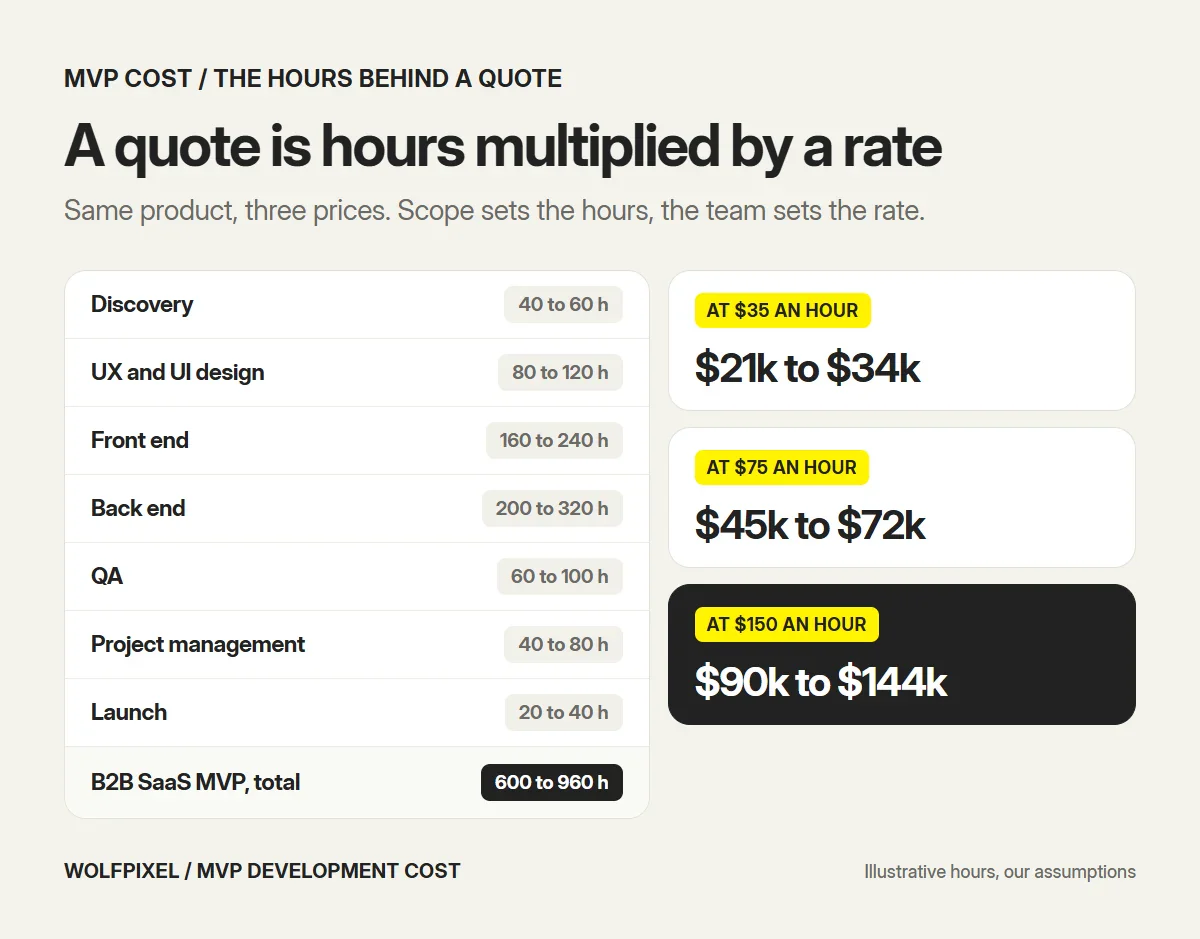
Nothing about the product changed between those columns. That is why comparing two quotes by their total tells you almost nothing. Ask how many hours each one covers and who spends them.
What drives MVP cost up
| Cost driver | Why it adds cost | How to keep it down |
|---|---|---|
| User roles | Each role needs its own screens, permissions and testing | Launch with one user type and an admin |
| Integrations | Each one adds setup, error handling and maintenance | Start with the one integration users can’t live without |
| Platforms | Web, iOS and Android are three builds | Launch on one platform, usually web or one mobile OS |
| Payments | Billing, invoices, failed payments, refunds | Use a hosted checkout from a payment provider |
| Compliance | Security reviews, audit trails, legal work | Scope only what your first customers require |
| AI features | Model costs, evaluation, review flows | Prove the workflow manually before automating it |
| Custom design | Bespoke components and motion | Use a small design system and save polish for the core flow |
| Screen count | More screens to design, build and test | Cut to the screens the core workflow needs |
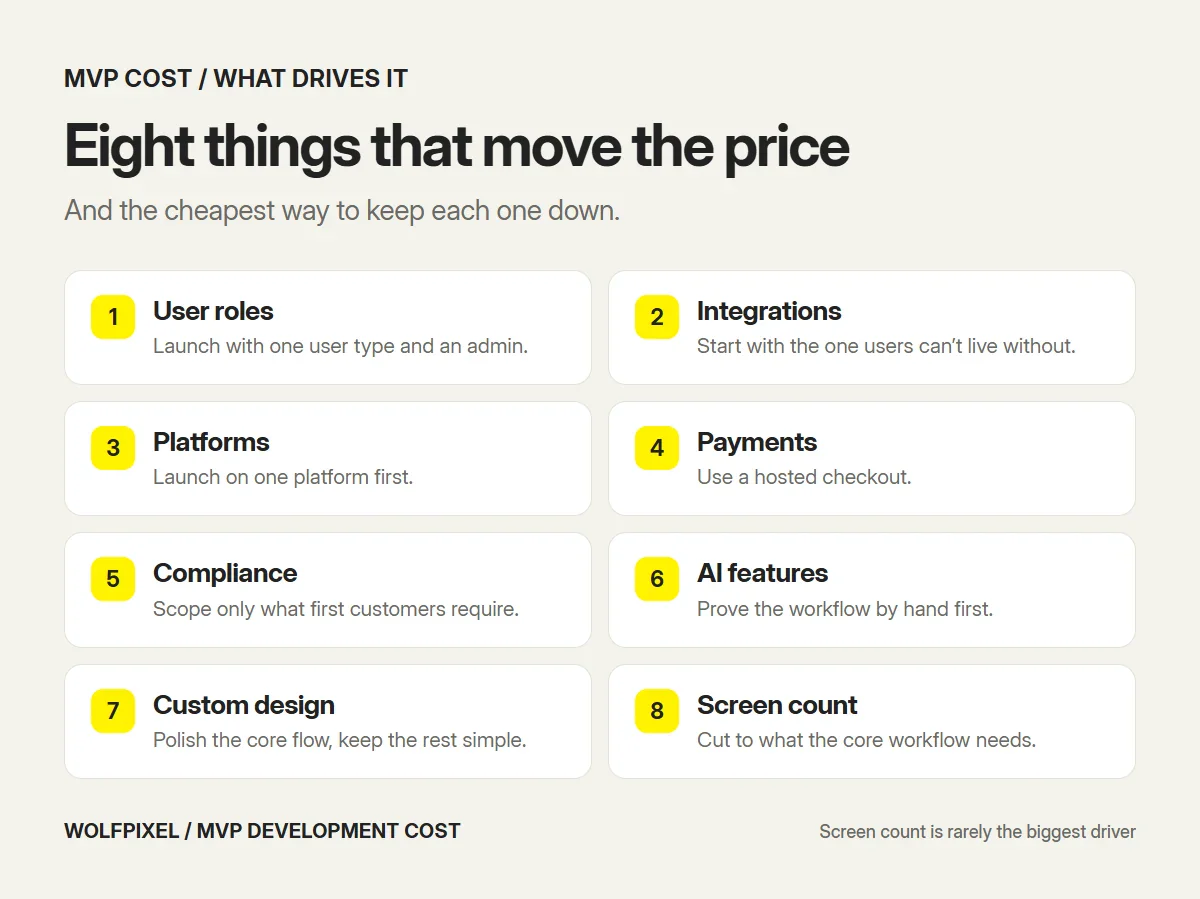
Screen count gets the most attention in quotes, but it is rarely the biggest driver. A ten-screen product with three user roles and two integrations costs more than a twenty-screen product with one role and none. If your MVP is a mobile app, our guide to mobile app design cost breaks down the design side by screen and platform.
MVP cost by team type
| Team | How they charge | Published range | Best for | Watch for |
|---|---|---|---|---|
| Freelancer | Hourly or fixed | About $4,000 to $15,000 | A tight scope you can manage yourself | You become the project manager and QA |
| Offshore agency | Fixed or hourly | About $10,000 to $60,000 | A defined MVP on a budget | Time zones and the seniority of the team |
| US agency | Fixed or hourly | Roughly 2 to 3 times offshore prices | Complex or regulated products | Price, and minimum project sizes |
| In-house team | Salaries | $25,000 to $150,000+ for the MVP period | Funded teams building for years | Hiring time before work starts |
| No-code or AI builder | Monthly subscriptions | A subscription plus your time | Testing demand quickly | Limits on logic, scale and data ownership |
The freelancer, agency and in-house ranges follow Setronica’s and Acorn Globus’s published figures, and the US multiplier is Acorn Globus’s note that US-based teams typically cost two to three times more than South Asian or Eastern European teams. These are one-time build costs, except for the no-code row, which is a recurring subscription. Our comparison of design agencies, freelancers and in-house teams covers the trade-offs beyond price.
MVP design: a small investment that can prevent expensive rework
In our illustrative hours model, UX and UI design account for roughly 8 to 20% of the total, depending on how the phase estimates combine. That is not a universal benchmark, but design is where scope gets decided. Setronica publishes MVP design at $3,000 to $8,000 for basic design, $8,000 to $20,000 for custom design and more for complex products.
The value of design at the MVP stage is less about how it looks and more about what it stops you from building. Testing a clickable prototype with a small group of representative users can reveal confusing flows, missing steps and unnecessary features before development begins. Five users can be a useful starting point for a focused usability study, but the right sample depends on the product, the audience and what you need to learn. Our product design service is built around this step. Our guides to what a software prototype is and UI/UX design cost go deeper on both.
No-code and AI builders vs custom development
| No-code or AI builder | Custom development | |
|---|---|---|
| Cost to first version | Low, often a subscription plus your time | $15,000 and up |
| Speed | Days to weeks | Weeks to months |
| Custom logic | Limited to what the platform supports | Greater flexibility for custom logic |
| Performance at scale | Can struggle | Built for it |
| Data ownership and security | Depends on the platform’s terms, configuration and access controls | More control over architecture, hosting and data, depending on implementation |
| Best for | Testing demand and workflows | A product you will grow for years |
AI app builders have made the first version far cheaper than it was even two years ago. They are a good way to test whether people want the product. Whether they suit a product long term depends on the platform, its configuration, access controls and the compliance your customers need. Many teams rebuild once the idea is proven and requirements grow, so if you start on a builder, plan for that possibility instead of being surprised by it.
The costs most MVP quotes leave out
| Cost | Typical amount | What it means |
|---|---|---|
| Hosting and databases | About $50 to $200 a month (published) | For an early product. Grows with traffic, usage, infrastructure and provider pricing |
| Third-party tools and APIs | About $50 to $500 a month (published) | Email, authentication, payments, maps and other services, billed by usage |
| App store fees | $99 a year (Apple), $25 one time (Google) | Set by Apple and Google for publishing mobile apps |
| Legal policies | About $1,000 to $3,000 (published) | Professionally drafted terms of service and privacy policy. Varies by jurisdiction |
| Compliance work | About $5,000 to $15,000 (published) | For regulated products such as fintech and health |
| Changes after launch | 20 to 30% of the build budget (published) | A contingency allowance to keep, not an observed average |
| Yearly maintenance | 15 to 20% of the build cost (published) | A budgeting guideline from the cited source, not a universal rule |
| Analytics, monitoring and backups | Varies | Product analytics, error monitoring, uptime alerts and backups |
| Security updates | Varies | Dependency updates and fixes as vulnerabilities are found |
| Customer support | Varies | Time or tools to answer users, often the founders at first |
The rows marked published come from Setronica, and the maintenance range from Techtic. The app store fees are set by Apple and Google.
The line that catches most founders is the one after launch. The first real users always find problems and ask for changes. If the whole budget went into the build, there is nothing left to respond to what the MVP teaches you, which is the point of building it.
How to budget the full cost to build an MVP
A build quote is only part of what an MVP costs in its first year. A simple way to set the full budget:
First-year MVP budget = design and build + contingency + running costs + legal and compliance
Here is a worked example for a B2B SaaS MVP. The build figure sits inside the published B2B SaaS range above, and the other lines use the published guidelines from the next section. The specific choices are our assumptions, so swap in your own.
| Budget line | Assumption | Amount |
|---|---|---|
| Design and build | Midpoint-style quote for a B2B SaaS MVP | $60,000 |
| Contingency for changes after launch | 25% of the build budget (published range 20 to 30%) | $15,000 |
| Hosting and databases | $100 a month for 12 months (published range $50 to $200) | $1,200 |
| Tools and APIs | $250 a month for 12 months (published range $50 to $500) | $3,000 |
| Legal policies | Terms and privacy policy (published range $1,000 to $3,000) | $2,000 |
| First-year total | $81,200 |
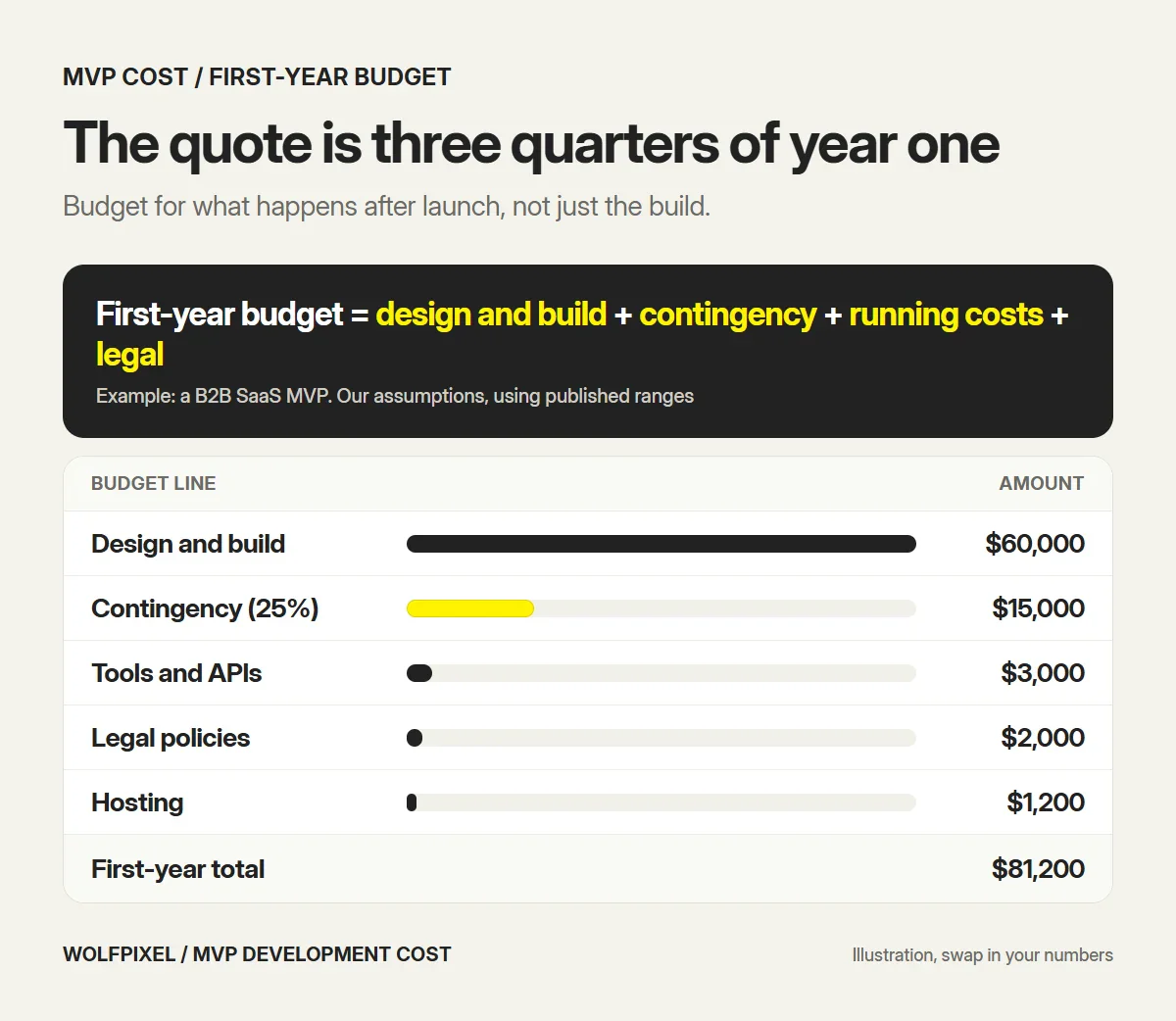
In this example, the build quote is about three quarters of the first-year cost. Founders who budget only for the quote usually run out of money exactly when the first users start asking for changes.
MVP development timeline
Published timelines track the price bands closely. Using Phenomenon Studio’s published figures:
| MVP type | Published timeline |
|---|---|
| Simple web app | 6 to 10 weeks |
| B2B SaaS MVP | 10 to 16 weeks |
| Native mobile app | 12 to 18 weeks |
| Marketplace | 12 to 20 weeks |
| AI-native product | 14 to 22 weeks |
Time and cost move together because most of an MVP budget is hours. A shorter timeline with the same scope usually means a larger team, not a smaller bill. Design sits at the start: at Wolfpixel, first screens land in your Figma within 7 days and a 10-screen product UI usually takes 2 to 3 weeks, which is time the build doesn’t spend guessing.
The cost of not validating first
The most expensive MVP is the one nobody needed. Validation costs a fraction of the build. Phenomenon Studio prices validation research at $8,000 to $15,000 for 15 to 20 interviews, and Shipkit estimates that cutting three to five features saves $10,000 to $30,000.
A simple way to think about it, using an example of our own: if a $70,000 build has a meaningful chance of testing the wrong idea, spending $5,000 to $10,000 on interviews, a landing page and a tested prototype first is cheap insurance. Even if it only cuts two unnecessary features, it has probably paid for itself. If you want that research run for you, it is what our UX research service does.
How to lower MVP cost without losing viability
- Validate before you build. Interviews and a landing page cost a fraction of code.
- One user, one workflow. Every extra role and journey multiplies hours.
- Prototype before code. Test the core flow with a small group of representative users and fix it in Figma.
- Reuse proven services. Use existing providers for login, payments, email and analytics instead of building them.
- One platform first. Add the second when the first proves demand.
- Keep the design system small. A dozen well-made components beat a hundred half-made ones.
- Fix the scope before the price. Fixed-price quotes are only fixed if the scope is.
How we scope and design an MVP at Wolfpixel
This is the process we follow on product projects, so you can see where design time goes and why it reduces build hours:
| When | What happens | What it saves in the build |
|---|---|---|
| Days 1 to 3 | Interviews with your team and users, analytics and competitor review | Features nobody needs never reach the backlog |
| Days 3 to 5 | User flows, a sitemap and a prioritized feature list | Developers get a fixed list of screens, roles and states |
| Days 5 to 14 | High-fidelity screens and a clickable prototype, first screens in your Figma by day 7 | Layout and flow problems are fixed in Figma, not in code |
| Final week | Test the prototype with users, fix what they trip on, hand off specs and components | Fewer rounds of rework after the first release |
We estimate design time by counting what has to be designed, not by guessing a total: the core user flows, the screens in each flow, the user roles and the states every screen needs, such as empty, loading and error. That is the same inventory a developer needs for an accurate build quote, which is why a scoped design often makes development quotes easier to compare.
Two scope decisions from our own projects show how this works in practice:
- Earnify, an affiliate growth platform. The merchant program creation flow keeps setup short and relies on ready-made tools rather than custom development. That is a scope decision as much as a design one: fewer custom pieces to build and maintain.
- Axon, an AI workflow platform. Instead of designing a blank builder first, new workflows start from a library of tested templates and a sandbox test run, which gives teams a tested starting point instead of a blank canvas.
The flows behind decisions like these are the subject of our guide to user flow examples.
How to compare two MVP quotes
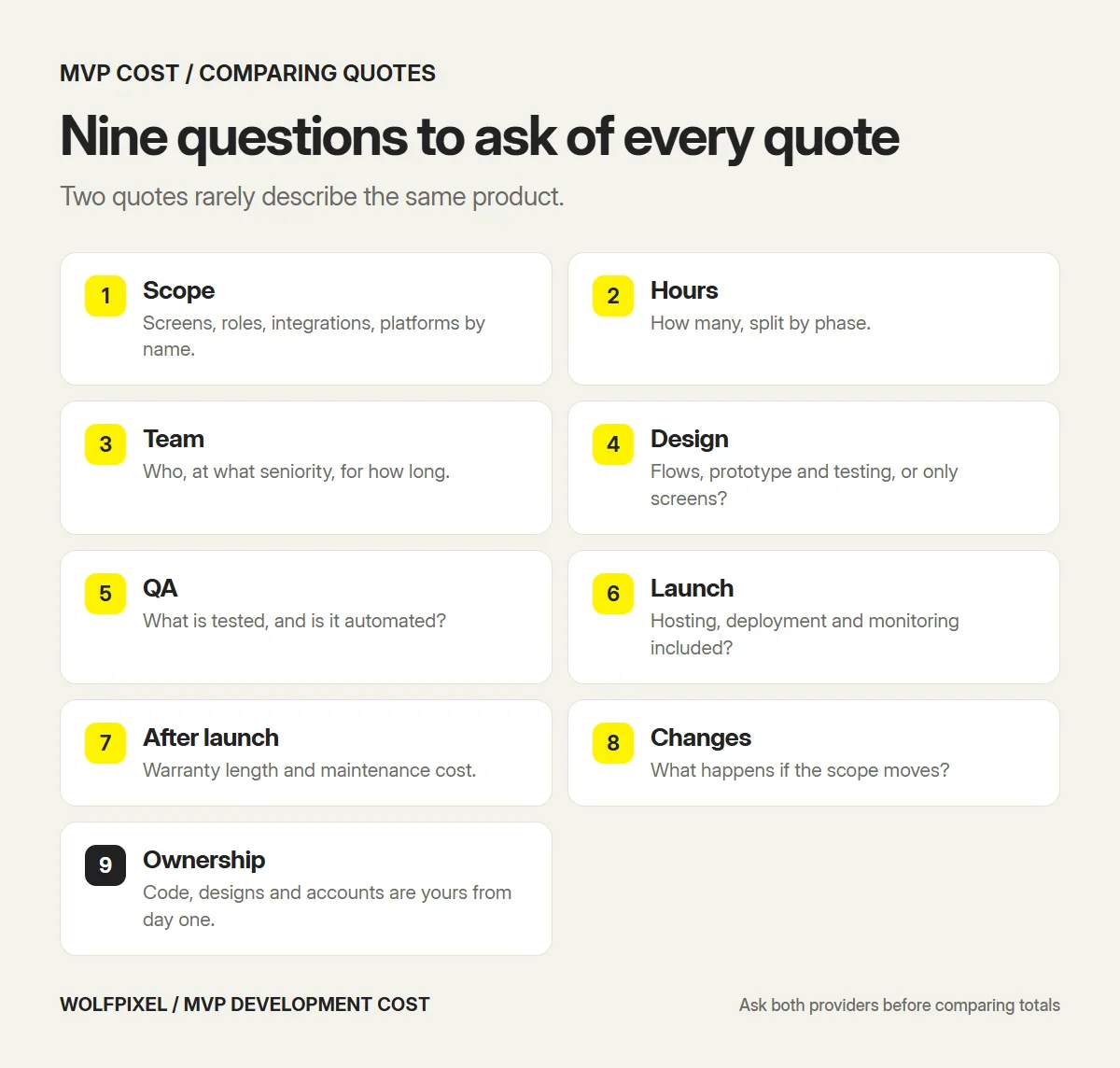
Two quotes rarely describe the same product. Ask each provider these questions before comparing totals:
- Scope: which screens, user roles, integrations and platforms, by name?
- Hours: how many, and split by phase?
- Team: who works on it, at what seniority, and for how long?
- Design: are flows, a prototype and user testing included, or only screens?
- QA: what is tested, and is testing automated?
- Launch: are hosting setup, deployment and monitoring included?
- After launch: how long is the warranty, and what does maintenance cost?
- Changes: what happens to the price if the scope changes?
- Ownership: do you own the code, designs and accounts from day one?
What MVP design costs at Wolfpixel
Wolfpixel focuses on the part of the MVP budget that decides what gets built: product strategy, UX research, UX and UI design, clickable prototypes, design systems and a developer-ready handoff. Front-end and backend implementation are handled by your development team or a development partner, and we work with them from the first call. Our design prices are fixed and published on our pricing page. Here is how they sit next to published MVP design ranges:
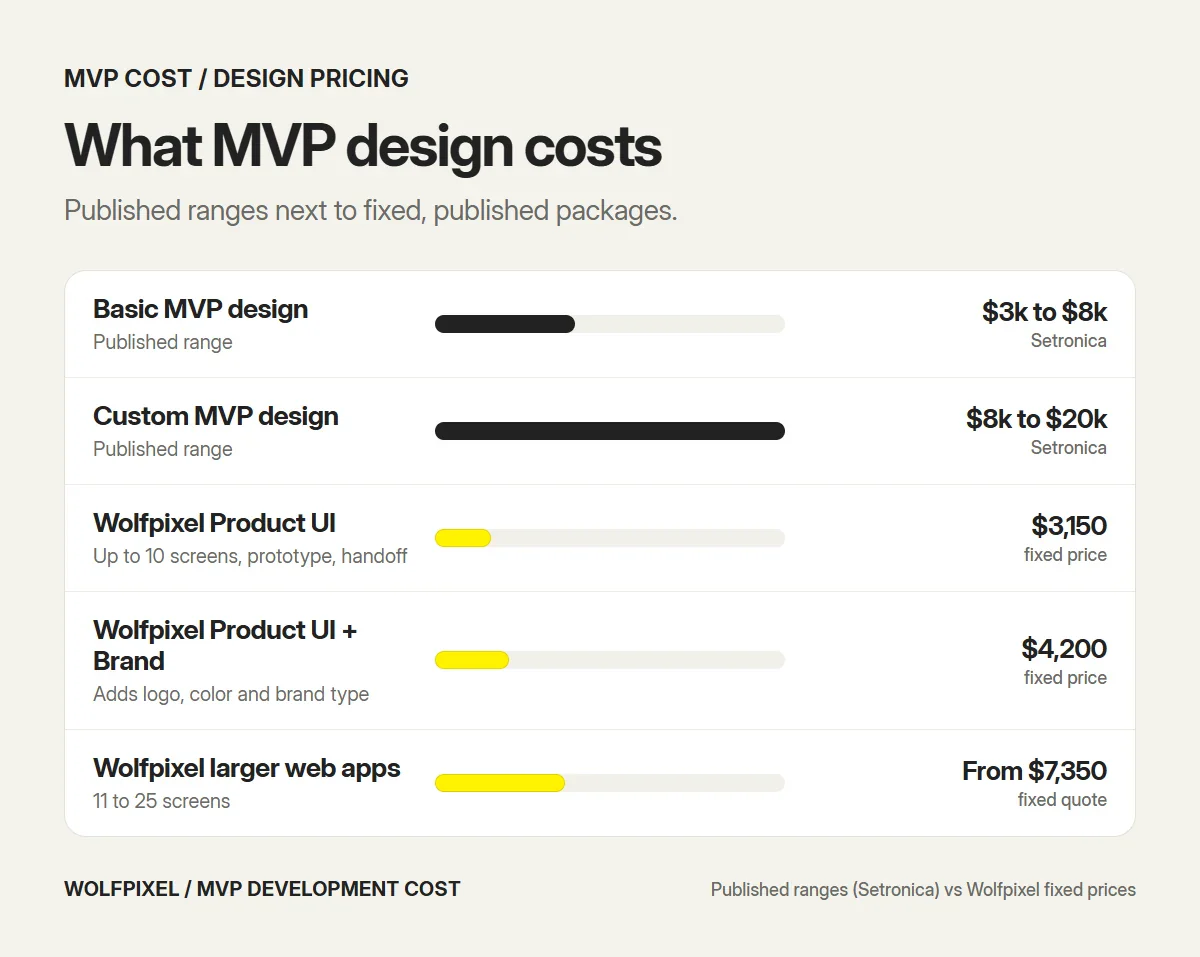
| Package | Price | What you get |
|---|---|---|
| Product UI | $3,150 | User research and flows, high-fidelity screens for up to 10 screens with layouts for every breakpoint, a clickable Figma prototype of the core workflow, a starter design system, a dev-ready handoff and revisions until it is right |
| Product UI + Brand | $4,200 | Everything in Product UI, plus a logo, color palette, brand type and design documentation |
| Larger web apps | From $7,350 | For products with 11 to 25 screens, see web app design |
What happens next: after a free 30-minute call you get a written scope and a fixed quote, and first screens land in your Figma within 7 days. Ten screens covers many focused MVPs, but not every product. If your MVP needs more, the scope and price grow with it, and you know both before work starts. See the product design service for the full process.
Sources and method
We reviewed every source below in November 2026 and re-checked each figure against its page on November 16, 2026. Prices are quoted as published and may have changed since.
Published MVP prices (all are company estimates; no independent survey of MVP costs exists)
- Phenomenon Studio: MVP development cost in 2026 (October 20, 2026), for prices and timelines by type and the cost of validation research.
- Setronica: How much does it cost to build an MVP (March 24, 2026), for validation vs product MVPs, design, team and running costs.
- Techtic: MVP development cost 2026 (2026), for regulated products and maintenance.
- Acorn Globus: MVP development guide (updated April 2026), for South Asian and Eastern European pricing and the US multiplier.
- Shipkit: MVP development cost (undated), for the savings from cutting features.
Rates and fees
- Clutch: software development pricing (updated September 21, 2026), for average project cost and typical hourly ranges by country (platform ranges based on client reviews, not guaranteed rates).
- US Bureau of Labor Statistics: software developers (last modified August 27, 2026), for the May 2025 median hourly wage of software developers, quality assurance analysts and testers (an employee wage, not an agency rate).
- Apple Developer Program enrollment and Google Play Console registration, for app store fees.
Our own estimates
- The hours-by-phase model and the three example rates.
- The cost-driver table, the validation example and the first-year budget example.
- The Wolfpixel process, from our product design page, and the Earnify and Axon examples, from our case studies.
- Wolfpixel’s packages, from our pricing page.
MVP Development Cost FAQs
How much does MVP development cost?
For 2027 budgeting, MVP pricing guides published in 2026 put most MVPs between about $15,000 and $150,000. These are company estimates, not measured market averages. A simple web app with one core workflow sits near the bottom, a typical B2B SaaS MVP around $40,000 to $90,000, and marketplaces, native mobile apps, AI products and regulated products at the top. Team location changes the price more than anything else.
How long does it take to build an MVP?
Published estimates put a typical MVP at about 6 to 16 weeks and a complex or regulated one at 4 to 6 months. Discovery and design usually take 2 to 4 weeks of that, and design for a 10-screen product can be done in 2 to 3 weeks.
Why do MVP quotes vary so much?
A quote is hours multiplied by a rate. The hours depend on screens, user roles, integrations, platforms and compliance. The rate depends on who does the work and where. The same 800 hours costs about $28,000 at $35 an hour and $120,000 at $150 an hour.
How much does it cost to design an MVP?
Published guides put MVP design at about $3,000 to $8,000 for a basic product, $8,000 to $20,000 for custom design and more for complex products. At Wolfpixel, Product UI for up to 10 screens is $3,150, which covers many focused MVPs. Larger products with 11 to 25 screens start at $7,350.
Is a no-code MVP cheaper?
Usually, yes, for testing demand. No-code and AI app builders can produce a working first version for the cost of a subscription and your own time. The trade-offs are limits on custom logic, performance, data ownership and security, which matter once business customers start using the product.
What hidden costs come with an MVP?
Hosting and databases, third-party tools and APIs, app store fees, legal policies and compliance work, analytics, and maintenance after launch. Published guides suggest a budgeting guideline of 15 to 20% of the build cost each year for maintenance and a contingency of 20 to 30% of the budget for changes after launch.
Should I hire a freelancer, an agency or build in-house?
Freelancers cost the least and suit a tightly scoped build you can manage yourself. Agencies cost more but bring design, development, QA and project management together. In-house teams make sense once you have funding and a product worth building for years.
How can I reduce MVP development cost?
Validate the problem before building, cut the scope to one user and one core workflow, design and test a clickable prototype before code, reuse proven services for login, payments and email, and launch on one platform first.
Does Wolfpixel design or build MVPs?
Wolfpixel focuses on the design side of an MVP, which means product strategy, UX and UI design, clickable prototypes, design systems and a developer-ready handoff. Product UI for up to 10 screens is $3,150. Front-end and backend implementation are handled by your development team or a development partner, and we work with them from the first call.
Want your MVP scoped before you get build quotes?
Send us the idea and the one thing you need to prove. A senior designer replies within 4 business hours with the screens your MVP needs and a fixed design quote.

Was this article helpful?

Written by
Maniruzzaman Jubayer
Co-founder & COO | Product Design Specialist at Wolfpixel
Maniruzzaman Jubayer is Wolfpixel’s Co-founder & COO and a product design specialist with 7 years of experience. He personally oversees website, app, dashboard and digital product design at Wolfpixel and helps founders scope MVPs before they are built. This guide compares published MVP prices and explains the hours, team choices and hidden costs behind a quote. Wolfpixel offers the MVP design services mentioned in the article.
View all articles