

 19 min read
 Published

EdTech products fail in a different way from other software. A learning app can have a clean interface and still lose, because the teacher could not set it up between classes, the district’s rostering never synced, or the student on a shared Chromebook could not find the next lesson. Picking a design partner who has never had to think about any of that is an expensive way to find out.
I’m Maniruzzaman Jubayer, Co-founder & COO and Product Design Specialist at Wolfpixel, with 7 years of experience. This guide is for EdTech founders, product leads and heads of design who need a UX partner for a learning product in 2027 and want a shortlist built on evidence rather than on who ranks agencies for a fee.
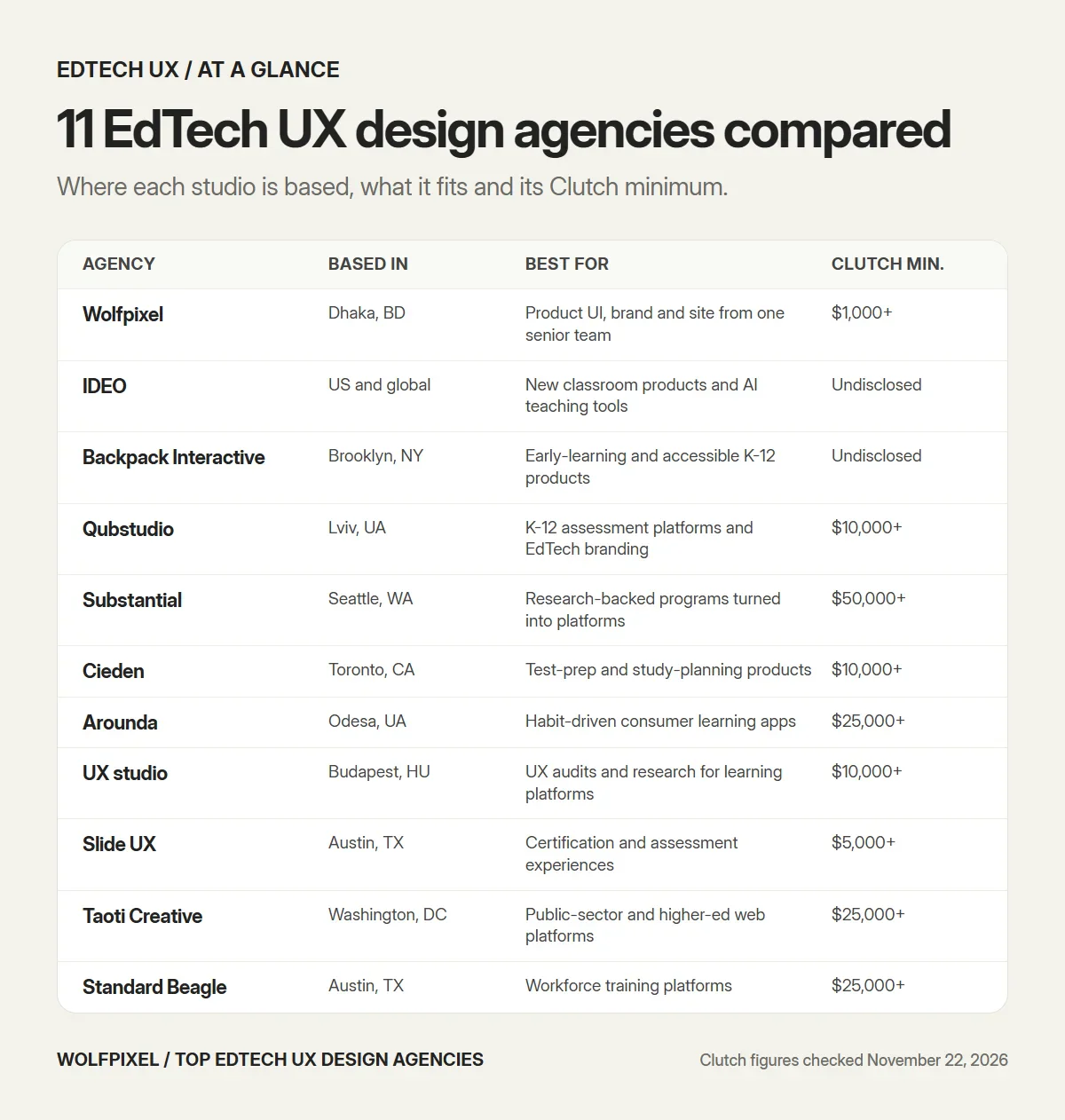
The short answer: the top EdTech UX design agencies for 2027 are Wolfpixel, IDEO, Backpack Interactive, Qubstudio, Substantial, Cieden, Arounda, UX studio, Slide UX, Taoti Creative and Standard Beagle. Each one has published education work you can read before you call them. They differ most on the segment they know (K-12, higher education, test prep, workforce training or consumer learning), on whether they design only or also build, and on price, from a Clutch minimum of $1,000+ to $50,000+.
Key takeaways:
- Shortlist by segment first. A K-12 classroom tool, a university LMS add-on and a workforce training platform need different expertise.
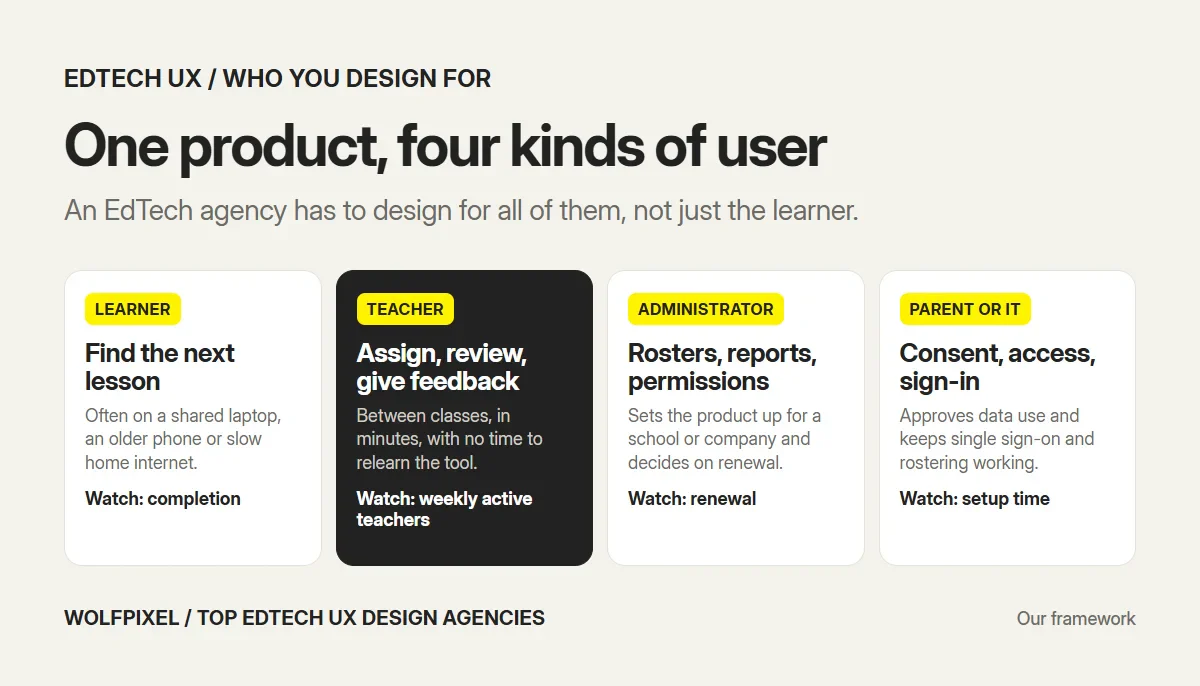
- An EdTech product has at least four kinds of user: learners, teachers, administrators, and parents or IT. Ask every agency which of them it researched with on its last education project.
- Two rules now shape the work. The amended COPPA Rule has been in full force since April 22, 2026, and public schools and colleges must meet WCAG 2.1 AA under the ADA Title II rule from April 26, 2027.
- Clutch minimums for the agencies here run from $1,000+ to $50,000+. Treat them as a floor for planning, not a quote.
- Read the case study, not the logo wall. Several case studies on this list report outcomes; several report only what was delivered. Ask how any number was measured.
How we wrote this: in November 2026 we reviewed the pages Google ranks for this topic, including UX Planet, Top UX Design Agencies, Cieden, Edition, Insivia and UX Agencies, and Google’s AI Overview for the query. We then read each agency’s own education case studies and checked its Clutch profile on November 22, 2026. Every figure about an agency comes from the agency’s own site or its Clutch profile and is linked below. Wolfpixel is our company. We list it first, as we do in our other guides, and its entry is written to the same standard of evidence as the others.
What an EdTech UX design agency does
An EdTech UX design agency, sometimes called an EdTech design agency, researches, designs and tests software that people learn with. That includes learning platforms, classroom apps, assessment and test-prep tools, course marketplaces, tutoring products and corporate training systems.
Typical EdTech UI/UX design services include:
- Research with every user group: interviews and usability tests with learners, teachers, administrators and, for younger students, parents.
- Learning flows: onboarding, the next lesson, practice, feedback and progress, designed for completion rather than time spent.
- Teacher and admin tools: assigning work, giving feedback, rosters, permissions and reports.
- Integration moments: how the product launches from the LMS, signs people in and returns grades, which the 1EdTech LTI standard and the OneRoster standard define.
- Accessibility and privacy on screen: contrast, keyboard and screen-reader support, consent flows and data choices.
- Design systems so the product stays consistent as content and features grow.
- EdTech website design, for some agencies, so schools, districts and buyers understand the product before a demo.
UX design for EdTech is harder than for most software because the person who buys the product is rarely the person who uses it every day.
How we chose these EdTech UI/UX design agencies
To find the top UX design service providers for EdTech companies, every agency on this list had to pass one test: at least one education case study on its own website that names or clearly describes the client and explains what the agency designed. A course landing page or a concept shot on a design gallery did not count.
We then compared the agencies on six things:
- Education work you can read. Named clients, the scope of the work and, where published, the outcome.
- Range of users. Evidence of research or design for teachers and administrators, not only learners.
- Accessibility. Specific accessibility work in education projects, or a stated WCAG or Section 508 practice.
- Integration and privacy thinking. LMS, rostering, single sign-on, consent and data choices treated as design problems.
- Delivery model. Design only, or design and engineering, so you know whether you need a separate build partner.
- Price signals. The minimum project size and hourly band on Clutch, checked on November 22, 2026.
We did not rank on awards, logo walls or social following. Where an agency publishes a number, we quote it exactly and say where it comes from. Where it does not, we say so.
The 11 top EdTech UX design agencies for 2027
1. Wolfpixel
- Based in: Dhaka, Bangladesh, with a US company, Wolfpixel LLC
- Founded: 2022
- Clutch: 5.0 from 5 reviews, minimum project $1,000+, $25 to $49 an hour
- Best for: EdTech startups that need product UI, a brand and a marketing website from one senior team
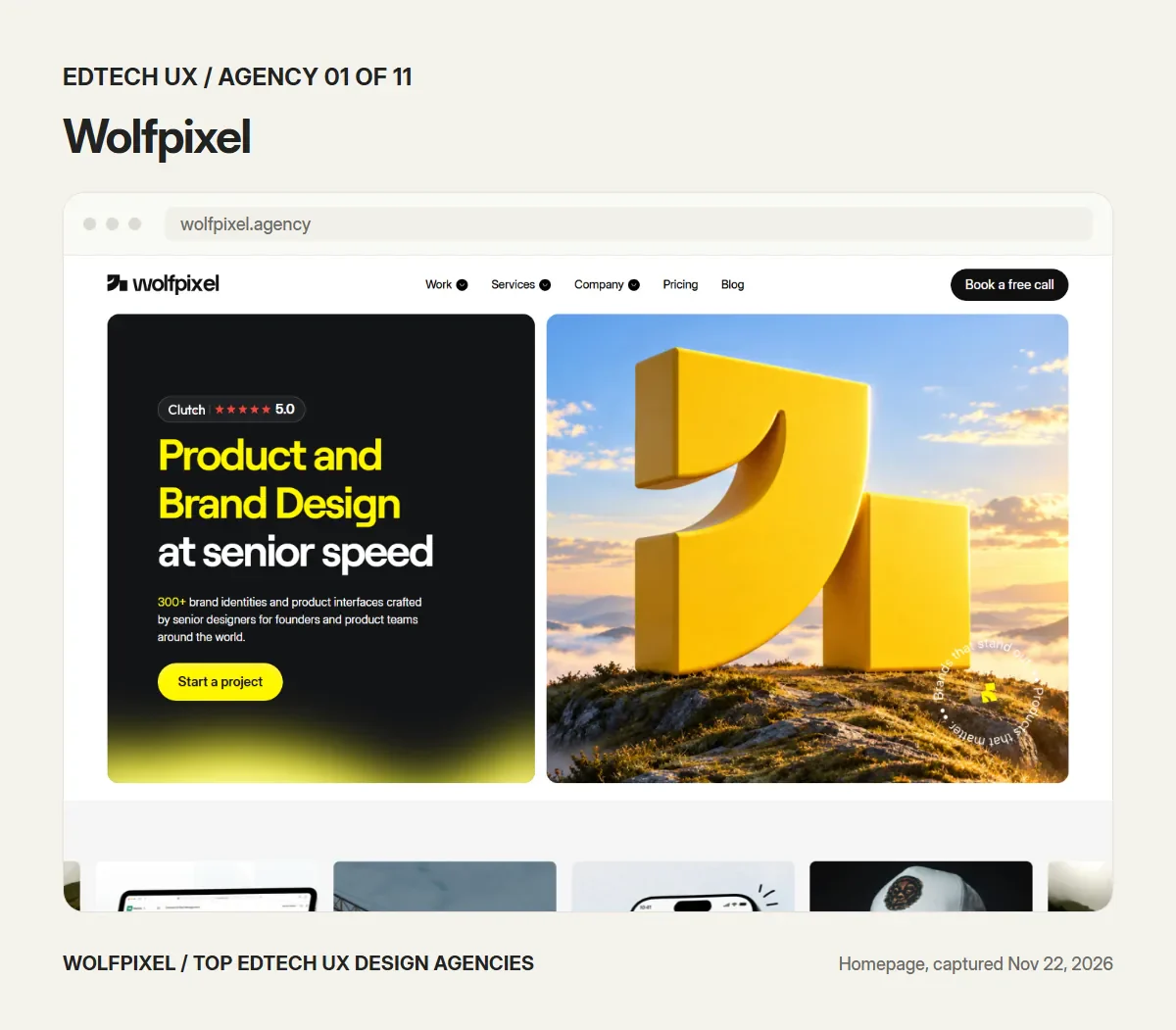
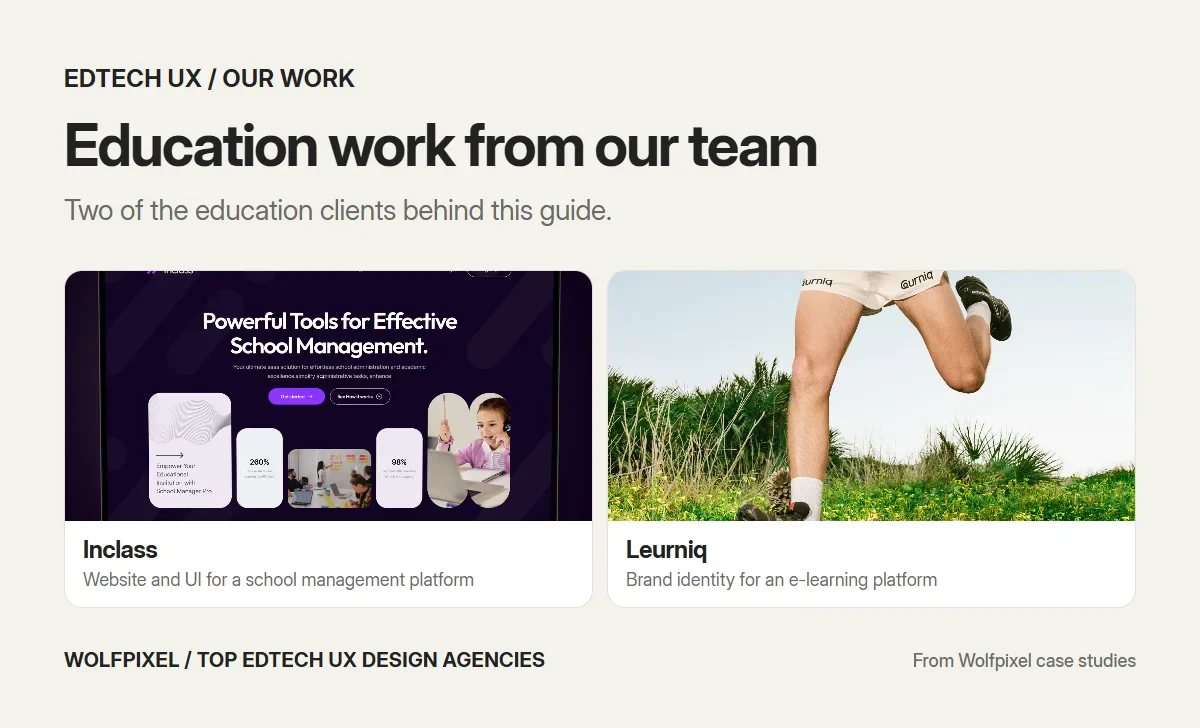
Wolfpixel is a product and brand design agency where every project is led by a senior designer, and the people on the call are the people doing the work. Our education work so far has been for education companies. For Inclass, a school management platform, we designed the website and UI so that cautious school buyers could see the product at work, with course progress, learning activity and dashboard views, rather than read about it. For Leurniq, an e-learning platform for students and adult learners, we created the brand identity, a typography system and its application to a learning dashboard and landing screens. For TechScholars, we designed the logo and the website; their co-founder Sayandeep Das said: “They designed our brand logo and the website. I’m really happy with both.”
We publish prices: product UI for up to 10 screens starts at $3,150 on our pricing page, and we send a fixed quote within 48 hours of a brief.
Verify before hiring: we have not yet published a K-12 classroom product with measured learning outcomes, we do not build LMS or rostering integrations ourselves, and we do not issue accessibility certifications. If those are central to your project, ask us how we would cover them, or pick a studio below.
2. IDEO
- Based in: offices in Cambridge (MA), Chicago, San Francisco, London and Shanghai
- Founded: 1991, in Palo Alto
- Clutch: no reviews; minimum and hourly rate undisclosed; 250 to 999 employees
- Best for: new classroom products and AI teaching tools that have to earn teachers’ trust
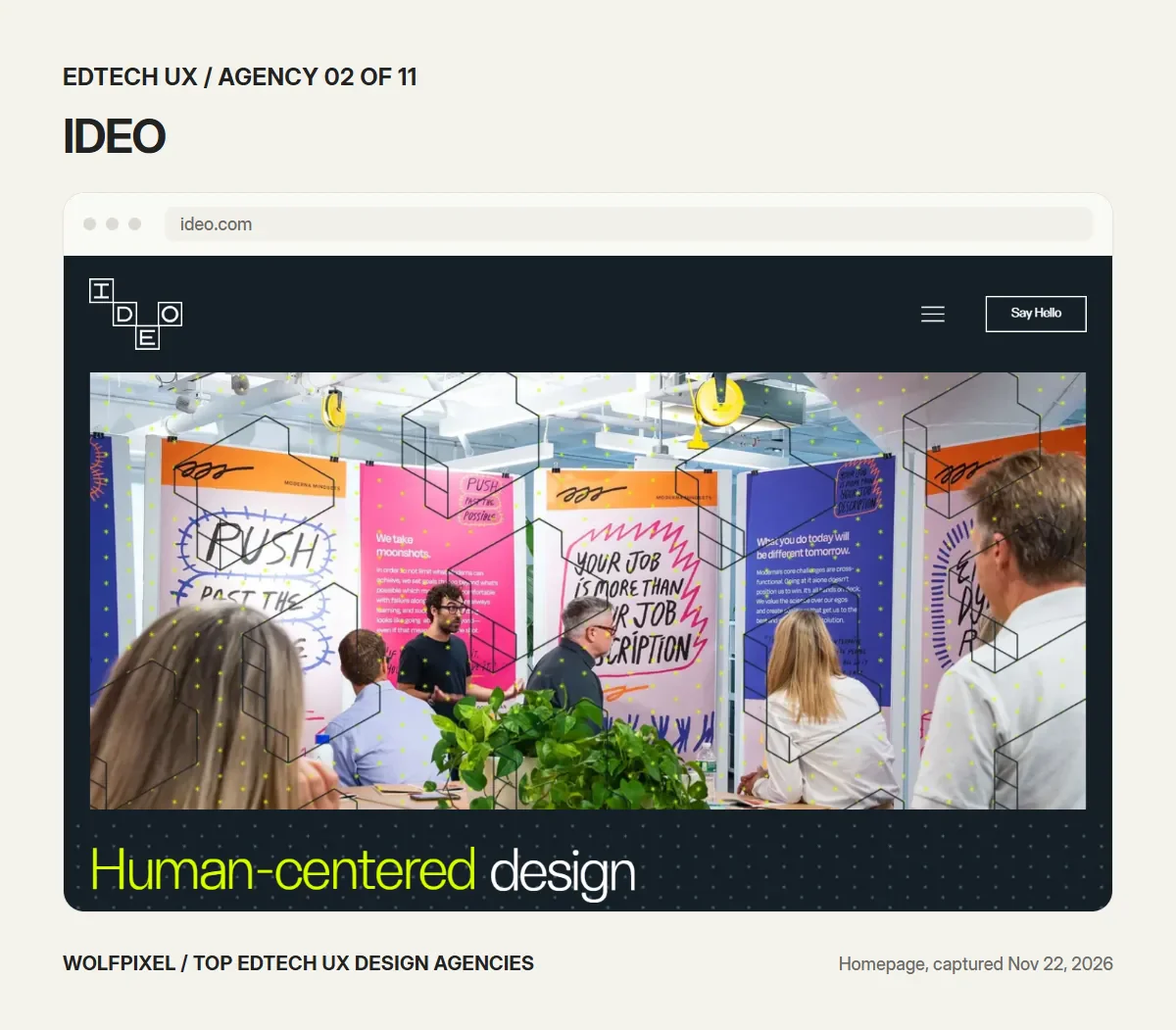
IDEO’s Ethiqly case study is the strongest public example of AI in learning design on this list. IDEO co-designed the product in classrooms with students and teachers, built working prototypes that were tested in schools, and created the brand. The AI suggests feedback on student writing, and teachers approve it before students see it. IDEO reports the product is now used in “25 countries” and was acquired by Carnegie Learning in 2026, “4 years from launch to acquisition”. For Taylor’s Education Group, IDEO designed the playbook for a new international school brand, Lexel, and reports “115% of Lexel’s student enrollment target reached during the launch year of its first campus” (case study).
Verify before hiring: IDEO’s Ethiqly work covered prototypes, a school beta and the brand. Confirm who would build and maintain your production product, and ask for a scoped estimate early, because Clutch lists no minimum.
3. Backpack Interactive
- Based in: Brooklyn, New York
- Team: a small team; Clutch lists 2 to 9 employees
- Clutch: 1 review; pricing undisclosed
- Best for: early-learning and accessible K-12 products
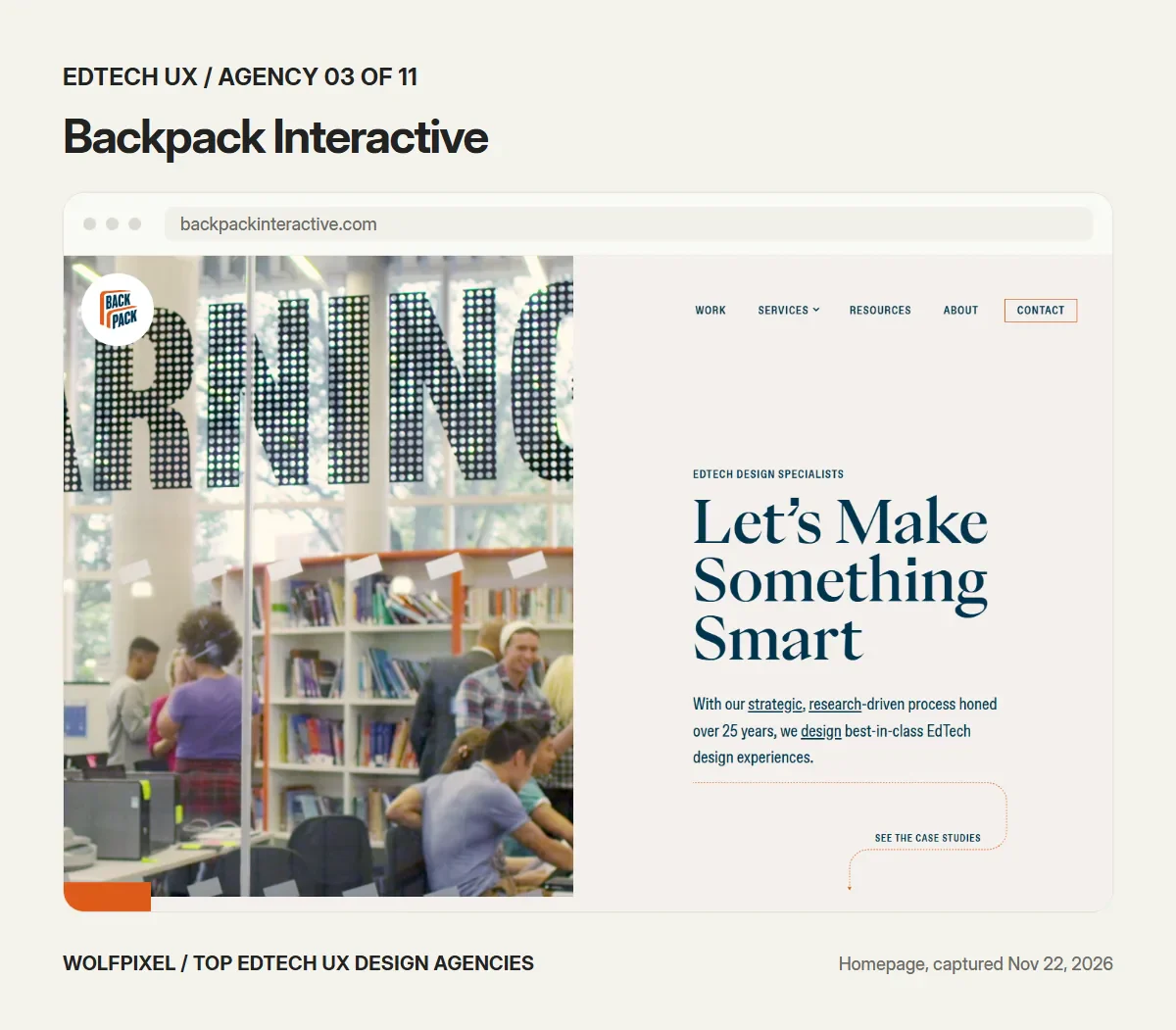
Backpack Interactive works only in EdTech, which is rare among the studios that rank for this topic. For Magpie Literacy, it designed Starwriter, a handwriting web app for Pre-K to first grade, including research, prototyping, usability testing, illustration, accessibility work and an educator portal; the case says it is used in classrooms in six states. For Learning Ally, it designed the LINK audiobook reader for students with dyslexia or visual impairments, and reports “over 1M pages read” since its 2016 launch. The studio has an accessibility and inclusion lead and runs a teacher council of educator advisors.
Verify before hiring: Backpack Interactive designs and hands off to your engineers. Plan for a separate development partner, and ask for references, since Clutch shows a single review.
4. Qubstudio
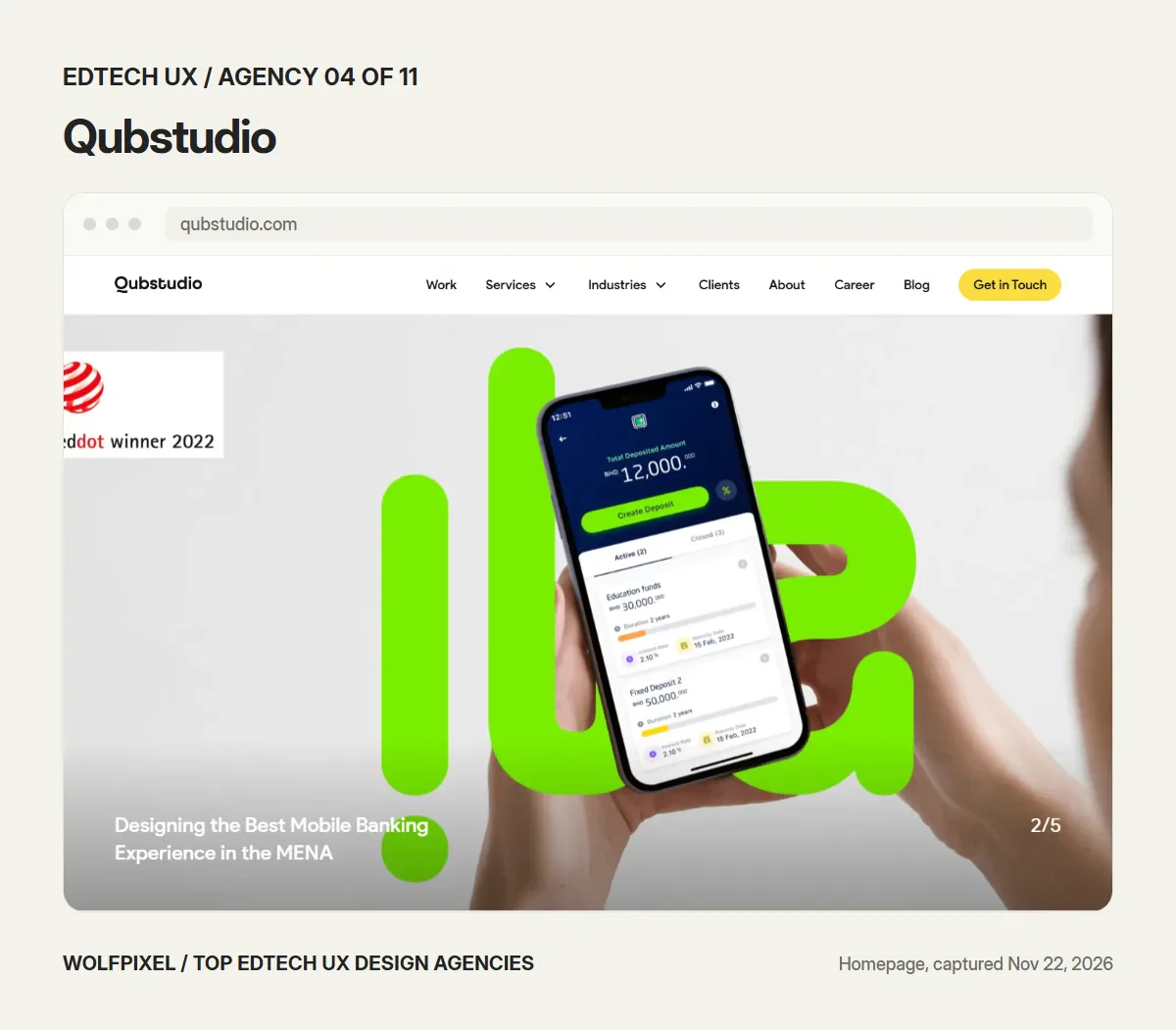
- Based in: Lviv, Ukraine, with a London office
- Founded: 2006 (Clutch)
- Clutch: 4.9 from 94 reviews, minimum $10,000+, $50 to $99 an hour, 50 to 249 employees
- Best for: K-12 assessment platforms and EdTech branding
Qubstudio’s education work centres on K-12 products. For LinkIt!, a K-12 assessment and data platform, it delivered a year-long rebrand and website and redesigned the TestTaker student exam platform, the Parent and Student Portal and the Staff Portal, which means work for students, families and school staff in one engagement. On its education UX page, Qubstudio says its work for Kide Science, a STEAM lesson platform, raised “the conversion rate … from 24% to 54% during one month”.
Verify before hiring: the Kide Science figure appears on a summary page without a full case study, so ask for the details behind it. The site describes both an end-to-end service and a team list without developers, so confirm who builds.
5. Substantial
- Based in: Seattle, Washington
- Founded: 2006
- Clutch: no reviews shown; minimum $50,000+, $150 to $199 an hour, 50 to 249 employees
- Best for: turning a research-backed learning program into a platform
Substantial designs and builds software, and its education cases show careful discovery before screens. For the University of Washington’s I-LABS, it ran a five-week discovery with 12 bilingual early-childhood educators, ruled out off-the-shelf LMS products in favour of an LMS API with a content system the team can edit, and built a bilingual English and Spanish platform (SparkLing case study). For the Bezos Family Foundation’s Vroom early-learning app, it removed the sign-in wall and added a content system with a tips database, and reports “32,000 new users at launch” (Vroom case study).
Verify before hiring: in 2026 Substantial repositioned itself as an “applied intelligence partner” focused on AI. Confirm that the team behind its education work is still available for your project.
6. Cieden
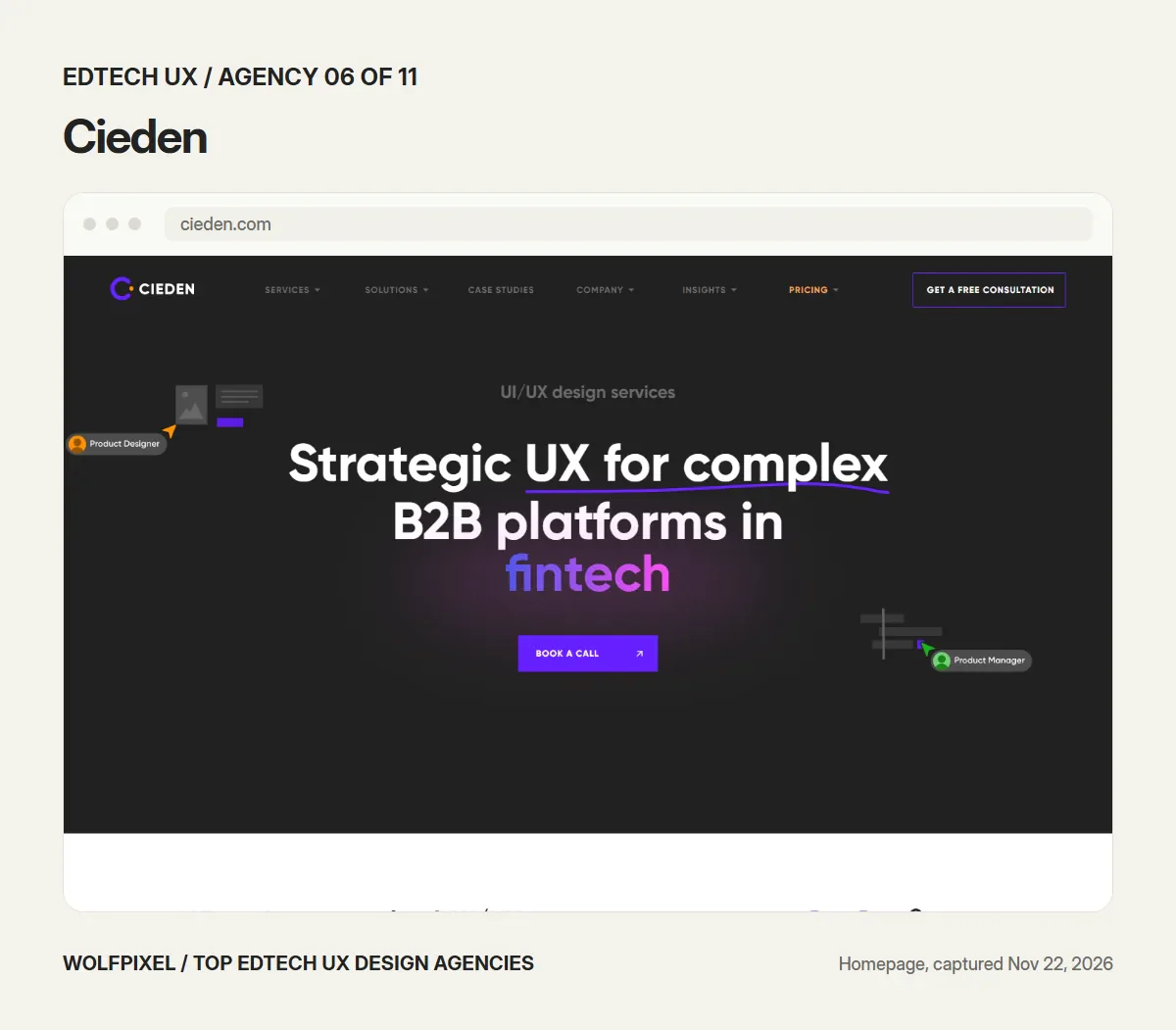
- Based in: Toronto, Canada, with offices in Wilmington (DE) and Lviv
- Founded: 2016 (Clutch)
- Clutch: 4.9 from 46 reviews, minimum $10,000+, $50 to $99 an hour
- Best for: test-prep and study-planning products
For MedEntry, which prepares students for medical school entry exams, Cieden ran a 12-month redesign of the web platform and designed a new mobile app, with a “My Journey” study plan, a calendar that syncs with Google Calendar, bookmarks and notes, a skill trainer, analytics, a leaderboard and game elements (case study). Its EdTech services page lists WCAG and ADA design, LMS and student information system work, and FERPA, COPPA and SOPIPA considerations.
Verify before hiring: the MedEntry case reports no outcome figures. Cieden also publishes its own ranking of EdTech design agencies with itself in first place, so read it as a competitor’s view. Ask for engineering references if you need the build.
7. Arounda
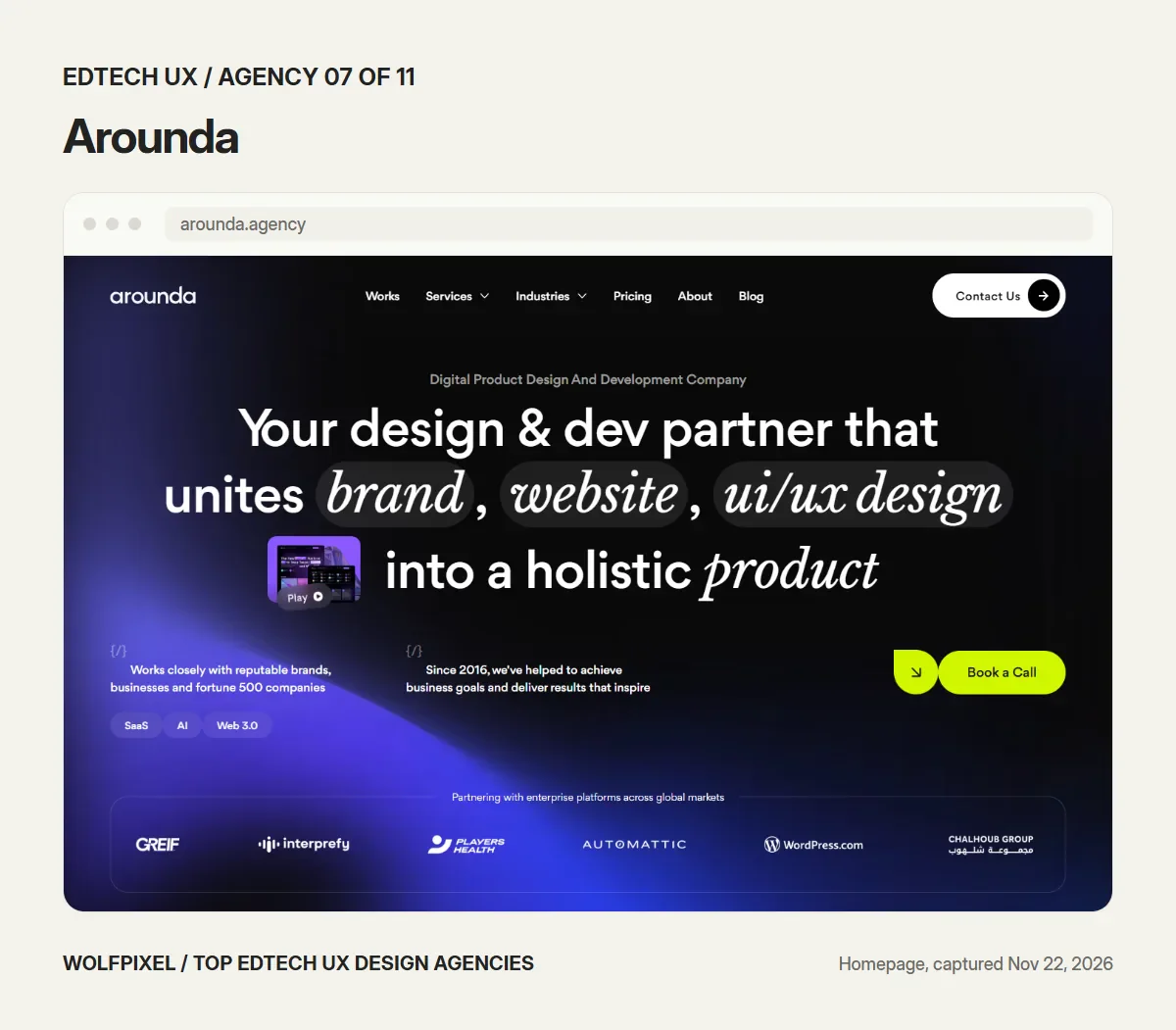
- Based in: Odesa, Ukraine, and Tallinn, Estonia
- Founded: 2016 (Arounda’s site)
- Clutch: 5.0 from 88 reviews, minimum $25,000+, $25 to $49 an hour
- Best for: habit-driven consumer learning apps
For Ohrbit, an online learning platform for Jewish study, Arounda unified the web, mobile and admin experiences, with a daily learning feed, progress tracking, a design system and an admin panel. It reports “+38% Daily learning activity”, “+31% Faster lesson completion”, “+42% Returning users” and “-28% Admin workload”, the clearest set of engagement results on this list. Arounda designs and develops.
Verify before hiring: Ohrbit is a consumer learning app, not school or university software, and the case does not say how the percentages were measured. Note that Arounda’s own pricing page says projects start “from $6,000”, while Clutch lists $25,000+.
8. UX studio
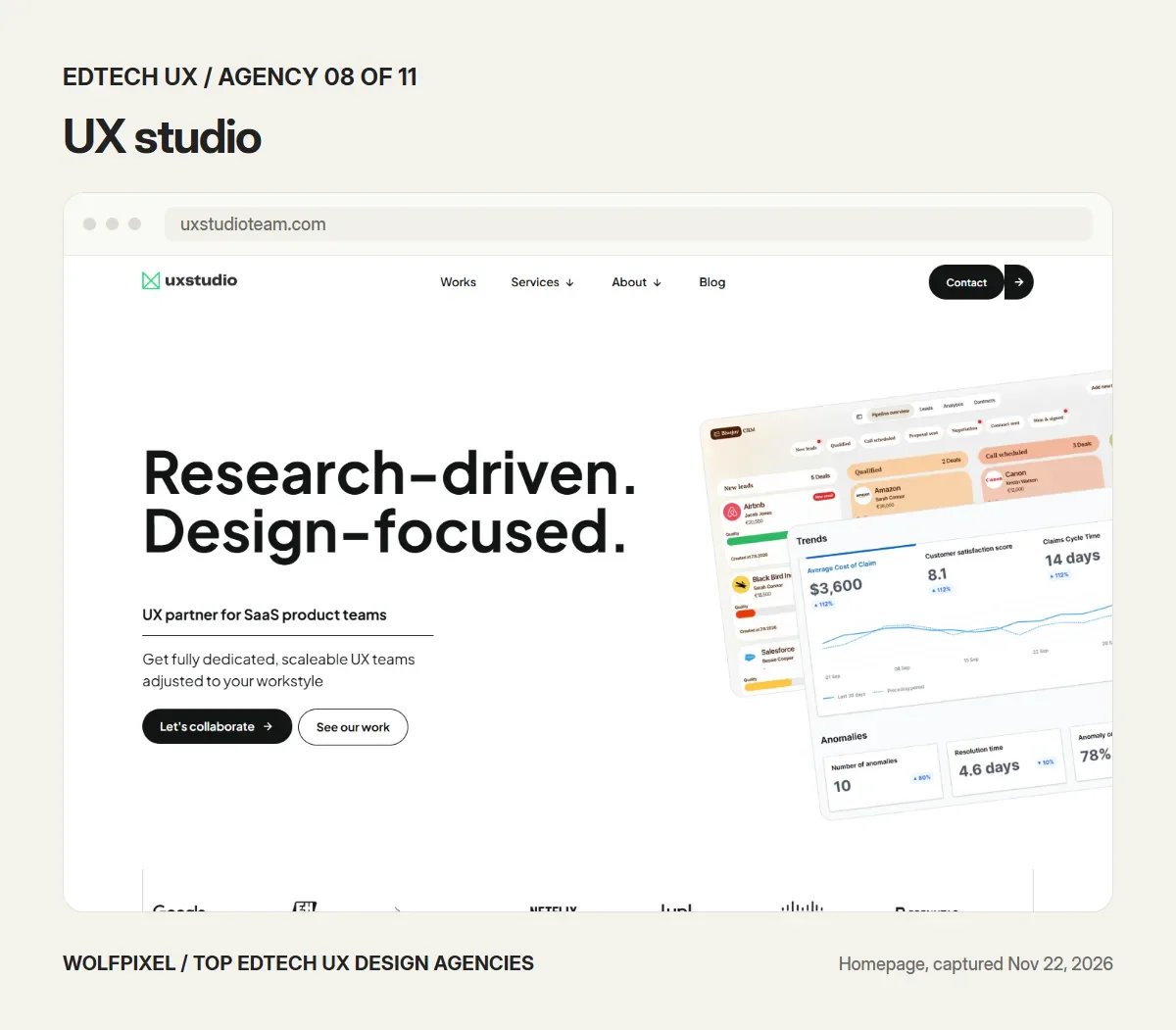
- Based in: Budapest, Hungary
- Founded: 2013
- Clutch: 5.0 from 41 reviews, minimum $10,000+, $50 to $99 an hour
- Best for: UX audits and research for learning platforms
UX studio is research-led. For a US college of music and performing arts, one researcher and one designer ran a four-week UX and UI audit of its learning platform, built a design system in Figma and fixed accessibility issues such as colour contrast and focus states. For Keystone’s Masterstudies website, it ran a year-long redesign across 44 languages (case study). The studio says it conducts research with children, and it offers front-end and back-end development.
Verify before hiring: the music college is under NDA, and the published results are outputs, such as an inventory and recommendations, rather than measured outcomes.
9. Slide UX
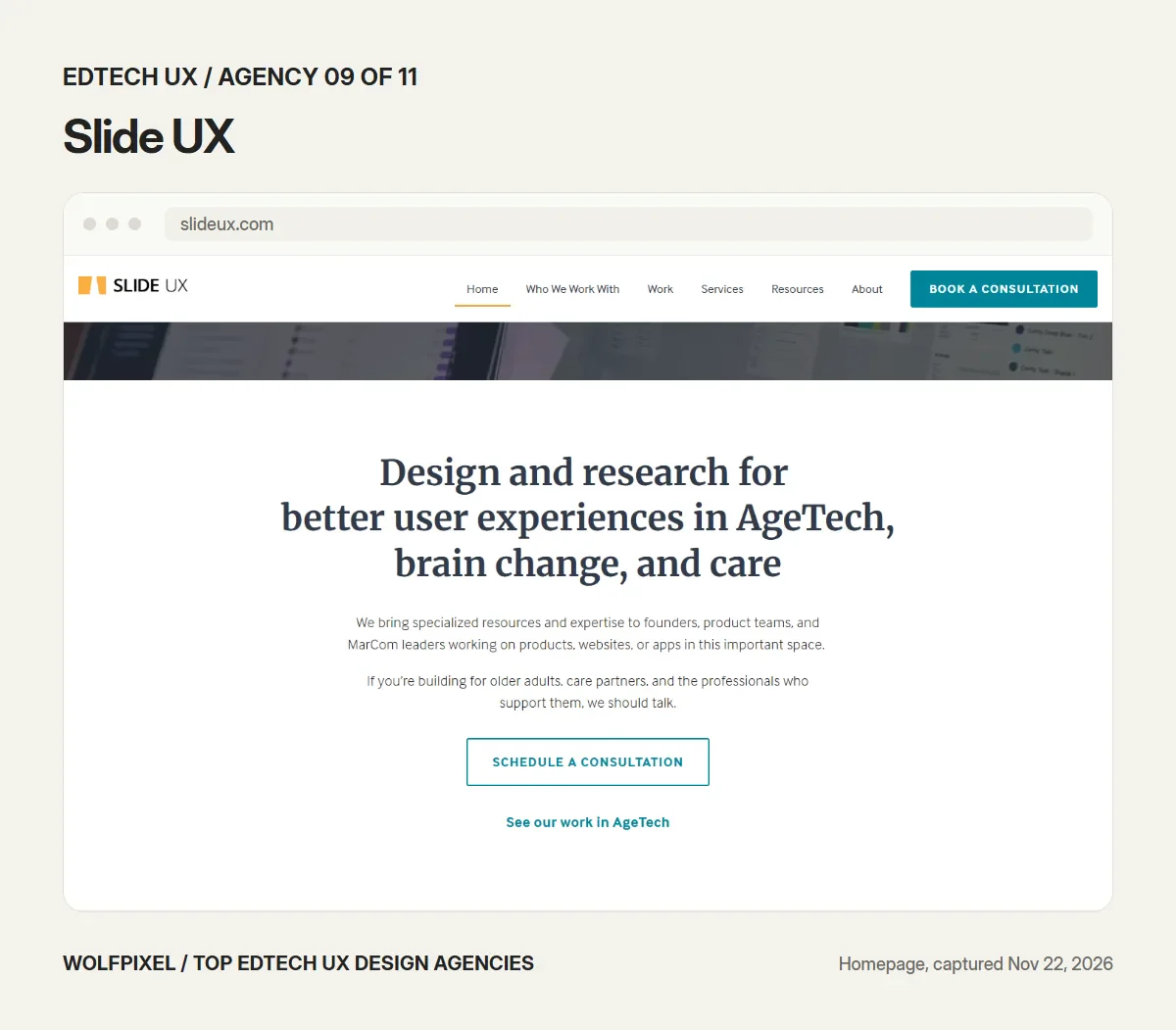
- Based in: Austin, Texas
- Founded: 2012
- Clutch: 4.9 from 72 reviews, minimum $5,000+, $150 to $199 an hour, 2 to 9 employees
- Best for: certification and high-stakes assessment experiences
For the American Board of Radiology, Slide UX redesigned the public website and the signed-in MyABR experience, and designed the Online Longitudinal Assessments that replace a once-a-decade in-person exam, with several rounds of user research (case study). On a separate page, Slide UX says adoption of the new signed-in experience “hit roughly 93%”, and describes usability interviews and design for a Harvard online learning portal with more than 250 courses (source). Slide UX designs and works with engineering partners.
Verify before hiring: the studio now positions itself mainly around products for older adults, and its education work is mostly professional certification rather than school learning.
10. Taoti Creative
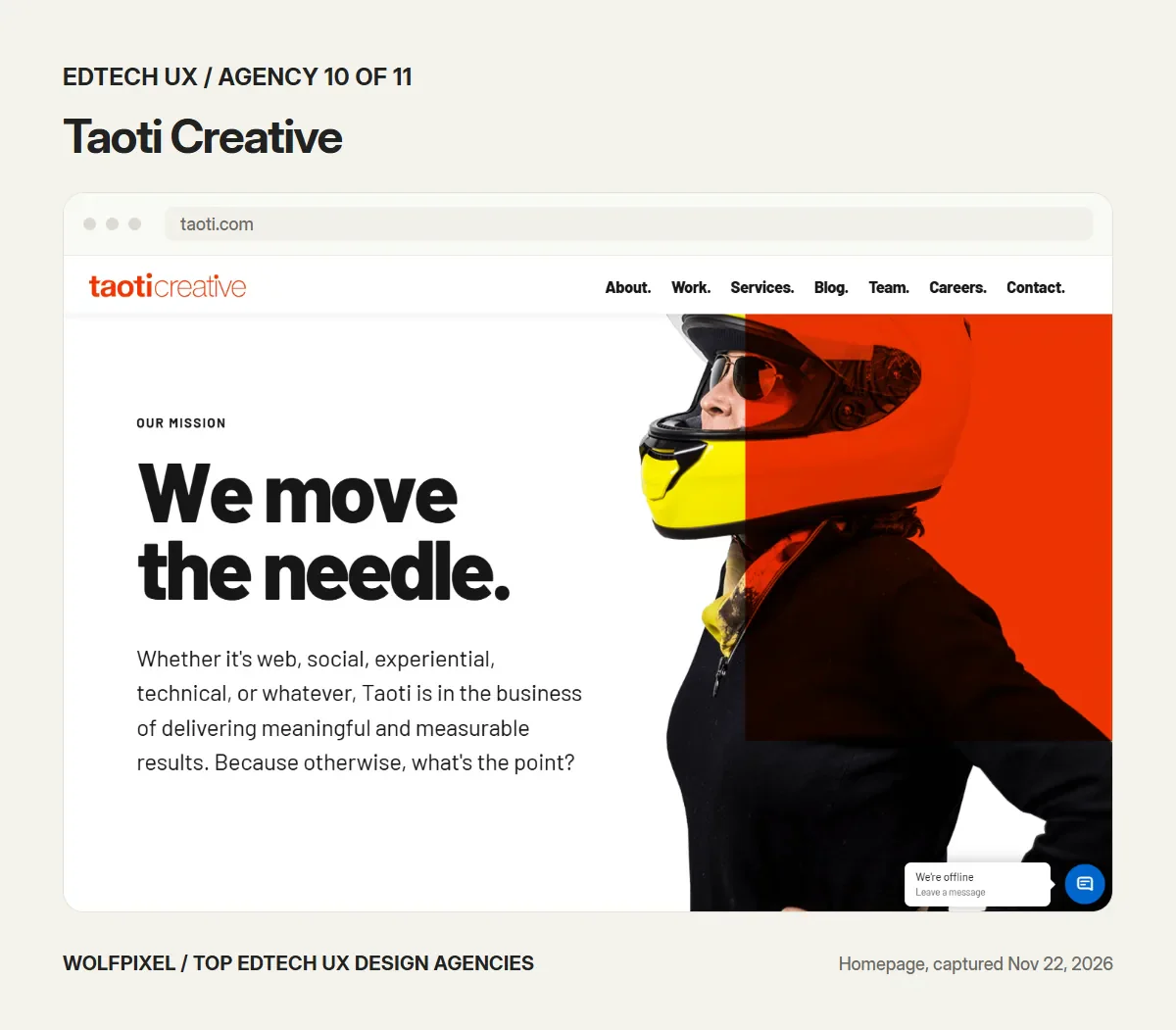
- Based in: Washington, DC
- Founded: 1996 (Clutch)
- Clutch: 4.9 from 16 reviews, minimum $25,000+, $150 to $199 an hour
- Best for: public-sector and higher-education web platforms that must meet Section 508
For the U.S. Department of Education, Taoti delivered the design and technical build of the student privacy website, a Section 508-compliant, responsive site built on the U.S. Web Design System, with a resource library, browsing by audience and a FERPA complaint path (case study). For Cornell University, it built the Global Learning site in Drupal, with pages for each audience (case study). Taoti designs and develops, including Drupal and WordPress.
Verify before hiring: on the Department of Education project, Taoti worked from wireframes supplied by a partner, so ask which parts of the design were its own. Its work is closer to education websites than to learning products.
11. Standard Beagle
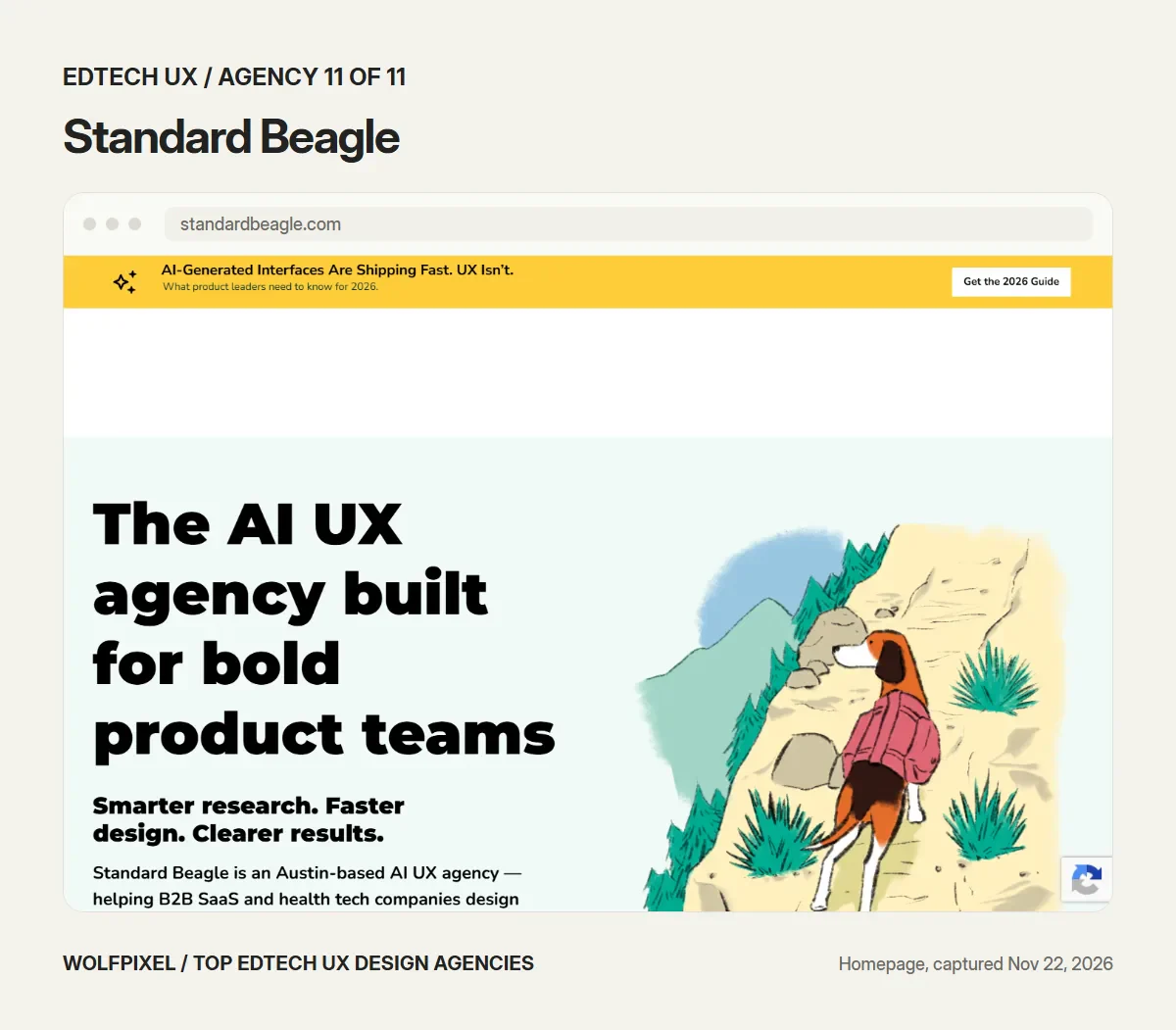
- Based in: Austin, Texas
- Founded: 2012 (Clutch)
- Clutch: 4.9 from 17 reviews, minimum $25,000+, $100 to $149 an hour, 2 to 9 employees
- Best for: workforce training and corporate learning platforms
For BuildWitt, a training platform construction companies use to train employees, Standard Beagle ran a six-month engagement covering UX research, a component guide for engineers and new features, including skills and certification tracking (case study). It reports research sessions “with 9 users, uncovering 75% of critical usability issues” and 11 actionable recommendations. The studio says its team is trained on WCAG and Section 508, and it offers development.
Verify before hiring: its only published learning case is workforce training, so it fits corporate learning better than K-12 or higher education.
Also considered: Lighthouse, a London studio whose Digital Theatre+ redesign served a video education platform for secondary and higher education, is now part of Digital Product People, so confirm who would staff the work. Edition, from Auckland, lists EdTech services, but its published education cases are mainly marketing websites, such as Kami’s.
EdTech UX design agencies compared
Clutch figures were checked on November 22, 2026. Hourly bands are in US dollars.
| Agency | Best for | Also builds? | Clutch min. | Hourly |
|---|---|---|---|---|
| Wolfpixel | Product UI, brand and website from one team | Yes | $1,000+ | $25–49 |
| IDEO | New classroom products, AI teaching tools | Prototypes | Not listed | Not listed |
| Backpack Interactive | Early learning, accessible K-12 | No | Not listed | Not listed |
| Qubstudio | K-12 assessment, EdTech branding | Confirm | $10,000+ | $50–99 |
| Substantial | Research programs turned into platforms | Yes | $50,000+ | $150–199 |
| Cieden | Test prep, study planning | On request | $10,000+ | $50–99 |
| Arounda | Habit-driven consumer learning apps | Yes | $25,000+ | $25–49 |
| UX studio | UX audits and research | Yes | $10,000+ | $50–99 |
| Slide UX | Certification and assessment | With partners | $5,000+ | $150–199 |
| Taoti Creative | Public-sector and higher-ed web platforms | Yes | $25,000+ | $150–199 |
| Standard Beagle | Workforce training platforms | Yes | $25,000+ | $100–149 |
Which agency fits your EdTech segment
The fastest way to narrow this list is to start with your segment, because each part of education has its own buyer and its own way to fail.
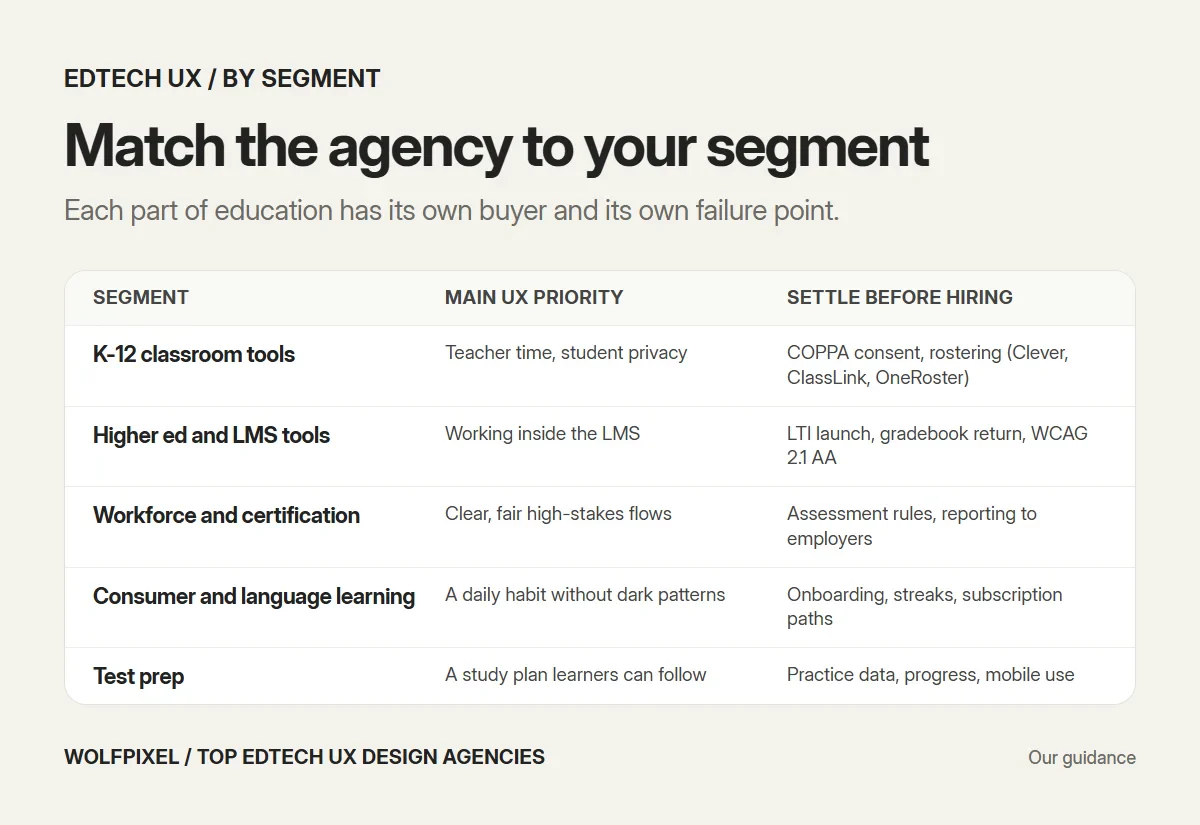
- K-12 classroom tools. Teacher time and student privacy decide adoption. Shortlist Backpack Interactive, Qubstudio and IDEO.
- Higher education and LMS tools. The product has to work inside the LMS and meet accessibility expectations. Shortlist UX studio and Taoti Creative, and ask Slide UX about its Harvard work.
- Workforce training and certification. Learners are adults under time pressure, and assessments must feel fair. Shortlist Standard Beagle and Slide UX.
- Consumer and language learning. The product competes with every other app on the phone. Shortlist Arounda and Substantial.
- Test prep. Learners need a plan they can follow and clear progress. Shortlist Cieden.
If you are an AI EdTech startup
AI tutors, feedback tools and course generators are now common in EdTech pitches, and buyers ask the same question each time: who controls what the learner sees? IDEO’s Ethiqly answers it in the workflow, because teachers approve AI feedback before students see it. Ask every agency how it would design that review step for your product.
EdTech AI startup website design is a separate job from the product. The site has to explain a new kind of tool to a cautious buyer, show the product working and answer privacy questions before the demo. If you need the product UI, the brand and the website together, choose a studio that does all three, or read our guide to SaaS web design agencies for the website side.
Rules that shape EdTech UX in 2027
Two rules changed what good EdTech design has to include, and both land on screens rather than only in policies.
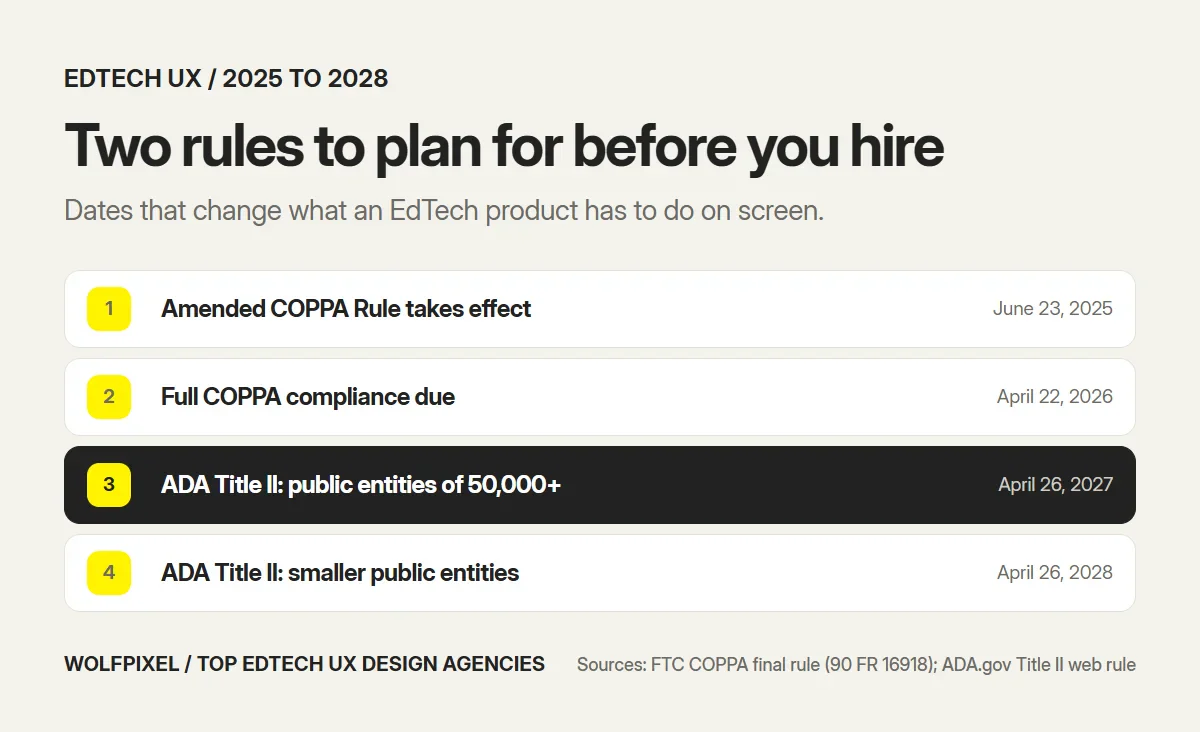
COPPA. The FTC’s amended Children’s Online Privacy Protection Rule took effect on June 23, 2025, and companies had until April 22, 2026 to comply fully. It requires separate verifiable parental consent before sharing a child’s personal information with third parties such as ad networks, and it requires a written security program for children’s data. Your agency should be able to show how consent, data choices and parent paths will look in the product (Federal Register, final rule).
ADA Title II. Public school districts and public colleges must make their web content and mobile apps meet WCAG 2.1 Level AA by April 26, 2027 if they serve 50,000 people or more, and by April 26, 2028 otherwise. The rule’s exceptions exclude third-party content only when it is not provided under a contract, license or other arrangement with the public entity, so licensed learning tools are part of the picture (ADA.gov). Expect public buyers to ask for accessibility documentation, and ask your agency who tests with assistive technology and who writes the conformance report.
FERPA still governs education records held by schools that receive federal funding, and vendors that handle those records work under the school’s rules (U.S. Department of Education).
None of this is legal advice. The design point is that privacy and accessibility decisions show up as screens, flows and copy, so they belong in the design brief.
How much EdTech UX design costs in 2027
The agencies in this guide list minimum project sizes on Clutch from $1,000+ to $50,000+. Hourly bands run from $25 to $49 at Wolfpixel and Arounda, $50 to $99 at Qubstudio, Cieden and UX studio, $100 to $149 at Standard Beagle, and $150 to $199 at Substantial, Slide UX and Taoti Creative.
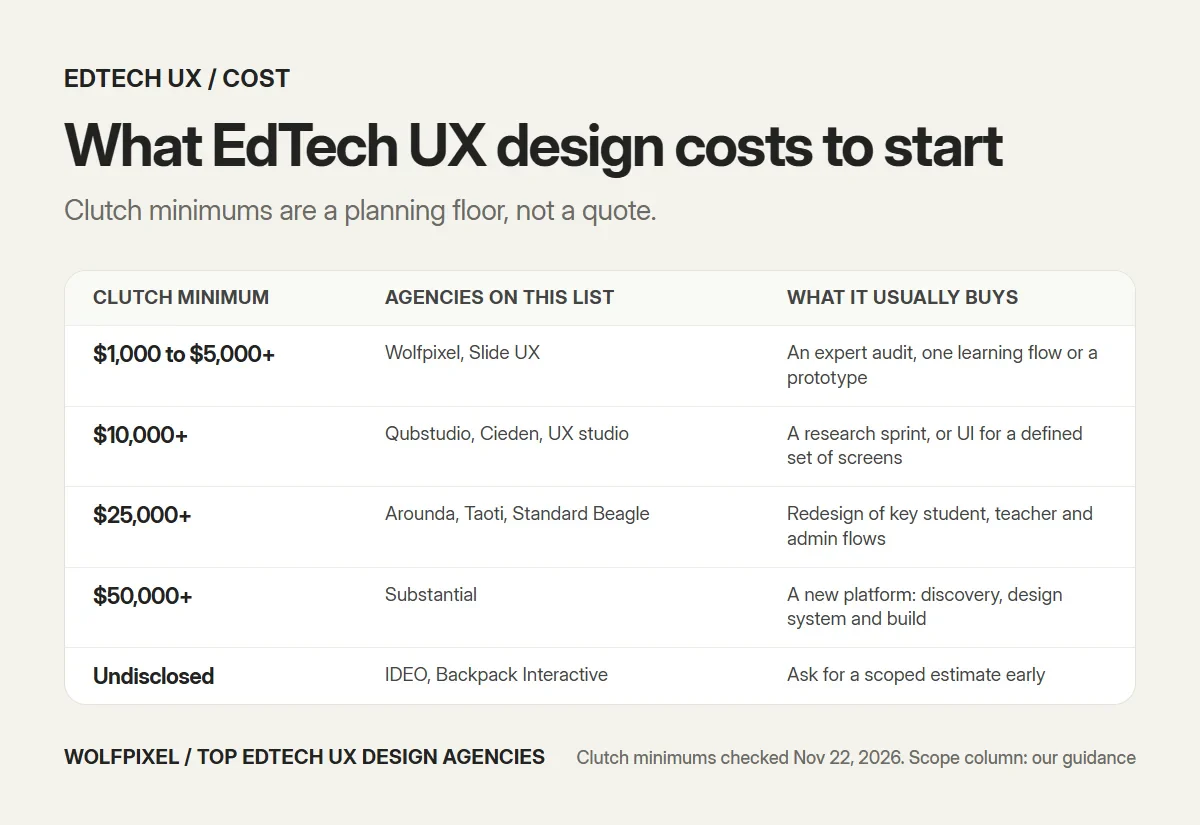
What moves the price is not the word EdTech. It is the number of user roles, the number of flows and screens, how much research is needed with each group, accessibility testing, integration work and whether the agency also builds. For broader benchmarks, see our UI/UX design cost guide.
Hire EdTech designers in-house, freelance or through an agency?
Most teams that search for how to hire EdTech designers are choosing between three models:
- In-house designer. Best when you have years of continuous product work and can give one person deep context. Slow to hire, and one person rarely covers research, UI and accessibility well.
- Freelancer. Good for a defined piece of work, such as a set of screens. Harder when you need research with teachers and administrators, a design system and steady capacity. Our guide to design agencies versus freelancers covers the trade-offs.
- Agency. Best when you need several skills at once, a redesign on a deadline, or research across user groups. You pay more per hour and get a team.
A common pattern is an agency for discovery and the design system, then an in-house designer to carry it forward. If time zones worry you, our guide to remote versus local design teams explains what overlap you actually need.
Questions to ask before you sign
Use these with every agency on your shortlist. The answers separate studios that have done EdTech from studios that have done websites for EdTech companies.
- Which user groups did you research with on your last education project: students, teachers, administrators, parents?
- Show us a teacher or admin workflow you designed, not only a learner screen.
- How will the product launch from an LMS, sign people in and return grades?
- What is your accessibility target, who tests with assistive technology and who writes the conformance report?
- How will consent, data choices and parent access appear on screen?
- How do you design AI features so a teacher can review what students see?
- How did you measure the result you quote in your case study?
- Who designs, who builds, and who maintains the product after launch?
- How will you plan research and launch around the school year?
Red flags when choosing an EdTech design agency
- Marketing sites presented as EdTech product work. A course landing page is not a learning product.
- Research with students only. No teachers, administrators or parents in the plan.
- Accessibility left until the end. No target, no assistive-technology testing, no documentation plan.
- Vague answers on student data. No view on consent or on what data the product collects.
- Integrations left to “the developers”. LMS, rostering and sign-in are where adoption is won or lost.
- Engagement tricks with no link to learning. Streaks and badges that do not change completion.
- A launch plan that ignores the school calendar. Shipping a redesign in exam season.
Building an EdTech product, or a website for your school?
This guide is about agencies that design learning products. If you run a school, college or education organization and need a better website for families and students, that is a different job, with different priorities: admissions, programs, calendars and a site your own staff can update. Our education web design agency page explains how we design and build those websites, with published prices and timelines.
How Wolfpixel works with education teams
We are a senior design team, so the designer you meet on the first call does the work. For EdTech companies, that usually means product UI for learners, teachers and admins, the brand and the marketing website from one team, so the product, the site and the sales deck look like one company. We start with research, which our guide to types of UX research explains, and we offer UX research, a UX audit of an existing product, and full UI/UX design.
If your product is live, send it to us. We will tell you where we think learners, teachers or admins get stuck and what a fixed-price fix would cost.
Sources and method
We reviewed every source below on November 22, 2026. Clutch figures are from each agency’s Clutch profile on that date and change often, so check them again before you decide.
- Agency case studies, linked in each entry above.
- Clutch profiles: Wolfpixel, IDEO, Backpack Interactive, Qubstudio, Substantial, Cieden, Arounda, UX studio, Slide UX, Taoti Creative, Standard Beagle.
- Federal Trade Commission: Children’s Online Privacy Protection Rule, final rule (Federal Register, April 22, 2025), for the effective and compliance dates and the consent and security requirements.
- U.S. Department of Justice, ADA.gov: Fact sheet on the Title II web and mobile app rule, for WCAG 2.1 AA and the 2027 and 2028 compliance dates.
- U.S. Department of Education: FERPA.
- 1EdTech: Learning Tools Interoperability and OneRoster.
- Ranking pages reviewed for coverage and gaps: UX Planet, Top UX Design Agencies, Cieden, Edition, Insivia and UX Agencies.
The segment guidance, the questions to ask, the red flags and the cost column labelled “what it usually buys” are our own recommendations from designing products and websites for education and software companies.
EdTech UX Design Agency FAQs
What does an EdTech UX design agency do?
An EdTech UX design agency researches, designs and tests learning products for everyone who uses them, usually learners, teachers, administrators and parents or IT staff. The work covers learning flows, teacher tools, admin dashboards, onboarding, accessibility, privacy and consent screens, and the moments where the product meets school systems such as the LMS, single sign-on and rostering. Some agencies also build the product.
Which is the best EdTech UX design agency for 2027?
It depends on what you are building. For a new classroom product or an AI teaching tool, IDEO has the strongest public case. For early learning and accessibility, look at Backpack Interactive. For K-12 assessment, Qubstudio. For test prep, Cieden. For workforce training, Standard Beagle. For product UI, brand and website from one senior team at a lower starting price, Wolfpixel.
How much does EdTech UX design cost?
The minimum project sizes listed on Clutch for the agencies in this guide run from $1,000+ to $50,000+, and two agencies do not disclose a minimum. Hourly bands run from $25 to $49 up to $150 to $199. As a planning guide, an audit or one learning flow can start in the low thousands, a set of core student, teacher and admin flows usually starts around $25,000, and a new platform with a design system and build often starts at $50,000 or more.
How long does an EdTech UX design project take?
A focused audit or research sprint usually takes four to six weeks. UX studio’s audit for a US music college took four weeks, and Substantial’s discovery for I-LABS took five. A redesign of a live platform often takes several months; Standard Beagle’s engagement with BuildWitt ran six months and Cieden’s MedEntry redesign twelve. Plan launches around the school year, not just the sprint plan.
Do EdTech products need to follow COPPA and FERPA?
Often, yes. FERPA protects education records held by schools that receive federal funding, so vendors who handle those records must follow the school’s rules. COPPA applies to online services directed at children under 13. The FTC’s amended COPPA Rule took effect on June 23, 2025, with full compliance due by April 22, 2026, and it requires separate parental consent before sharing children’s data with third parties such as ad networks. Ask a lawyer about your product; ask your design agency how consent and privacy will appear on screen.
Does the ADA Title II web rule apply to EdTech vendors?
The rule applies to state and local governments, which includes public school districts and public colleges, and it covers web content and apps they provide through contracts and licenses as well as their own. Large public entities must meet WCAG 2.1 Level AA by April 26, 2027 and smaller ones by April 26, 2028. In practice, public buyers will expect the learning tools they license to meet that standard, so plan accessibility testing and documentation into your design work.
Should we hire EdTech designers in-house or work with an agency?
Hire in-house when you have continuous product work and can keep a designer busy for years. Use an agency when you need research with several user groups, a redesign on a deadline, or skills your team lacks, such as accessibility or design systems. Many EdTech teams do both, with an agency setting up the research and the design system and an in-house designer carrying it forward.
What is the difference between an EdTech UX agency and an education web design agency?
An EdTech UX agency designs software that people learn with, such as learning platforms, assessment tools and classroom apps. An education web design agency designs the websites that schools and colleges use to reach families and students, such as admissions, programs and calendars. Some studios do both, but the skills and the buyers are different, so make sure the agency you choose has done the kind of work you need.
Building a learning product and not sure where users get stuck?
Send us your product or prototype. A senior designer replies within 4 business hours with the flows we would look at first, for learners, teachers and admins, and a fixed quote.

Was this article helpful?

Written by
Maniruzzaman Jubayer
Co-founder & COO | Product Design Specialist at Wolfpixel
Maniruzzaman Jubayer is Wolfpixel’s Co-founder & COO and a product design specialist with 7 years of experience. He oversees website, app, dashboard and digital product design at Wolfpixel, including work for education companies such as Inclass, Leurniq and TechScholars. This guide is for EdTech founders and product leads choosing a design partner. Wolfpixel appears on the list, and the entry says so.
View all articles