
 12 min read
 Published
SaaS product development is the process of planning, designing, building, launching and continuously improving software that you host and sell on a subscription. It runs through eight stages, from validating the idea to measuring how customers use the product, and unlike most software projects it doesn’t end at launch.
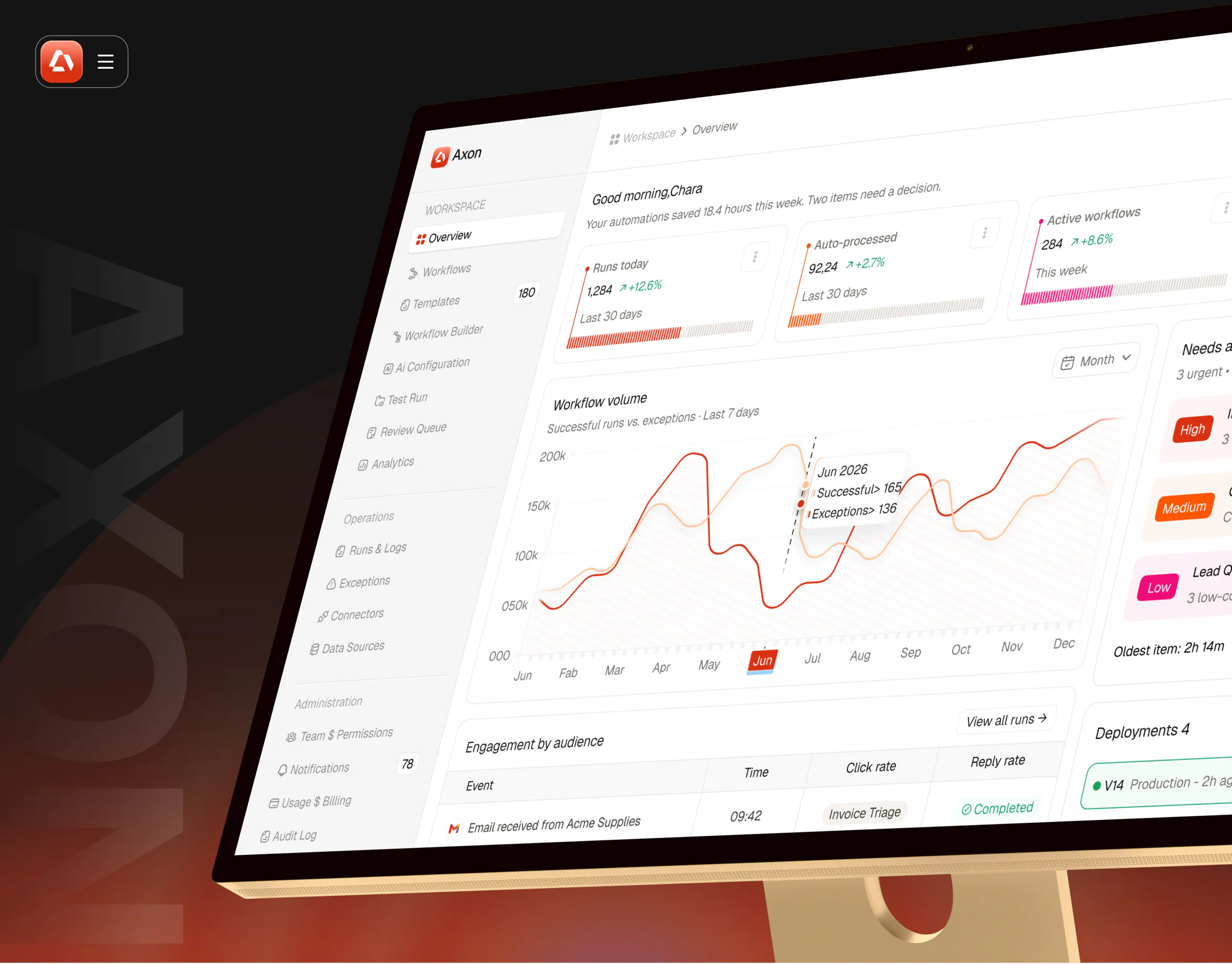
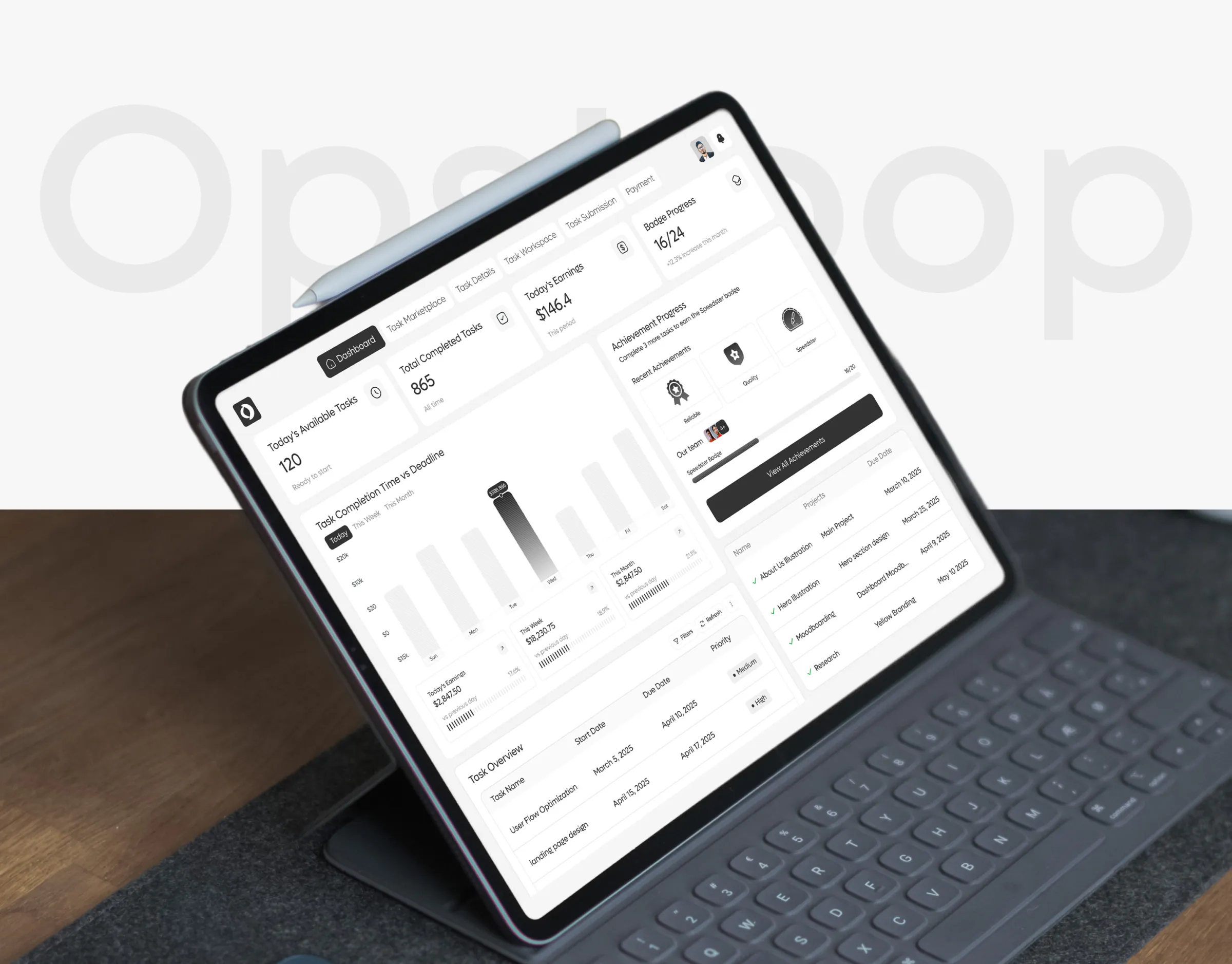
I’m Maniruzzaman Jubayer, Co-founder & COO and Product Design Specialist at Wolfpixel, with 7 years of experience. We design SaaS products at every stage, from first screens for founders to redesigns of products like OpsLoop and Alignify. Most guides to this topic are written by development shops and treat design as a step between requirements and code. This one shows where design decisions actually change the outcome.
The short answer: SaaS product development moves through eight stages: discovery and validation, MVP scoping, UX and UI design, architecture, build and QA, security and compliance, launch and onboarding, then measuring and iterating. The order matters less than the loop. Each release should end with data that shapes the next one.
Key takeaways:
- Validate the problem before you scope the product. Interviews are cheaper than code.
- A SaaS MVP needs more than its core feature: accounts, team invites, roles, billing and analytics.
- Prototype the core flow before engineering starts. It is the cheapest place to find mistakes.
- Business customers will ask security questions early. Plan for them in scope, not after the first deal stalls.
- Launch is the start of the loop. Activation and retention data decide what you build next.
How we wrote this: we reviewed the guides ranking for this topic in November 2026 and the architecture guidance from AWS and Microsoft they rely on. Durations, team sizes and the “can’t skip” list are our own estimates from SaaS projects we have designed, and we label them that way. The full list is in Sources and method.
What is SaaS product development?
SaaS product development covers everything it takes to create and run a software-as-a-service product: research, design, engineering, infrastructure, security, launch and ongoing improvement.
It differs from a typical software project in four ways:
| Typical software project | SaaS product | |
|---|---|---|
| Hosting | Installed by or for the customer | Run by you, for every customer |
| Customers | One client or one install base | Many customers on one system |
| Revenue | One-off fee or license | Recurring subscription |
| Finish line | Delivery | None. The product updates continuously |
Those four differences add work that a one-off project doesn’t have: multi-tenancy, billing, account and team management, onboarding and continuous delivery. AWS describes SaaS as more of a business model than an architecture strategy, and that is the right way to think about development too. Every stage serves the subscription.
If you’re building for businesses, our guide to what B2B SaaS is explains the buying committee and metrics that shape these stages.
The 8 stages of SaaS product development at a glance
| # | Stage | Main output | Led by | Typical time (our estimate) |
|---|---|---|---|---|
| 1 | Discovery and validation | Validated problem and target customer | Founder or product lead | 2 to 6 weeks |
| 2 | MVP scoping | A prioritized scope and success metric | Product lead | 1 to 2 weeks |
| 3 | UX and UI design | Flows, prototype, product UI, design system | Product designer | 2 to 6 weeks |
| 4 | Architecture | Tenancy model, stack, data design | Tech lead | 1 to 3 weeks, overlapping design |
| 5 | Build and QA | Working, tested product | Engineering | 2 to 4 months for an MVP |
| 6 | Security and compliance | Security basics and documentation | Tech lead | Ongoing from build |
| 7 | Launch and onboarding | Live product, first customers activated | Product and growth | 2 to 4 weeks |
| 8 | Measure and iterate | Data-backed roadmap | Whole team | Continuous |
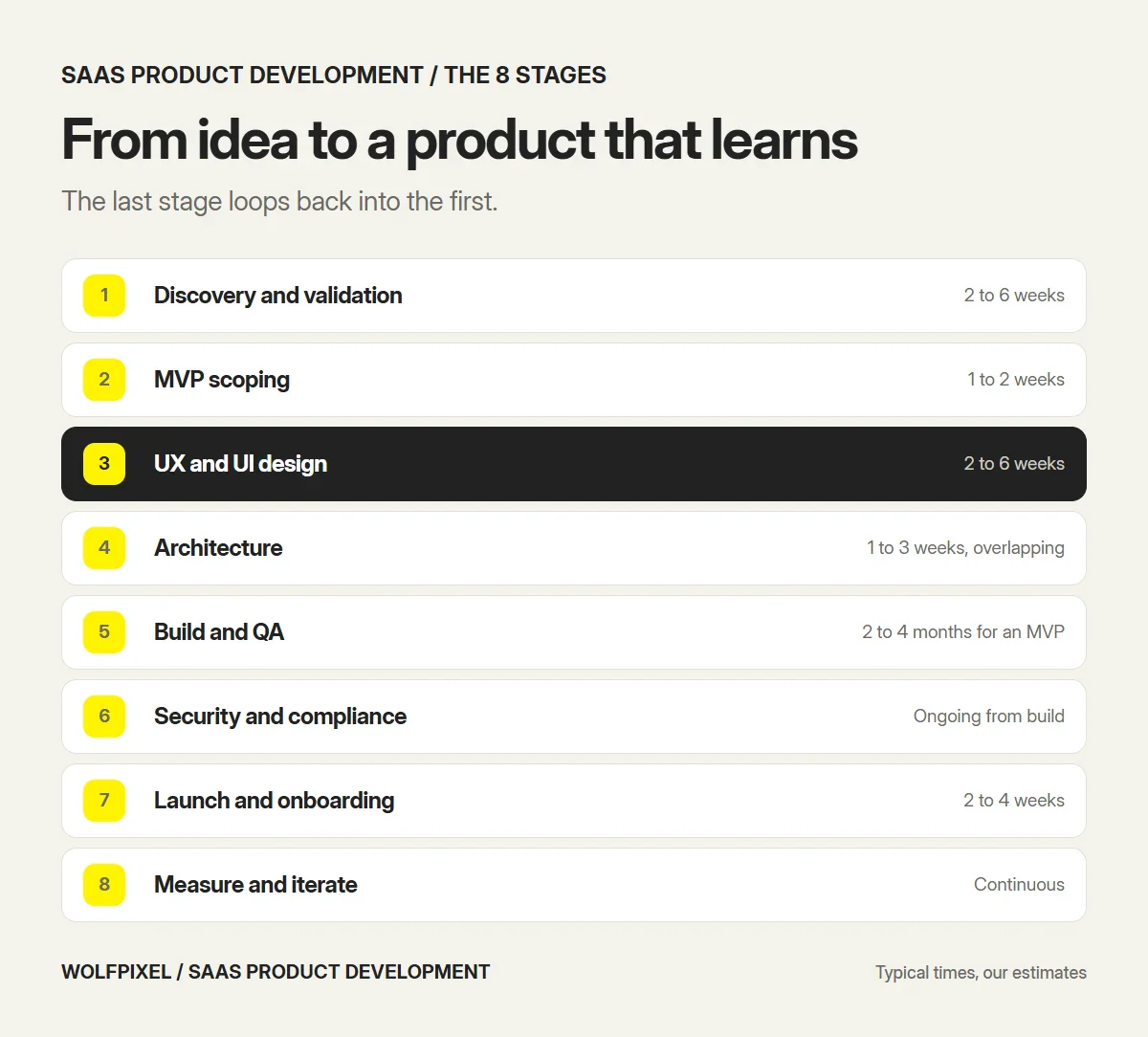
Times vary a lot with scope and team size. Treat them as a planning range, not a promise.
Stage 1: Discovery and validation
Discovery answers one question: is this problem painful enough that a specific group of customers will pay to solve it?
- Talk to potential customers. Not about your idea, but about how they handle the problem today, what it costs them and what they have already tried.
- Map who buys and who uses. In B2B SaaS these are often different people. A product the user loves can still stall if the budget owner or IT can’t see its value.
- Study the alternatives. Competitors, spreadsheets and “we just live with it” are all competition.
- Test willingness to pay. A landing page with pricing, pre-orders or letters of intent tell you more than “I’d use that.”
The output is a short, written statement of the problem, the customer and the evidence. If you can’t write it, you aren’t ready to scope. If you need help running the interviews, that is what our UX research service does.
Stage 2: Scope the MVP
The MVP is the smallest product that tests your riskiest assumption with real customers. Our guide on what MVP means in software development covers the idea in depth. For SaaS, the trap is scoping only the core feature and forgetting what a subscription product needs around it.
| A SaaS MVP can’t skip | Why |
|---|---|
| Secure sign-up and login | Customers trust you with their data from day one |
| Team invites and basic roles | B2B software is used by teams, not individuals |
| Billing or a clear path to paying | You need to know whether people will pay |
| A simple account area | Customers need to manage users, plans and settings |
| Product analytics | Without data, the MVP can’t teach you anything |
| Basic security answers | Business buyers ask before they sign |
Everything else, such as integrations, advanced reporting, custom roles and white-labeling, can usually wait until customers ask for it.
Stage 3: UX and UI design
Design is where the scope becomes something people can use, and it is the cheapest stage to change your mind in. A screen redesigned in Figma costs hours. The same change after it ships costs a sprint.
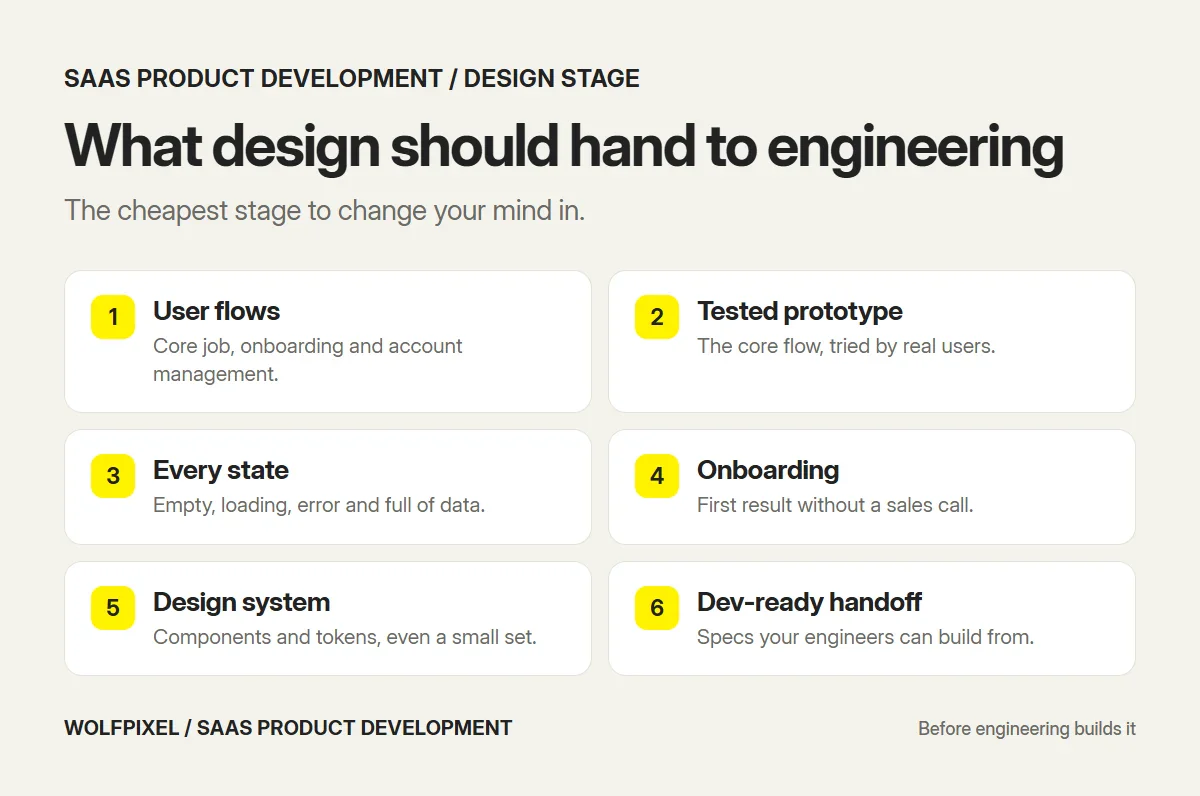
What design should deliver before engineering builds:
- User flows for the core job, onboarding and account management.
- A clickable prototype of the core flow, tested with real users. Our guide on what a software prototype is explains which fidelity to use.
- Product UI for every state: empty, loading, error and full of data.
- Onboarding that gets a new account to its first result without a call.
- A design system, even a small one, so new features stay consistent.
- A dev-ready handoff with specs and components your engineers can build from.
The full design process is in our SaaS design guide. The key point for development planning is timing: design should start during scoping and stay one step ahead of engineering, not be squeezed in between them.
Stage 4: Architecture and tenancy
Architecture decisions are expensive to reverse, so they deserve time early. The biggest SaaS-specific one is tenancy: how customers share the system.
Microsoft’s guidance describes a spectrum of tenancy models, from a separate deployment for each customer to a fully shared multitenant system, and notes that in B2B SaaS a tenant is usually a customer organization with many users. Shared systems cost less to run. Separate ones are easier to sell to customers with strict data rules. Many products start shared and offer dedicated options to enterprise customers later.
Other early decisions: the tech stack, how data is separated per customer, how you deploy updates without downtime, and how you will bill.
Stage 5: Build and QA
With a tested design and an agreed architecture, the build is mostly execution. A few practices make it smoother:
- Build in short cycles and demo working software every week or two.
- Build the core flow first, end to end, before widening scope.
- Automate tests for sign-up, billing and permissions. These break quietly and cost customers.
- Keep the designer involved. Questions come up during build. Answering them in hours prevents guesses that become permanent.
Stage 6: Security and compliance
Business customers will ask how you protect their data, often before they sign. Plan for it from the build stage:
- Encrypt data in transit and at rest.
- Offer strong authentication, and single sign-on once you sell to larger companies.
- Keep audit logs of important actions.
- Document how you handle data, backups and incidents.
Larger customers often ask for a SOC 2 report or a security questionnaire. You don’t need everything on day one, but knowing what your target customers will ask stops a promising deal from stalling in review.
Stage 7: Launch and onboarding
Launch is less a date than a sequence: a private beta with design partners, a wider release, then public availability. What decides whether launch works is onboarding. A new account that never reaches its first result will churn, however good the product is.
Design the first session around one moment of value, remove every setup step that can wait, and use empty states to guide rather than to apologize. Our guide to SaaS user onboarding covers this stage in detail.
Stage 8: Measure and iterate
After launch, SaaS product development becomes a loop: measure, learn, decide, ship. The metrics that matter most early on:
| Metric | What it tells you |
|---|---|
| Activation rate | Share of new accounts reaching the first meaningful result |
| Time to value | How long that takes |
| Retention | Share of accounts still active after one, two or three months |
| Trial-to-paid conversion | Whether people will pay |
| Net revenue retention | Whether existing customers grow over time |
Pair the numbers with conversations. Data tells you where users drop. Interviews and session recordings tell you why. For a product that is already live, a UX audit is a fast way to find where users drop. Each cycle should end with a decision about what to build, change or remove next.
The team you need at each stage
| Stage | Core roles |
|---|---|
| Discovery | Founder or product lead, product designer or researcher |
| Scoping | Product lead, tech lead, designer |
| Design | Product designer, with product and tech lead reviews |
| Architecture and build | Tech lead, 2 to 3 engineers, part-time QA |
| Security | Tech lead, with outside help for audits |
| Launch and iterate | Product lead, designer, engineers, customer success |
These are typical early-stage team shapes from our experience, not a rule. Small teams combine roles. Larger ones add DevOps, data and security specialists.
In-house, agency or low-code?
| Option | Best for | Trade-off |
|---|---|---|
| In-house team | Long-term products with funding to hire | Slow to hire, expensive before product-market fit |
| Agency or specialist partner | Fast access to senior skills for a defined phase | You need to own product decisions yourself |
| Hybrid | Most early SaaS companies | Needs clear handoffs between partners |
| Low-code or no-code | Testing demand before building properly | Limits on scale, customization and security |
Many founders keep product ownership and engineering in-house and bring in a specialist for design or a first build. Our comparison of design agencies, freelancers and in-house teams goes deeper on that choice.
Common SaaS product development mistakes
- Building before validating. Months of engineering on a problem nobody pays to solve.
- Scoping only the core feature. Then discovering billing, invites and roles in week ten.
- Skipping the prototype. Finding usability problems after they are coded.
- Treating launch as the finish line. No analytics, no onboarding, no plan for what to learn.
- Ignoring the buyer. A product users like but IT can’t approve won’t close in a business deal.
Where Wolfpixel fits
We work at stage 3 and stage 8 most: designing the product before it is built, then refining it once real data comes in. Our SaaS product design service designs onboarding, dashboards, roles and billing as one product, then stays for 30 days after launch to refine it on usage data. For earlier founders, product design starts at $3,150 for up to 10 screens, with first screens in your Figma within 7 days.
Sources and method
We reviewed every source below in November 2026.
- AWS: SaaS architecture fundamentals, for SaaS as a business model and multi-tenancy.
- Microsoft Learn: tenancy models for multitenant solutions, for the tenancy spectrum and tenants in B2B SaaS.
Our own estimates
- The stage durations, team shapes and the list of what a SaaS MVP can’t skip, based on SaaS projects we have designed.
- Wolfpixel’s timelines and prices, from our SaaS design and product design pages.
SaaS Product Development FAQs
What is SaaS product development?
SaaS product development is the process of planning, designing, building, launching and continuously improving software that is hosted by the vendor and sold on a subscription. Unlike a one-off software project, it never really ends, because the product is updated for every customer after launch.
What are the stages of SaaS product development?
The common stages are discovery and validation, MVP scoping, UX and UI design, architecture, build and QA, security and compliance, launch and onboarding, and measuring and iterating. In practice the last stage loops back into the earlier ones for every new feature.
How long does it take to develop a SaaS product?
A focused MVP usually takes a few months from validated idea to launch, depending on scope, team size and how much is reused. Design for an MVP often takes weeks, not months. A mature product takes years, because SaaS development continues after launch.
How is SaaS development different from other software development?
SaaS products are hosted by the vendor, serve many customers from one system, charge recurring subscriptions and update continuously. That adds work most projects don’t have, such as multi-tenancy, billing, account and team management, onboarding and the security reviews business customers ask for.
What features does every SaaS MVP need?
Beyond its core feature, a SaaS MVP needs secure sign-up and login, a way to invite teammates, basic roles, billing or a clear path to paying, a simple account area and analytics to see whether users get value. Business customers will also ask about data security early.
What team do you need to build a SaaS product?
A typical early team has a product lead, a product designer, two or three engineers covering front end and back end, and part-time QA. As the product grows, teams add DevOps, data, security and customer success roles.
Should you build a SaaS product in-house or with an agency?
In-house teams suit companies that have the budget and time to hire and will build for years. Agencies suit founders who need senior skills fast or for a defined phase, such as design or an MVP. Many teams mix the two, keeping product ownership in-house and bringing in specialists for design or build.
Will AI replace SaaS products?
AI is changing SaaS more than replacing it. Most SaaS products are adding AI features, and pricing is moving toward usage and outcomes. Business customers still need software that is secure, reliable and fits their workflow, which is what SaaS provides.
Where does design fit in SaaS product development?
Design starts during discovery and runs through every stage, from mapping flows before scope is fixed, prototyping before code, designing the product UI and onboarding, and refining the product on real usage data after launch.
Planning a SaaS product?
Share the idea, your stage and your timeline. A senior designer replies within 4 business hours with what to design first and a fixed quote.

Was this article helpful?

Written by
Maniruzzaman Jubayer
Co-founder & COO | Product Design Specialist at Wolfpixel
Maniruzzaman Jubayer is Wolfpixel’s Co-founder & COO and a product design specialist with 7 years of experience. He personally oversees website, app, dashboard and digital product design at Wolfpixel and works with SaaS founders from first idea to scaling product. This guide walks through the stages of SaaS product development and where design fits in each. Wolfpixel offers the SaaS product design services discussed in the article.
View all articles