


 16 min read
 Published
You have two quotes on the table. One is from a UI/UX agency in your city, with an office you can visit. The other is from a remote design team you have only met on video, and it’s cheaper. Both portfolios look good. The question is which one is the safer bet for your product.
I’m Maniruzzaman Jubayer, Co-founder & COO and Product Design Specialist at Wolfpixel, with 7 years of experience. Wolfpixel is a remote-first team, so we have a side in this. This guide sets out the comparison as fairly as we can, including the cases where a local agency is the better choice. You can read more about the team on our about page.
The short answer: location is the wrong thing to compare. Compare three things instead: who actually does the work, how many hours of your working day you share, and what the contract makes the team accountable for. A remote senior team usually wins on cost per senior hour and on access to experienced designers. A local agency wins when you need people in the room every week, or when law or procurement requires a local supplier.
Key takeaways:
- Published UI/UX agency rates run from $25 to $49 an hour in India, the Philippines and Ukraine to $100 to $149 in the US, according to Clutch.
- The hourly rate is half the price. Hours and rework make up the rest, and both depend on seniority.
- Two to four hours of daily overlap is enough for most product design work if everything else runs async.
- Ask for the named designers who will do the work, not the team on the sales call.
- Put IP transfer, file ownership, milestones and an exit clause in the contract, whichever option you choose.
How we wrote this: the rates and survey figures below come from published sources that we read in November 2026, and each one is linked. The cost examples and overlap schedules are our own illustrations, and we label them that way so you can swap in your own numbers. The full list is in Sources and method.
Remote senior team vs local UI/UX agency: side-by-side comparison
| Factor | Local UI/UX agency | Remote senior design team |
|---|---|---|
| Who does the work | Varies. Often a mix of senior, mid and junior designers behind a senior lead | Usually senior designers doing the work directly, if the team is genuinely senior |
| Hourly rate | Your local market rate. $100 to $149 in the US, $50 to $99 in the UK | The team’s market rate. From $25 to $99 depending on the region |
| Working-day overlap | Full day | Partial. Typically 2 to 4 hours, planned in advance |
| In-person workshops | Easy | Possible, but needs travel |
| Communication style | Meetings, calls and office visits | Scheduled calls plus async updates in Figma, Slack and Loom |
| Contracts and payment | Your own law, currency and courts | Cross-border. Needs clear IP, governing law and payment terms |
| Scaling up or down | Depends on the agency’s bench | Often flexible, since remote teams are built around project scopes |
| Best for | Physical products, regulated work, workshops every week | Software products, senior talent on a defined budget, async teams |
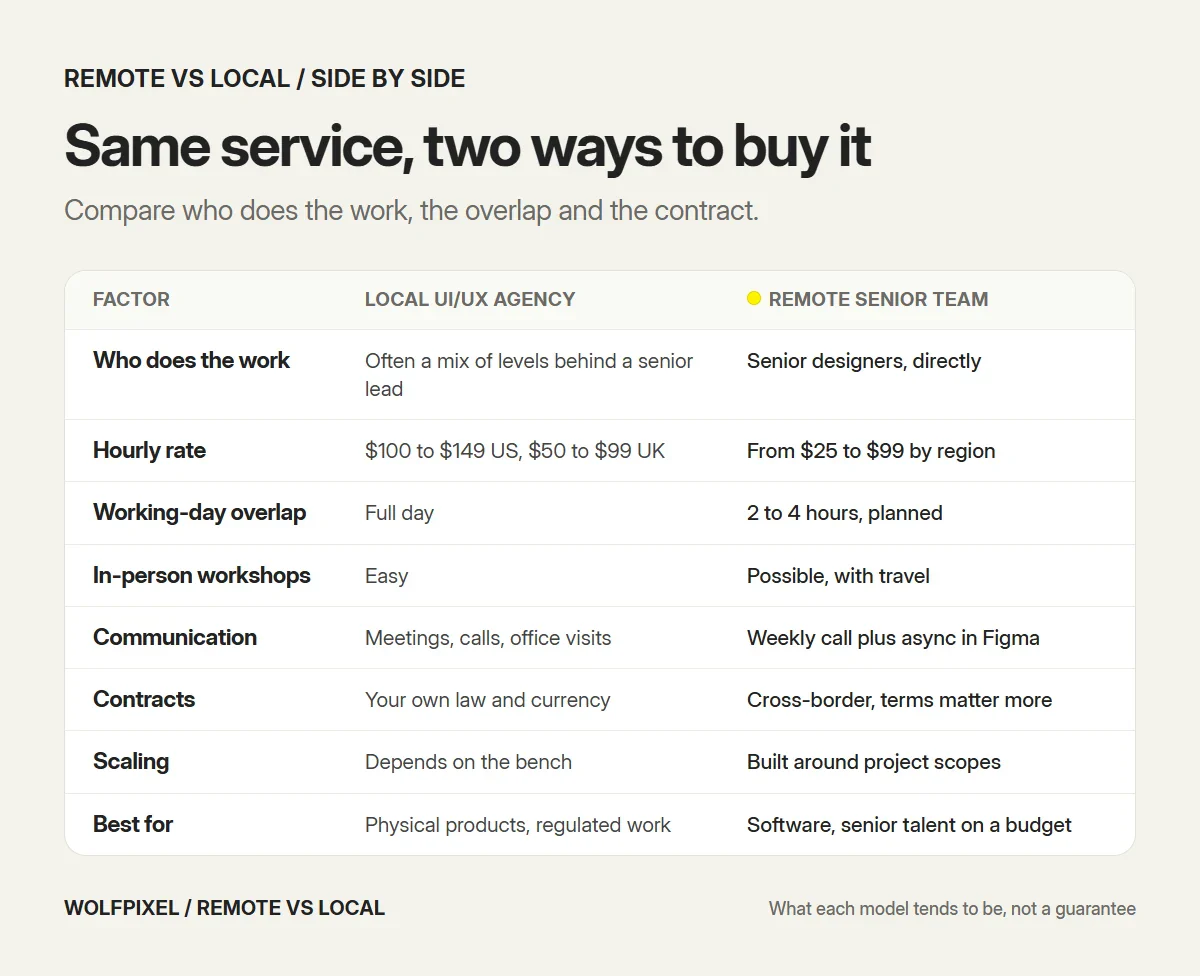
The table only tells you what each model tends to be. A local agency can be fully senior, and a remote team can be junior. The rest of this guide shows you how to check which one you’re actually talking to.
What “local agency” and “remote senior team” actually mean
The two labels hide a lot of variation, so it helps to define them before comparing.
A local UI/UX agency
A local agency is based in your city or country. You can visit the office, run workshops in the same room and pay in your own currency under your own law. Many local agencies are full-service shops with account managers, project managers and designers at several levels. Senior people often lead the pitch and the strategy, while mid-level and junior designers produce much of the day-to-day work. That isn’t a flaw. It’s how agencies train people and keep rates manageable. But it means the person you meet isn’t always the person designing your screens.
A remote senior design team
A remote senior team works from one or more other locations and is built around experienced designers doing the work themselves. It runs on scheduled calls and async collaboration, and it usually has a smaller management layer because the designers talk to you directly.
It’s different from two things it’s often confused with:
- A freelancer marketplace. You hire individuals, and you manage them. There is no shared process or cover if someone is away. Our comparison of a design agency vs freelancer vs in-house team covers that choice.
- Offshore staffing. You rent designers by the month and direct their work yourself. That suits companies with a design lead in-house, not founders who need someone to own the design.
Remote work is no longer unusual in tech. A Gallup study published in September 2025 found that 47% of remote-capable tech workers in the US are fully remote, 45% are hybrid and 9% are fully on-site. In the 2025 Stack Overflow Developer Survey, 45% of US respondents said they work fully remote. The engineers who will build your product are very likely working this way already.
Cost: what you pay for, not where they are
Price is the most common reason founders look at remote teams, and the rate difference is real. But the quote you sign is built from more than a rate.
Published UI/UX agency rates by region
Clutch’s UI/UX pricing guide publishes average hourly rates by agency location. These are the figures as of November 2026:
| Agency location | Average hourly rate (Clutch) |
|---|---|
| United States, Canada, Australia | $100 to $149 |
| United Kingdom, Poland, Spain | $50 to $99 |
| India, Philippines, Ukraine, Mexico | $25 to $49 |
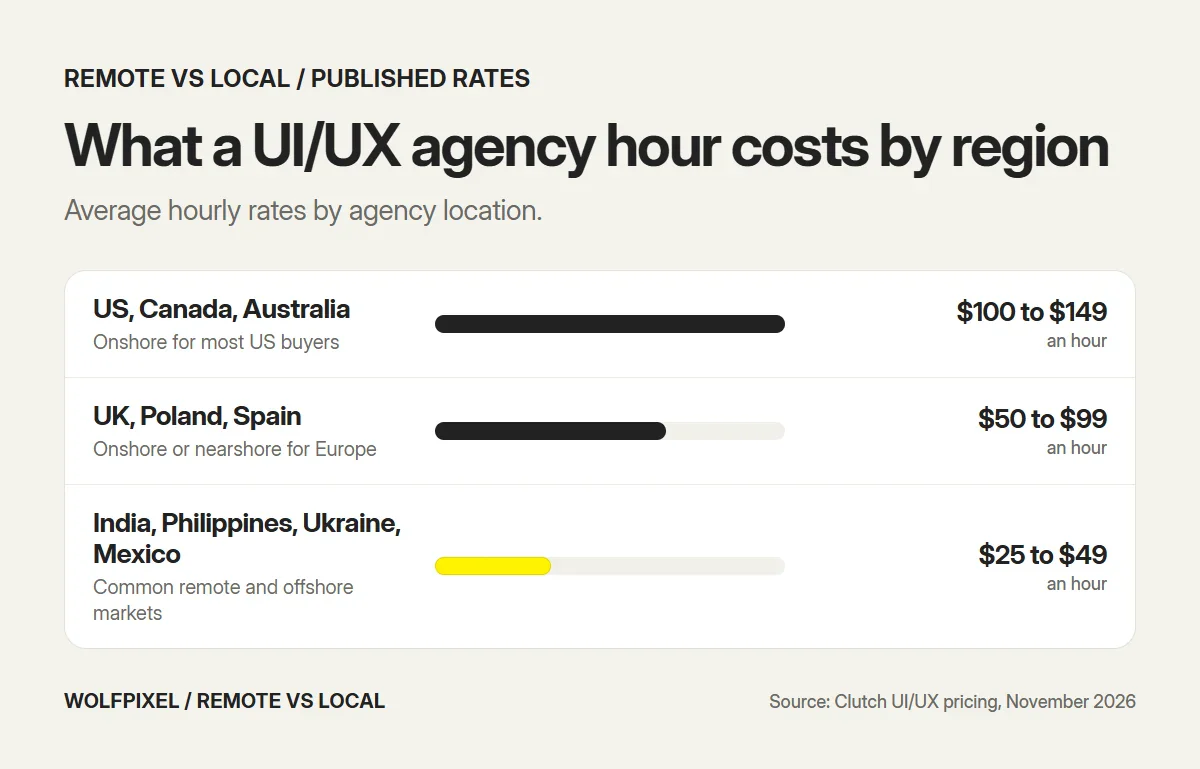
For context, the US Bureau of Labor Statistics reports a median salary of $104,000 for web and digital interface designers in May 2025. A US agency has to cover salaries at that level, plus office, sales and management costs, which is why its rate sits at the top of the table.
Why the hourly rate is only half the price
Every quote is hours multiplied by a rate. Then rework adds hours you didn’t plan for: screens redesigned because the brief was misunderstood, flows rebuilt after a review, files cleaned up before developers can use them.
A simple way to compare quotes is:
Real cost = hourly rate × planned hours × (1 + rework)
Here is an illustration for the same 120-hour product design project. The rates are the midpoints of the Clutch ranges above. The rework shares are our assumptions, chosen to show how much they move the result.
| Scenario | Rate | Planned hours | Rework | Real cost |
|---|---|---|---|---|
| US agency, low rework | $125 | 120 | 10% | $16,500 |
| UK agency, low rework | $75 | 120 | 10% | $9,900 |
| Remote team, low rework | $37 | 120 | 10% | $4,884 |
| Remote team, high rework | $37 | 120 | 60% | $7,104 |
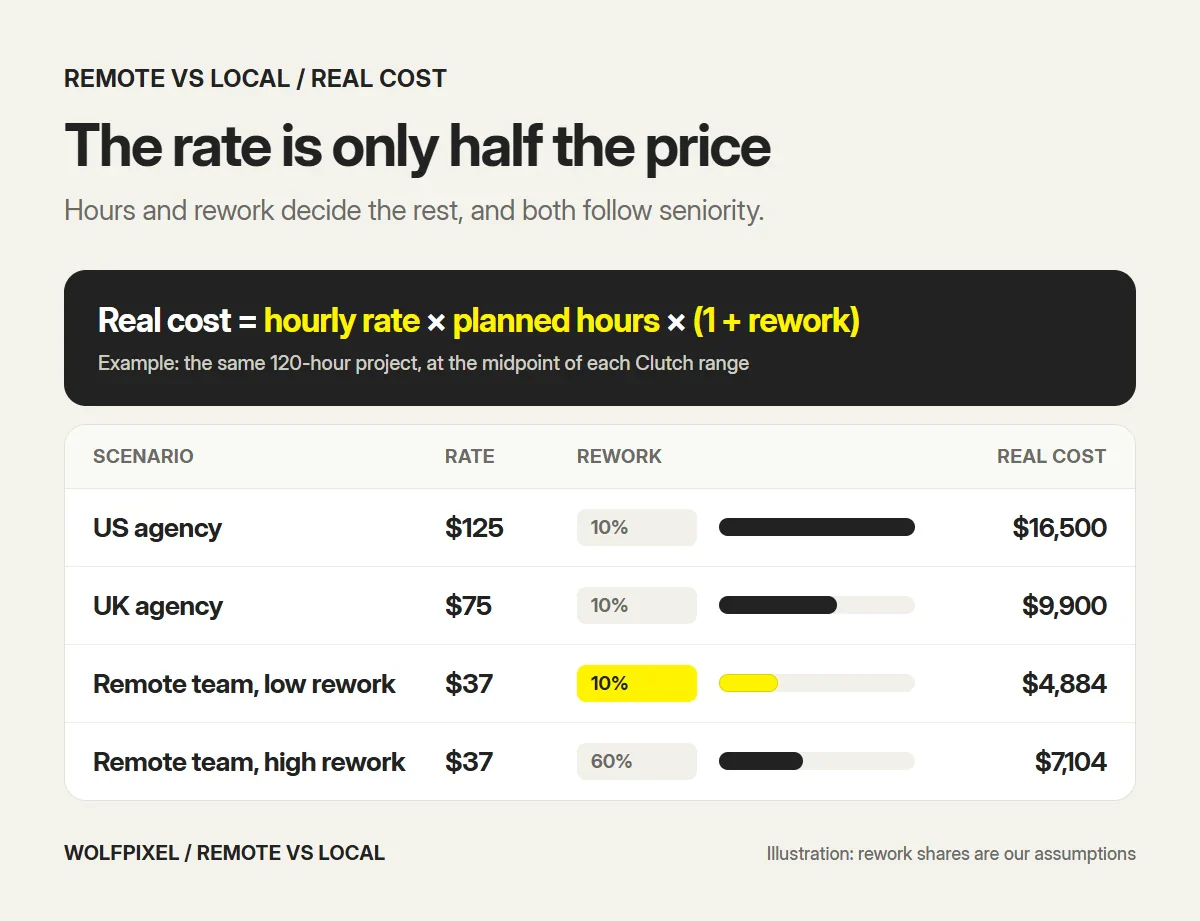
Two things stand out. Even with heavy rework, the remote team in this example costs less than the UK agency. But rework also costs time, and on a product with a launch date, time can be worth more than the saving. That’s why seniority matters more than the rate. Experienced designers tend to need fewer rounds because they ask the right questions before they design.
Fixed price vs hourly billing
Hourly billing puts the risk of slow or repeated work on you. A fixed price puts it on the agency, as long as the scope is written down. Whichever model you choose, ask for the scope in screens, flows and deliverables, and ask what happens to the price if the scope changes. For typical budgets by project type, see our guide to UI/UX design cost.
Expertise: who actually does the work
This is the question that matters most and gets asked least. Most proposals list a team, but they don’t say who will spend the hours.
The pitch team vs the delivery team
In a layered agency, a creative director and a senior designer often run the sales call and the first workshop. After that, the work may move to designers you haven’t met. That can work well when the senior lead reviews everything closely. It can also mean you pay senior rates for junior hours.
Remote senior teams tend to have fewer layers, and the designer on the first call is often the one designing. But “senior” is a word anyone can put on a website, so check it the same way for both options.
Five questions that reveal real seniority
- Who will design my screens, by name? Ask for their portfolios and years of experience.
- Who presents the work to me? The person presenting should be the person who designed it.
- Will the people on this call stay on the project? Get it in writing.
- Who reviews the work before I see it? There should be a senior review on every delivery.
- What happens if the lead designer leaves or is ill? A team should have cover. A freelancer usually doesn’t.
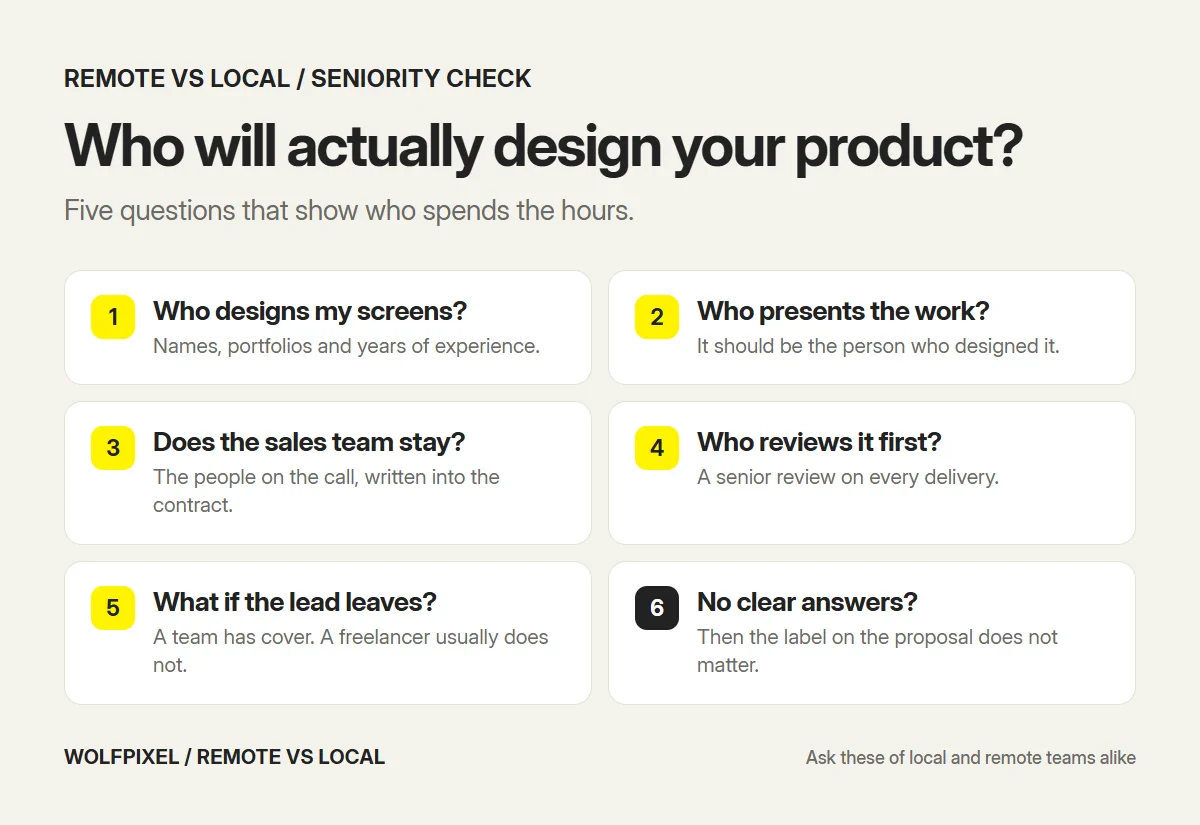
If a team can’t answer these clearly, the label on the proposal doesn’t matter, local or remote.
Communication and time zones
Communication is the real risk of remote work. In a Nielsen Norman Group survey of UX practitioners, 43% of respondents named communication as their biggest challenge of remote design work. The fix is not more meetings. It’s a clear rhythm.
How much overlap you actually need
For most product design projects, two to four hours of shared working time a day is enough. You use it for reviews, decisions and the occasional workshop. Everything else, such as comments, files and questions, moves async.
Here is how much of a standard 9-to-6 working day a team in Dhaka (UTC+6) shares with clients in different cities, in winter time. The second column shows an example schedule where the remote team starts its day later to meet US clients. These are our own calculations from standard time-zone offsets.
| Client location | Overlap on a standard day | Overlap if the team works 2 pm to 11 pm |
|---|---|---|
| Same city as the agency | 9 hours | Not applicable |
| Berlin (UTC+1) | 4 hours | 9 hours |
| London (UTC+0) | 3 hours | 8 hours |
| New York (UTC-5) | None | 3 hours |
| San Francisco (UTC-8) | None | None, unless the team has US-based designers |
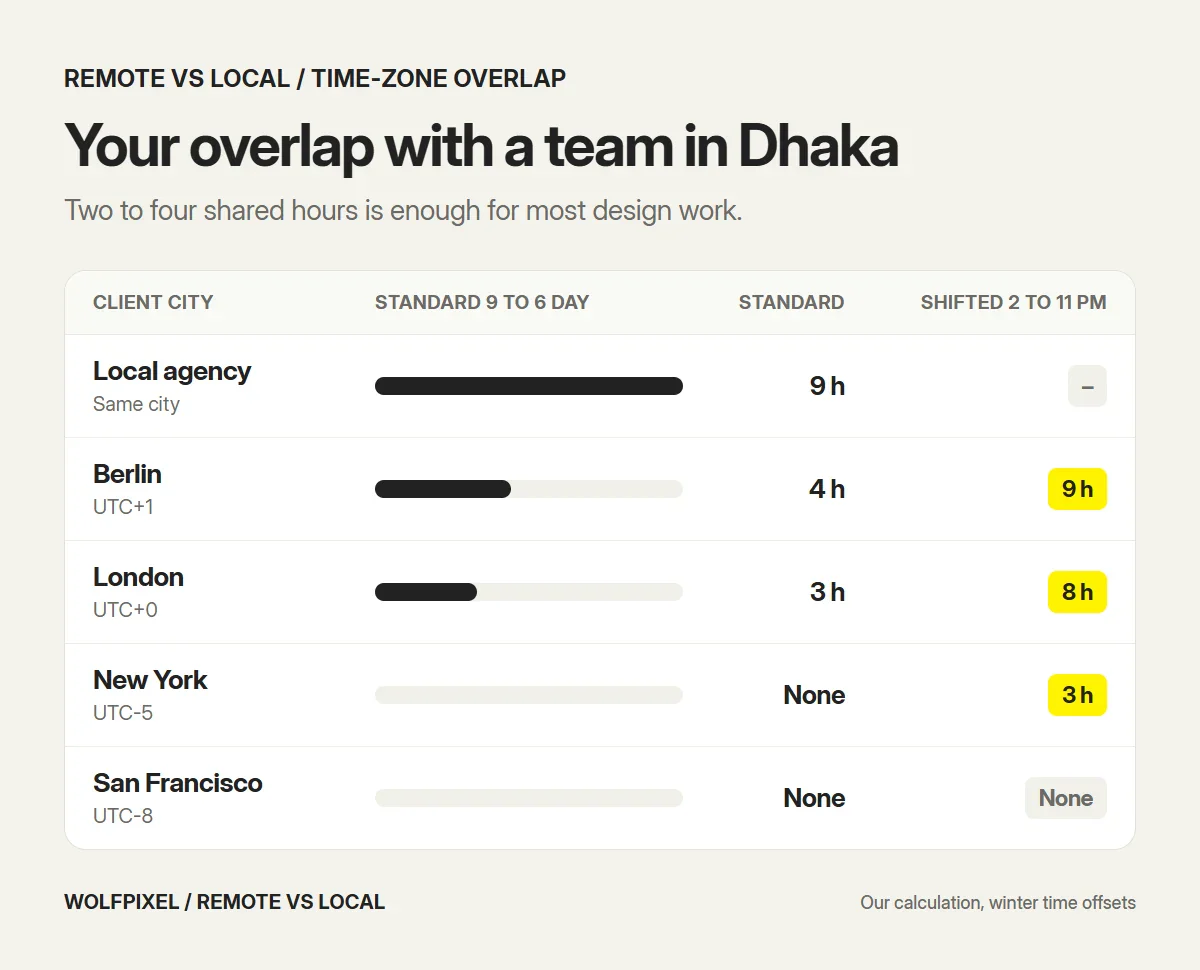
The pattern is clear. UK and European clients get useful overlap with South Asian and Eastern European teams without anyone changing their hours. US East Coast clients need a team that shifts its day. US West Coast clients usually need a team with designers in the Americas. Ask any remote team exactly which hours they’ll be available to you, and get it in writing.
The async workflow that makes remote work
The remote teams that work well tend to run the same few habits:
- One fixed weekly call with the decision-makers, used for reviews and decisions, not status updates.
- Comments in Figma, attached to the screen they’re about, not scattered across email.
- Short recorded walkthroughs for each delivery, so you can review on your own time.
- A decision log, so nobody reopens a settled question two weeks later.
- An agreed reply time, such as one business day, for questions in Slack or email.
Figma’s 2023 State of the Designer research, as reported by It’s Nice That, found that 95% of the designers surveyed work from home at least part of the time. The same research found that 38% feel more distant from co-workers. Remote design is normal. Staying close is the part that takes process.
Speed and flexibility
A local agency can start fast if it has people free, and slow if it doesn’t. The same is true of a remote team. What differs is the shape of the team. Remote senior teams are often built around project scopes, so they can add or remove a designer between phases more easily than an agency carrying a fixed bench.
Time-zone gaps can also help. When your day ends, a team six to ten hours ahead keeps working, and changes can be waiting for you the next morning. That only works when feedback is complete and clear before you log off.
One more thing to check is range. Many startups need brand, website and product design within the same year. One team that covers all three keeps the brand consistent from the logo to the dashboard, and saves you briefing three suppliers.
Accountability: contracts, IP and handover
A remote team is cross-border by default, so the contract does more work. The same checklist protects you with a local agency too.
- IP transfer. All design rights pass to you on payment.
- File ownership. Figma files live in your workspace, or transfer to it at handover.
- Named lead designer. The person you agreed on is written into the contract.
- Milestones and acceptance. You pay against deliverables you have approved.
- Revision terms. How many rounds, and what counts as a new request.
- Exit clause. You can end the project with notice and keep the work you paid for.
- NDA and data access. Signed before you share anything, with access limited to what’s needed.
- Governing law and currency. Agreed up front, including who pays transfer fees.
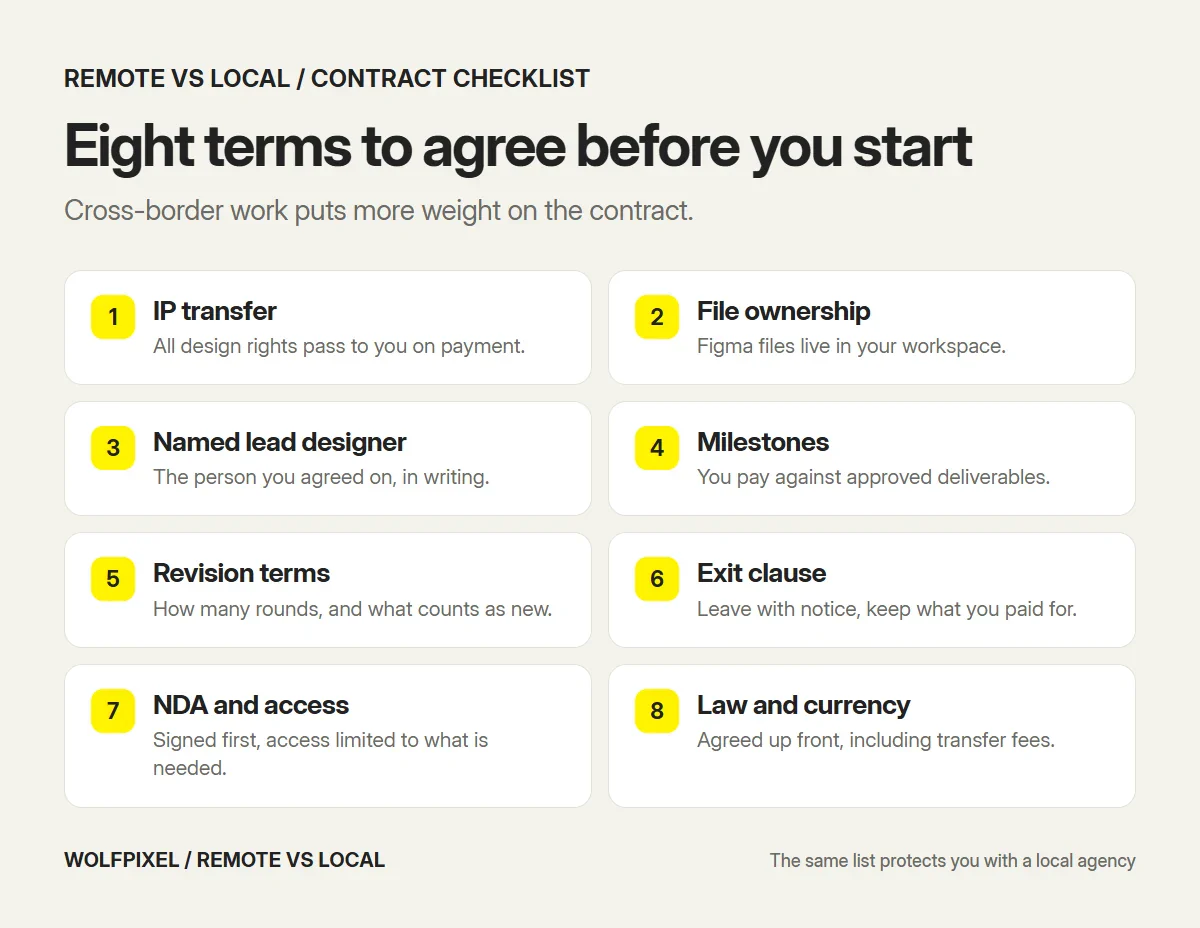
If a team pushes back on IP transfer or file ownership, treat it as a warning sign, wherever they’re based.
When a local UI/UX agency is the better choice
A local agency is often worth the higher rate when:
- The work happens in a physical place. Retail, hospitality, clinics and factories often need on-site research and testing.
- You want workshops in the room every week. Some teams decide much faster face to face.
- Law or procurement requires it. Some government, defense and regulated contracts require local suppliers or data residency.
- You need the agency to deal directly with local partners, such as print, events or retail fit-outs.
- Your team has no async habits and no time to build them.
If you’re in Chicago, for example, our page on UI/UX design in Chicago shows how we work with teams there.
When a remote senior team is the better choice
A remote senior team usually makes more sense when:
- You’re building software. SaaS products, web apps, mobile apps and dashboards are designed in Figma and reviewed on screen anyway.
- You need senior designers on a defined budget. A senior remote team can cost less than a mixed-level local one.
- You need first screens quickly and can give fast, clear feedback.
- Your team already works async across tools such as Slack, Linear or Notion.
- You want brand and product from one team, without managing several suppliers.
Decision scorecard: compare both options in 10 minutes
Score each option from 0 to 2 on every question. The highest total is your better fit. Double the score on any question that is a hard requirement for you.
| Question | 0 | 1 | 2 |
|---|---|---|---|
| Do I know who will design my screens? | No | Roles only | Named, with portfolios |
| Is the work led by a senior designer? | No | Reviewed by one | Done by one |
| How many hours of my day do we share? | Under 1 | 1 to 2 | 3 or more |
| Is the price fixed against a written scope? | Hourly, no cap | Estimate | Fixed |
| Do I own the IP and files on payment? | Unclear | After full payment | Yes, by milestone |
| Can I leave with notice and keep the work? | No | Partly | Yes |
| Have they designed similar products? | No | Adjacent | Yes, with case studies |
| Do they reply within one business day? | Rarely | Usually | Yes, in writing |
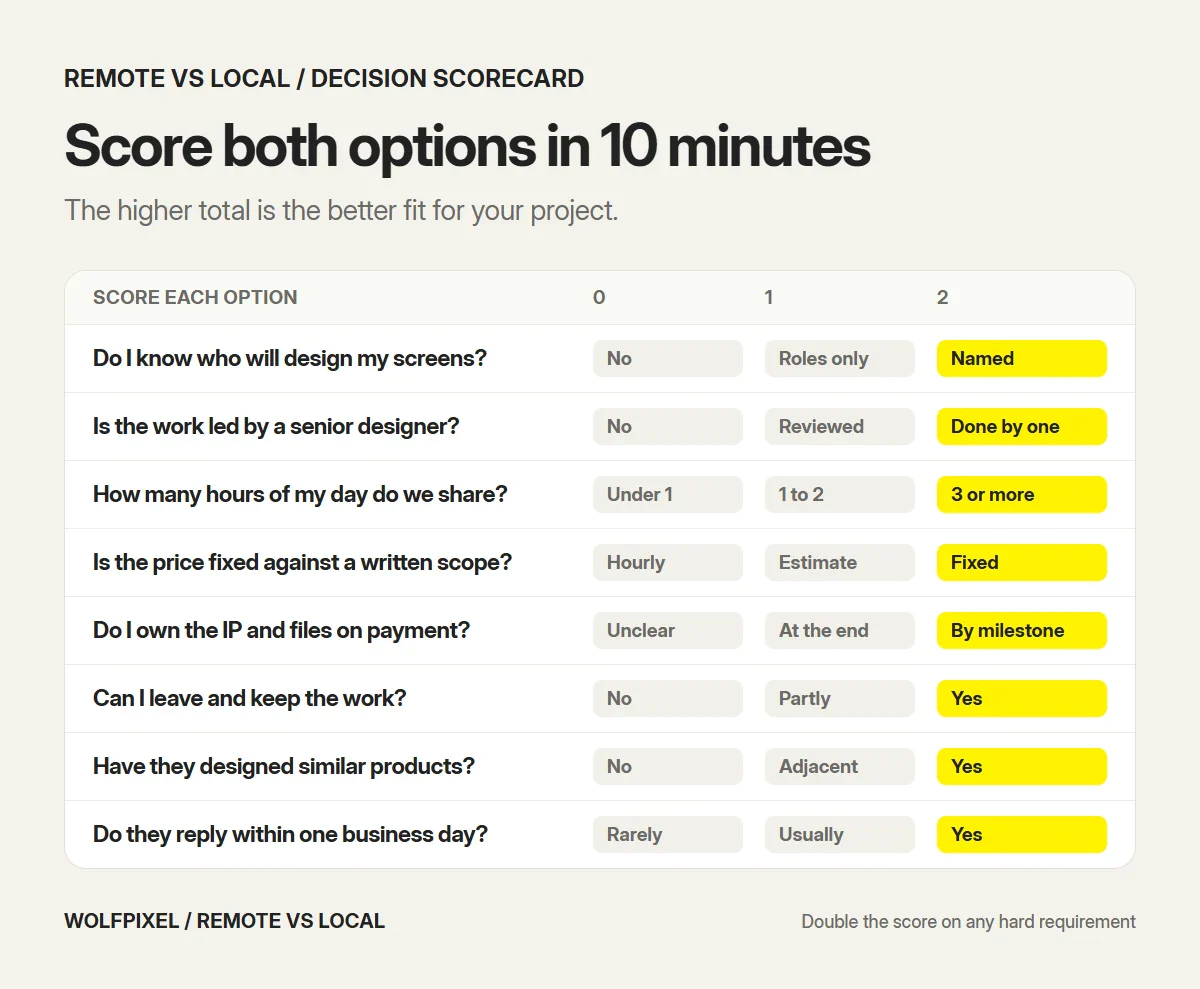
One question sits outside the scorecard: whether you genuinely need people in the room every week. If you do, that alone can decide it for a local agency. If both options score close, pick the one whose designers you’d rather spend the next three months with. Chemistry matters in design work more than in most services.
How Wolfpixel works as a remote senior team
For transparency, here is how our own model maps onto this guide.
- Who does the work: a senior designer with 5+ years of experience leads every project from kickoff to handoff. There are no juniors learning on your work and no account managers in the middle.
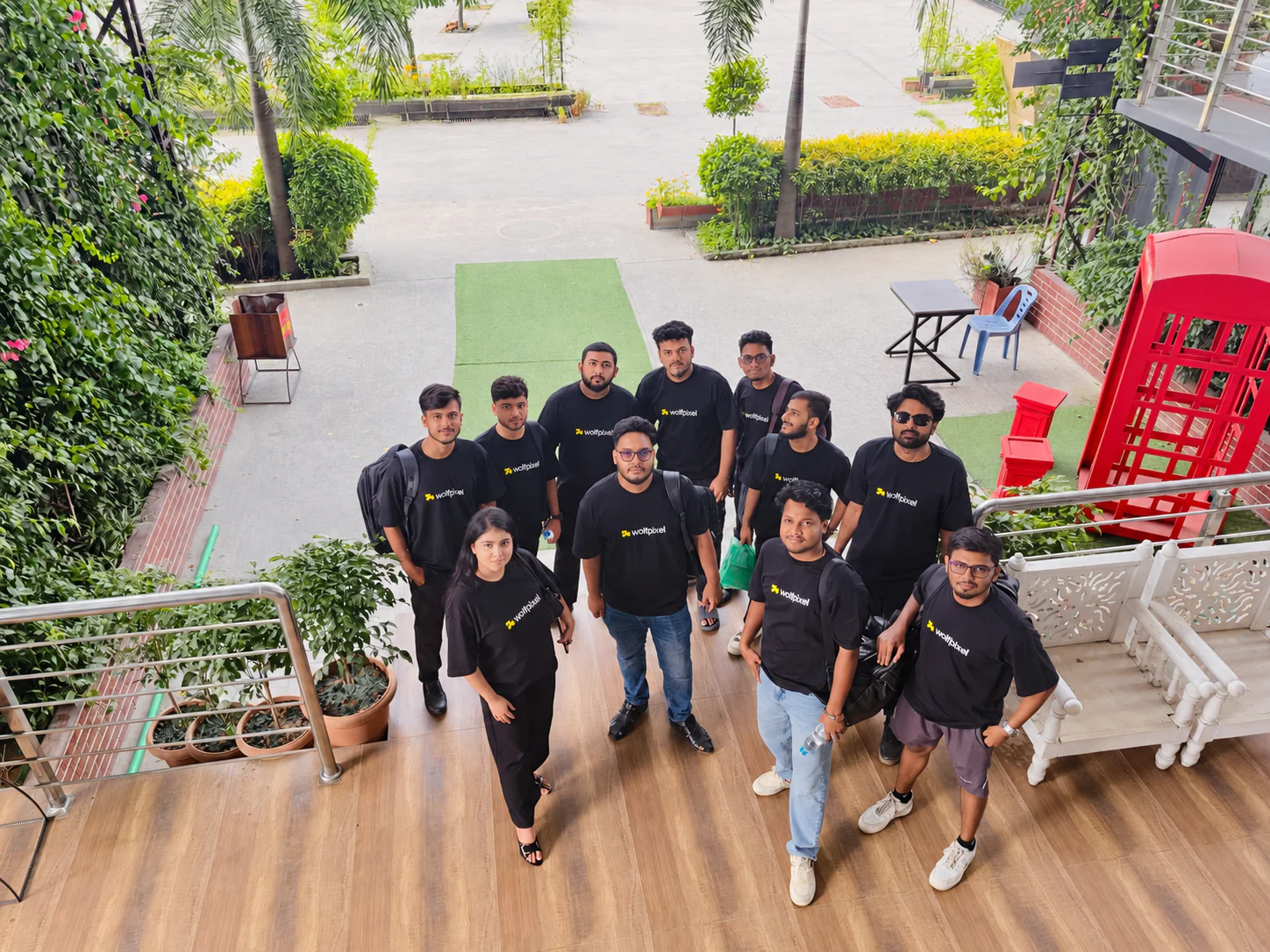
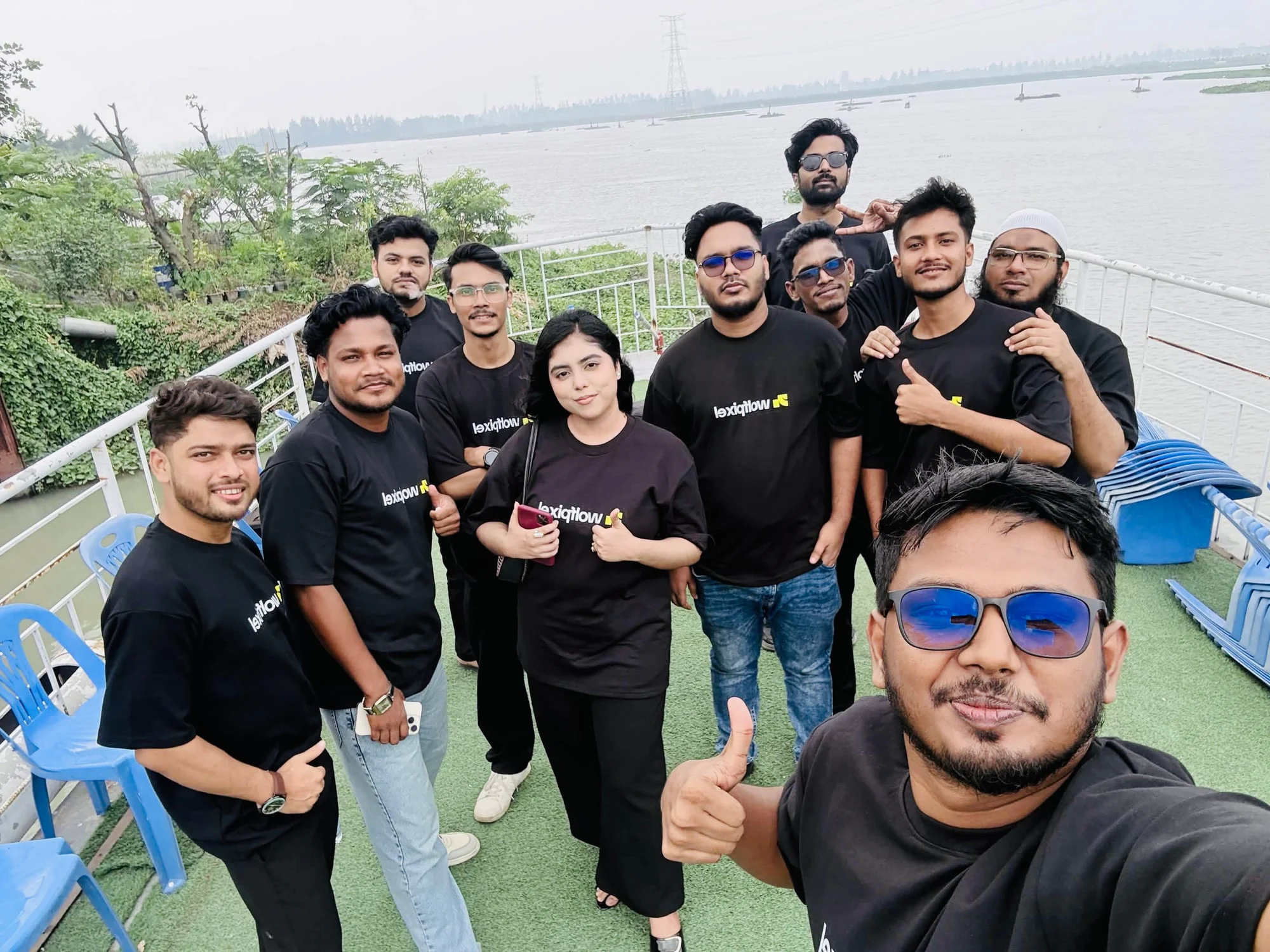
- Where we are: our team works across the United States, the United Kingdom and Bangladesh. Most of our clients are in the US, UK, Europe and Australia.
- Overlap: we plan calls and reviews inside your time-zone overlap, with async updates in Slack and Figma in between.
- Price: fixed and published. Product design starts at $3,150 for up to 10 screens, and UX audits start at $2,500. You can see every package on our pricing page.
- Range: one team for UI/UX design, website design and brand identity.
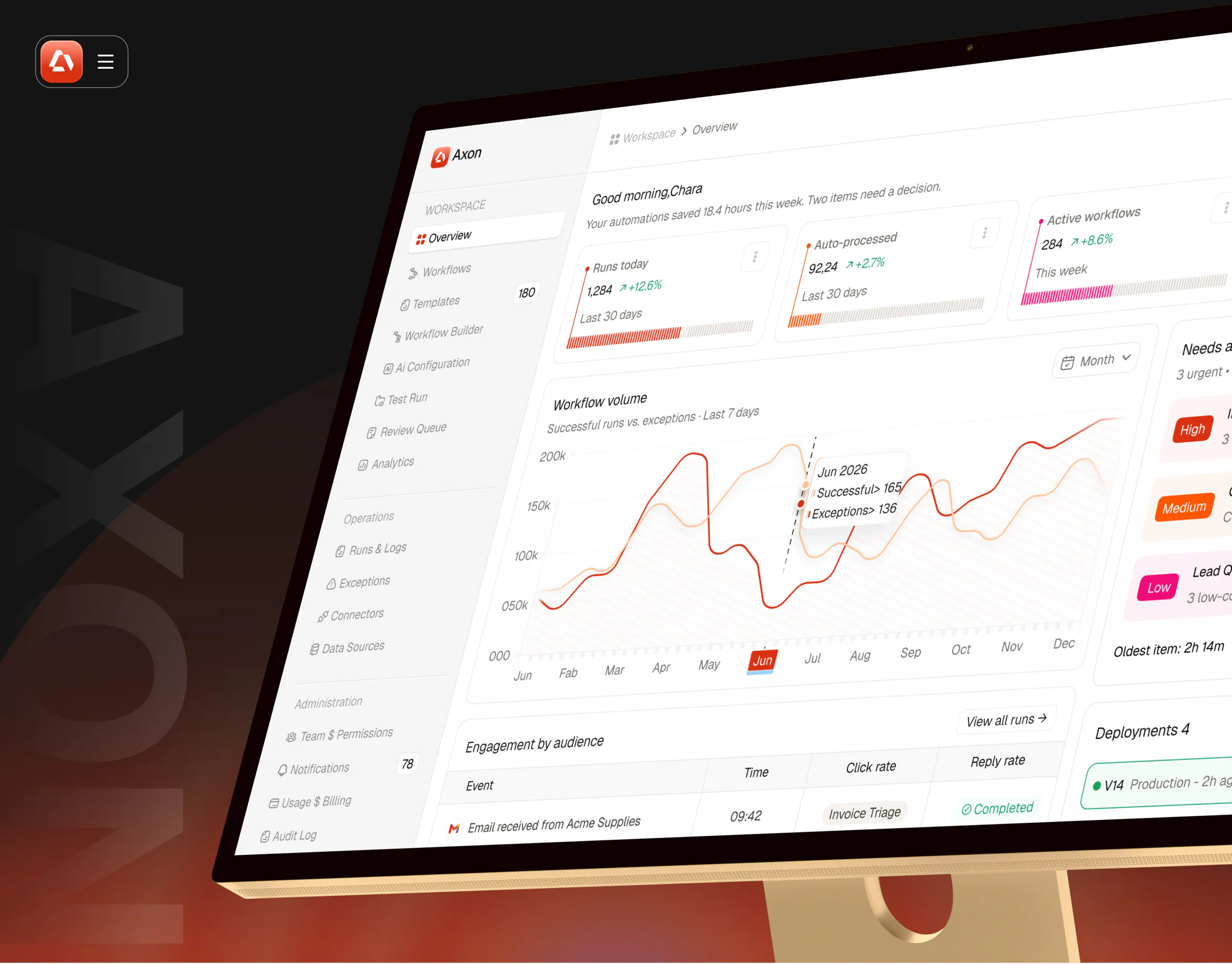
- Track record: 125+ founders have worked with us, and we’re rated 5.0 on Clutch. You can see projects such as Alignify, a sales CRM dashboard, and Axon, an AI workflow automation dashboard.
If you’re comparing us with a local agency, send us the same brief. A senior designer will reply within 4 business hours with the scope and a fixed quote, and you can ask us every question in the scorecard above. Start the conversation here.
Sources and method
We reviewed every source below in November 2026. Figures are quoted as published and may have changed since.
Rates and pay
- Clutch: UX/UI design pricing guide, for average agency hourly rates by location.
- US Bureau of Labor Statistics: web developers and digital designers, for the median pay of web and digital interface designers in May 2025.
Remote work and communication
- Gallup: hybrid work’s retreat (September 2025), for the share of tech workers who are fully remote, hybrid and on-site.
- Stack Overflow Developer Survey 2025: work, for the share of US developers working fully remote.
- Nielsen Norman Group: remote design challenges, for communication as the biggest remote challenge.
- It’s Nice That: Figma State of the Designer 2023, for designers working from home and feeling distant from co-workers.
Our own illustrations
- The real-cost formula and the 120-hour example, including the rework shares.
- The overlap table, calculated from standard winter time-zone offsets and an example shifted schedule.
- The scorecard, which reflects how we would compare two design partners.
- Wolfpixel’s team, prices and process, which come from our about page and pricing page.
Remote vs Local UX Design Agency FAQs
Is a remote UX design agency cheaper than a local one?
Usually, if the remote team is based in a lower-cost region. Clutch’s UI/UX pricing data puts agencies in the US, Canada and Australia at $100 to $149 an hour, the UK, Poland and Spain at $50 to $99, and India, the Philippines, Ukraine and Mexico at $25 to $49. The hourly rate is only part of the price, though. Hours, rework and who does the work decide the final cost.
Does my design agency need to be in my time zone?
No, but it needs to share part of your working day. Two to four hours of overlap is enough for most product design work, as long as feedback, decisions and files move async in between. If your team needs to meet with designers several times a day, a closer time zone or a local agency will be easier.
How many hours of overlap do I need with a remote design team?
Plan for at least two hours of overlap on working days and one fixed weekly call. Use the overlap for reviews and decisions, and agree on a reply time, such as one business day, for everything else. Teams that also run user interviews together may want three to four hours.
Can a remote design agency run discovery workshops?
Yes. Most discovery work, such as stakeholder interviews, user interviews, journey mapping and prioritization, runs well on video with a shared board in Figma or FigJam. In-person workshops matter more when the work happens in a physical space, such as a store, a clinic or a factory floor.
How do I check who will actually work on my project?
Ask for the names and portfolios of the designers who will do the work, how many years each has, who presents the work to you and who owns decisions. Ask whether the people on the sales call stay on the project, and write the named lead designer into the contract.
What is the difference between a remote design agency and a freelancer?
A remote agency is a team with a process, cover when someone is away, and usually brand, UX and UI skills under one contract. A freelancer is one person, which can be faster and cheaper for small, well-defined tasks. Our guide to design agency vs freelancer vs in-house compares the three in detail.
Is it safe to share my product with an offshore design agency?
It can be, if the contract covers it. Sign an NDA before sharing anything sensitive, make sure IP transfers to you on payment, keep the Figma files in your own workspace or transfer them at handover, and give access only to the tools and data the designers need.
Remote or local agency for a UK or EU startup?
The same rules apply, with one difference. UK and European startups usually get more natural overlap with teams in Eastern Europe, Africa and South Asia than US startups do. A London team and a team in Dhaka share about three hours of a standard working day without anyone changing their schedule.
Offshore vs onshore design agency, which is better?
Neither is better by default. An onshore agency is in your own country, which simplifies law, payment and in-person meetings, and usually costs more. An offshore agency is in another country, which lowers the rate and widens the talent pool, and asks more of your process. Choose by seniority, overlap and contract terms, not location alone.
How does Wolfpixel work with remote clients?
Wolfpixel’s team works across the United States, the United Kingdom and Bangladesh. A senior designer with 5+ years of experience leads every project from kickoff to handoff. We plan calls and reviews inside your time-zone overlap and send async updates in Slack and Figma in between. Product UI starts at $3,150 for up to 10 screens.
Want a senior team without the local price?
Send us your product or brief. A senior designer replies within 4 business hours with the scope and a fixed quote, and we’re happy to sign an NDA before you share anything.

Was this article helpful?

Written by
Maniruzzaman Jubayer
Co-founder & COO | Product Design Specialist at Wolfpixel
Maniruzzaman Jubayer is Wolfpixel’s Co-founder & COO and a product design specialist with 7 years of experience. He personally oversees website, app, dashboard and digital product design at Wolfpixel, a remote-first team working with founders in the US, UK, Europe and Australia. This guide compares remote and local design partners using published rates and survey data. Wolfpixel offers the remote design services discussed in the article.
View all articles