


 18 min read
 Published

UX audit cost is hard to pin down because the same two words are sold at $500 and at $60,000. Both prices are real. One buys a designer’s checklist review of a few screens, the other buys a research firm’s multi-evaluator review of a whole product. If you’re a founder or a head of product trying to budget for one, the number you need sits somewhere in between, and it depends on what you put in scope.
I’m Maniruzzaman Jubayer, Co-founder & COO and Product Design Specialist at Wolfpixel, with 7 years of experience. I personally oversee website, app and digital product design. This guide compares the prices audit providers actually publish, shows the hours behind a quote and gives you a way to compare two proposals that look nothing alike.
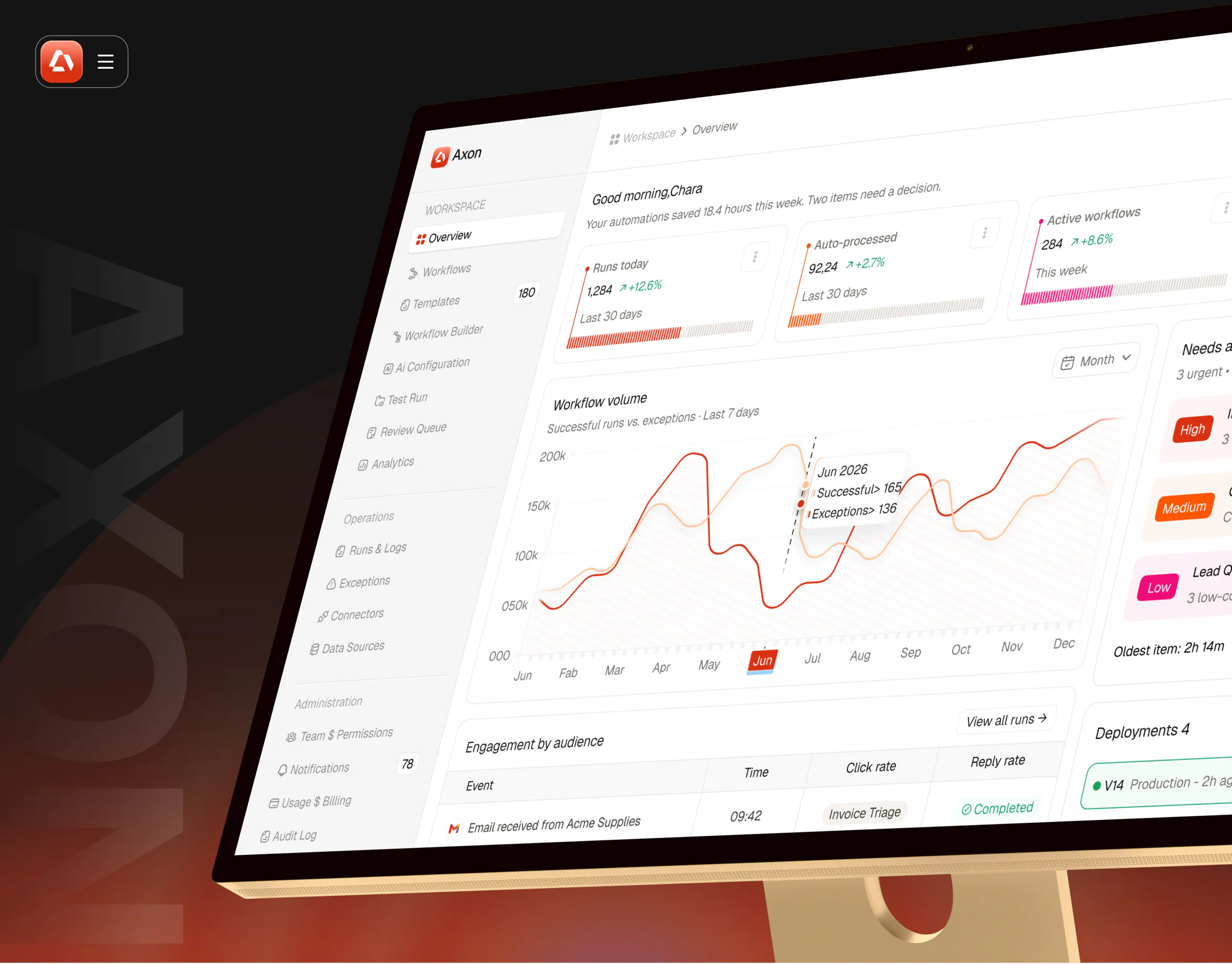
Our audits are run by the same senior team that designs products such as Axon, a workflow automation dashboard, and Crimino, a CRM dashboard. You can read more about the team on our about page.
If you already know you need one and want a team to run it, that’s our UX audit services page. This article is the pricing logic behind it.
The short answer: a UX audit costs about $500 to $5,000 for a one-person heuristic review, $3,000 to $15,000 for a single flow reviewed with analytics and session recordings, $8,000 to $35,000 for a full product and $18,000 to $80,000 or more at enterprise scale. Wolfpixel UX audits start at $2,500.
Key takeaways:
- A quote is hours multiplied by a rate. Scope sets the hours, and who does the work sets the rate.
- Flows, user roles and platforms move the price more than screen count does.
- A cheap audit is usually one evaluator and no data. It finds problems, but it can’t rank them by what they cost you.
- AI audit tools are a useful first pass for single screens. They can’t judge a multi-step flow against your funnel.
- Budget for the fixes too. Implementing the findings often costs more than finding them.
- Before you buy, work out the revenue uplift you need to break even. If it’s above about 10%, consider narrowing the scope or fixing the obvious problems first.
How we got these numbers: these are 2027 budgeting estimates based on publicly available pricing and usability research that we reviewed in November 2026. We read the UX audit price guides and pricing pages that rank for this topic and recorded every figure they publish, along with what each figure covers. Where we quote a range, we link the source, and the full list is in Sources and method at the end.
Two kinds of numbers appear in this guide, and we label them. Published figures come from the linked sources. Our estimates are the hour model and the break-even examples, shown with their assumptions so you can swap in your own. Actual prices vary with scope, evidence and who does the work. Wolfpixel sells UX audits, and our own starting price is included and labeled as ours. We’ll update this guide as new 2027 prices are published.
How much does a UX audit cost in 2027?
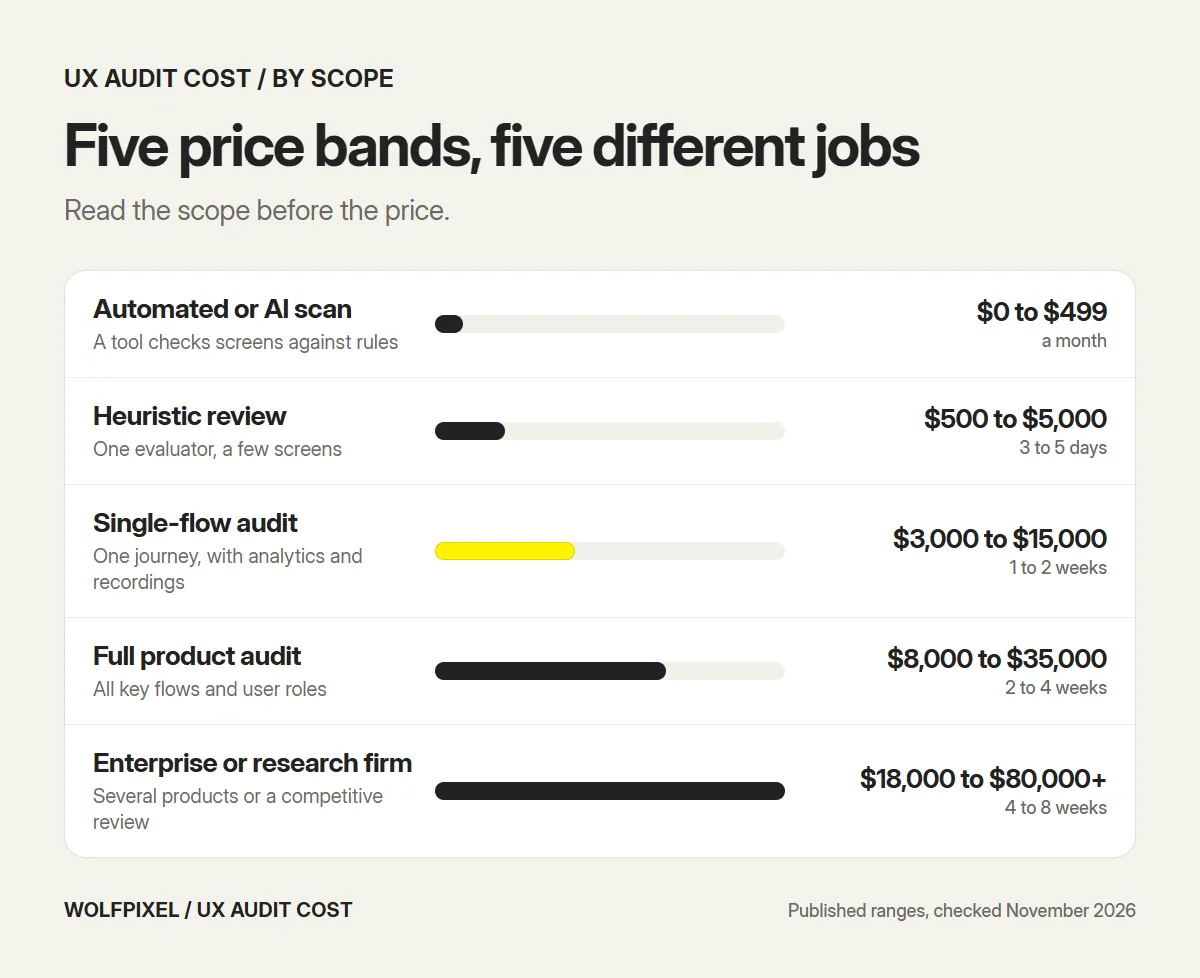
Across published guides, UX audit pricing falls into five bands. The bands overlap because providers define “audit” differently, so read the scope column before the price column.
| Scope | What it covers | Published price range | Usual timeline |
|---|---|---|---|
| Automated or AI scan | A tool checks screens against rules | $0 to $499 a month | Same day |
| Heuristic review | One evaluator, a few screens, a checklist | $500 to $5,000 | 3 to 5 days |
| Single-flow audit | One journey, such as onboarding or checkout, with analytics and recordings | $3,000 to $15,000 | 1 to 2 weeks |
| Full product audit | All key flows and user roles, sometimes with user testing | $8,000 to $35,000 | 2 to 4 weeks |
| Enterprise or research firm | Several products, platforms or a competitive review | $18,000 to $80,000+ | 4 to 8 weeks |
Here is where those ranges come from:
- Tools. UXAudit.Now lists SaaS audit tools at $29 to $499 a month, and Design Studio UI/UX puts AI audit tools at $9 to $30 a month.
- Heuristic review. Ronas IT starts its audits at $500 and three days. Krux puts a basic heuristic audit at $1,000 to $5,000.
- Single flow. Design Studio UI/UX prices a focused flow audit at $3,000 to $6,000. ArtVersion prices a focused strategic audit at $10,000 to $15,000 for about 50 hours of work.
- Full product. Design Studio UI/UX says $8,000 to $18,000, Krux says $8,000 to $25,000 and ArtVersion says $20,000 to $35,000 for 100 to 175 hours.
- Enterprise. Krux and ArtVersion put large or regulated products at $30,000 to $75,000 and above, and Eleken gives $30,000 to $80,000. Nielsen Norman Group publishes its expert review price directly: starting at $60,000 for a single website or application.
Two things stand out. The first is that none of these guides agree, and that’s normal, because they’re describing different amounts of work. The second is that the top of one provider’s range is often the bottom of another’s. So a number without a scope tells you almost nothing.
For context on how audit pricing fits the wider market, our guide to UI/UX design cost covers hourly rates and project budgets for design work in general.
Why UX audit quotes differ by 10x
Every quote is built the same way: hours multiplied by a rate. When two quotes are far apart, one of those two numbers is different, and usually both are.
Start with the hours. Here’s an illustrative model for a single-flow audit, such as signup through first use, on one platform with one user role. The hours are our assumptions, set out so you can see what the work consists of.
| Activity | What happens | Illustrative hours |
|---|---|---|
| Kickoff and access | Goals, the metric to move, logins and data access | 2 to 3 |
| Heuristic review | Each step checked against usability principles | 8 to 12 |
| Funnel analysis | Drop-off by step from your analytics | 4 to 8 |
| Session review | Recordings watched for hesitation, errors and dead ends | 6 to 10 |
| Accessibility check | Contrast, focus, keyboard use and labels | 3 to 5 |
| Synthesis and ranking | Issues merged, evidenced and ranked by impact and effort | 6 to 8 |
| Report and walkthrough | Annotated screens, fix list and a call with your team | 6 to 10 |
| Total | 35 to 56 |
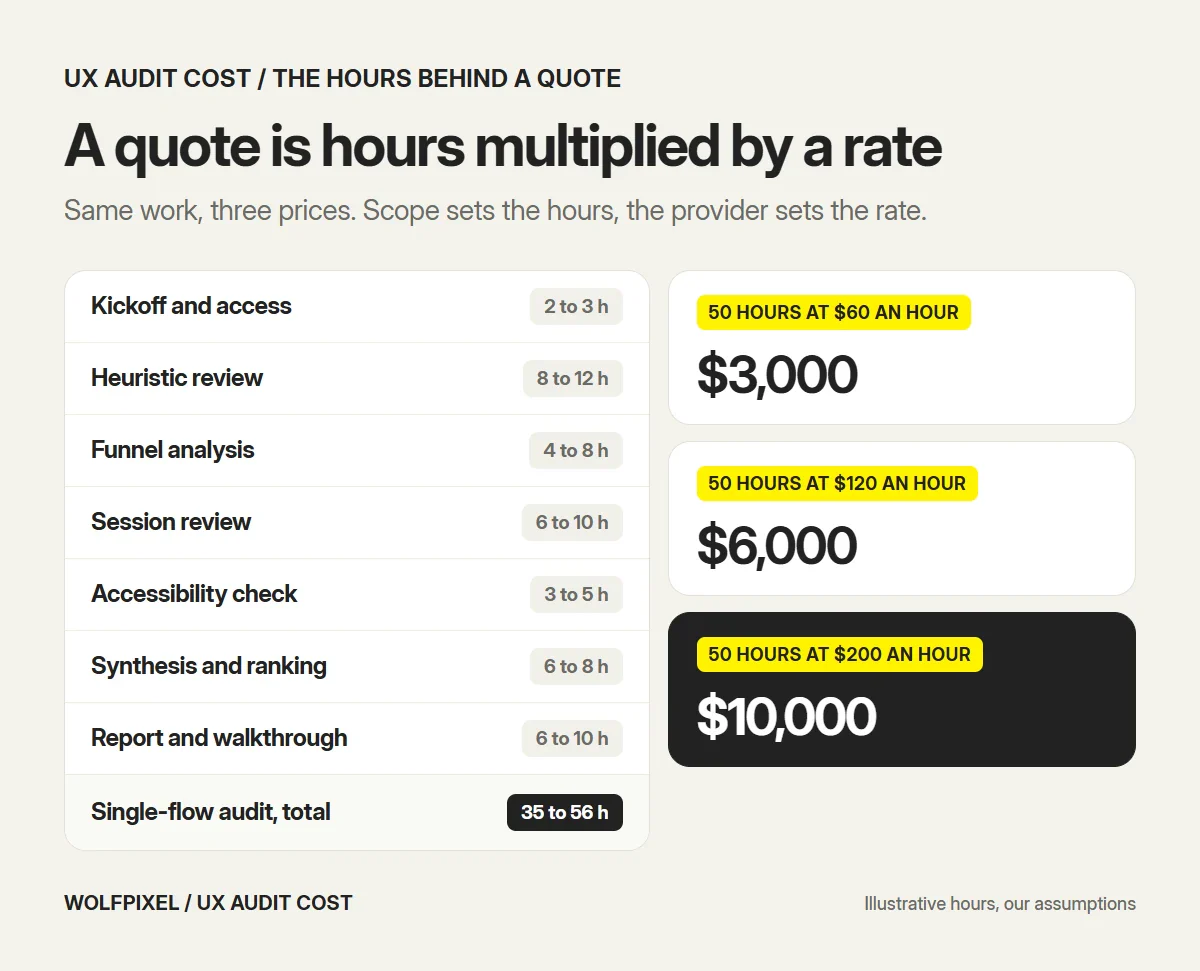
That lands close to ArtVersion’s published figure of about 50 hours for a focused audit. Now apply a rate. Fifty hours costs $3,000 at $60 an hour, $6,000 at $120 an hour and $10,000 at $200 an hour. Nothing about the work changed. ArtVersion’s own range of $10,000 to $15,000 for 50 hours works out to $200 to $300 an hour, which is senior US agency pricing.
Then the hours themselves move. Three things multiply them:
- User roles. An admin, a manager and an end user each see a different product. Design Studio UI/UX estimates that each extra role adds roughly 30% to 50% to audit time.
- Platforms. Web, iOS and Android are three reviews that share findings but not screens.
- Evidence. A review from heuristics alone is the fastest. Adding analytics, session recordings and user testing adds hours, and it also adds proof.
So when one provider quotes $2,000 and another quotes $20,000, don’t ask which is right. Ask how many hours each one covers, who spends them and on what evidence.
UX audit pricing by provider type
Who does the audit changes the rate, the depth and what you’re left with at the end.
| Provider | Pricing model | Typical price | Best for | Watch for |
|---|---|---|---|---|
| AI or automated tool | Monthly subscription | $0 to $499 a month | Quick checks on single screens, repeated often | No funnel data, no ranking by business impact |
| Freelance designer | One-time project fee | $500 to $8,000 | A small product or one flow, on a tight budget | One evaluator, variable method, availability |
| Design agency | One-time project fee, usually fixed | $2,500 to $35,000 | A live product with a stuck metric | Whether seniors do the work and what you receive |
| Research firm | One-time project fee | $60,000 and up | Enterprise products, competitive reviews | Evaluation only, long lead time |
| In-house team | Salaried staff time | No invoice | Products with a mature design team | Familiarity with the product hides problems |
These rows use different pricing models, so don’t compare them line by line. A tool is a recurring subscription, which means a year of it costs 12 times the monthly price. The freelancer, agency and research firm rows are one-time fees for one audit. In-house work has no invoice, but it has a cost in staff hours.
The freelancer range follows the published guides: Design Studio UI/UX puts a senior freelancer’s audit at $3,000 to $8,000, Krux gives the same range for a mid-range freelance audit, and lighter reviews start lower. The research firm figure is Nielsen Norman Group’s own starting price.
In-house is the option people underestimate. It looks free, but Krux points out that even an outsourced audit can use 20 to 40 hours of senior staff time for access, calls and questions, and a fully internal audit uses far more. The bigger issue is distance. A team that built a flow knows where to click, which is exactly why it struggles to see where a new user gets lost. If you’re weighing these options more broadly, our comparison of a design agency vs freelancer vs in-house team goes through the trade-offs.
UX audit cost by product type
The kind of product changes the price because it changes how many flows, roles and edge cases there are to review. Design Studio UI/UX publishes ranges by product type, and they show the pattern clearly.
| Product type | Published range | What drives the cost |
|---|---|---|
| E-commerce website | $3,500 to $12,000 | Cart and checkout, product filtering, buying across devices |
| Mobile app | $4,000 to $15,000 | Device range, gestures, offline states, notifications |
| B2B SaaS application | $5,000 to $20,000 | Several user roles, permissions, dense dashboards |
| Complex web app or enterprise dashboard | $8,000 to $25,000 | Data visualization, multi-step forms, role-based navigation |
The same source notes that dashboard-heavy B2B platforms are the most expensive products to audit. That matches the hour model above: every role and every dense screen adds review time.
Regulated products aren’t priced separately in the guides we reviewed, so treat the following as our view. A fintech product or a healthcare application usually sits in the complex web app band or above, because identity checks, consent steps and compliance wording all have to be reviewed alongside usability. Operations tools, such as logistics dashboards, cost more when the audit covers bulk actions and exception handling. For a SaaS product, the cheapest useful scope is nearly always the path from signup to first value.
What each price tier actually includes
Price bands are easier to judge when you see what’s in each one. This matrix is a general guide to what the tiers usually contain. Individual providers vary, so check each line against the quote in front of you.
| What you get | Heuristic review | Single-flow audit | Full product audit |
|---|---|---|---|
| Expert heuristic review | Yes | Yes | Yes |
| Annotated screenshots | Yes | Yes | Yes |
| Funnel and analytics review | Rarely | Yes | Yes |
| Session recording review | Rarely | Yes | Yes |
| Accessibility check | Basic | Yes | Yes |
| All user roles and platforms | No | No | Yes |
| Competitor benchmark | No | Sometimes | Yes |
| User testing with participants | No | Optional add-on | Sometimes |
| Issues ranked by impact and effort | Sometimes | Yes | Yes |
| Walkthrough call | Sometimes | Yes | Yes |
| Redesigned screens for top issues | No | Varies by provider | Varies by provider |
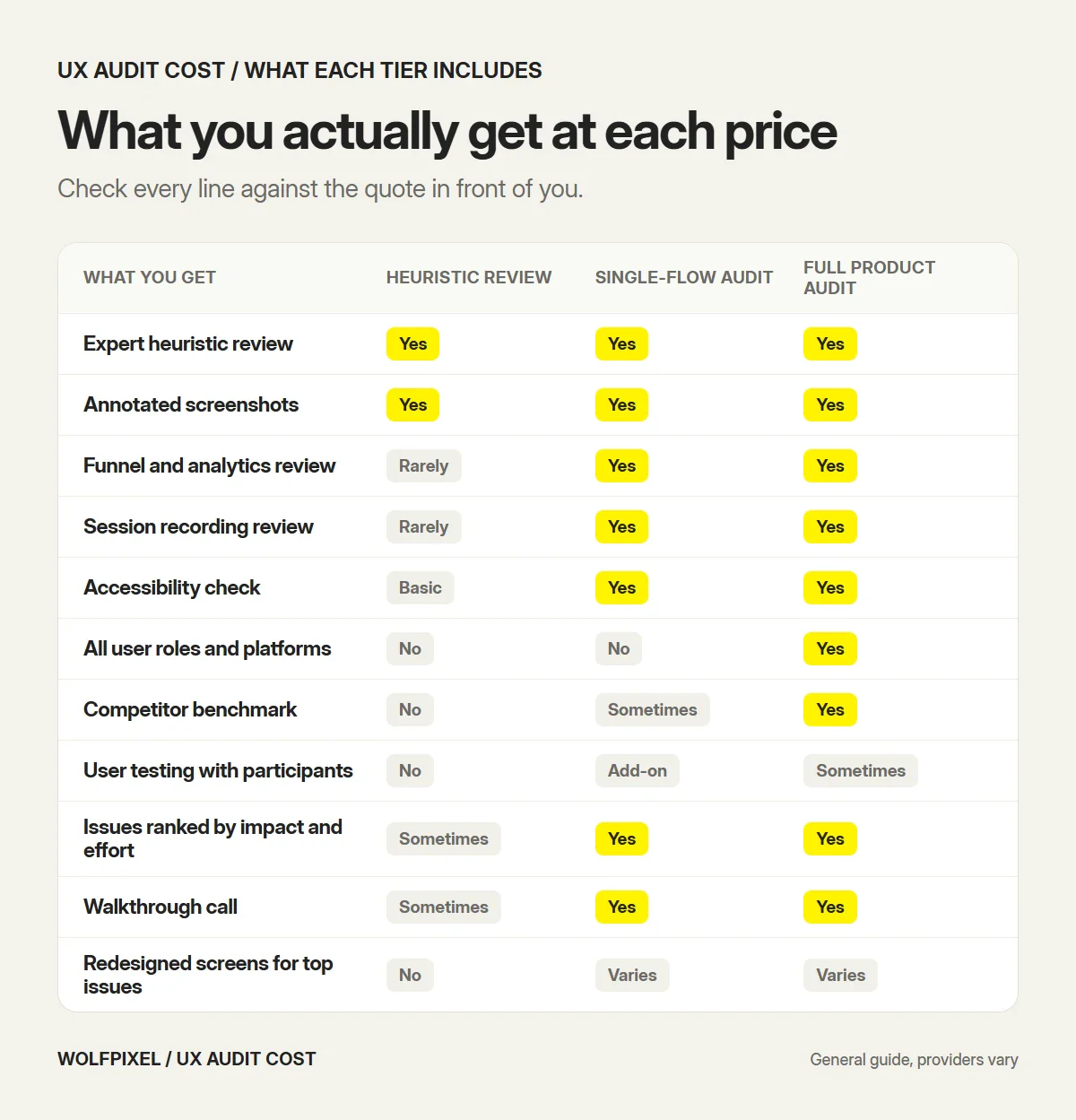
The last row is the one to read twice. Most audits end with a report, and the report describes problems. Somebody still has to design the fixes. Some providers include redesigned screens for the top issues, some price them as a follow-on project and some don’t offer design at all. That one line can change the real cost of an audit by thousands.
The report itself is included at every tier, so a UX audit report cost is rarely a separate line. What you’re paying more for is depth: evidence for each finding, a ranked backlog and someone to walk your team through it.
If you want to know what a thorough process looks like step by step, our UX audit guide covers the method, a checklist and a report template.
What a cheap UX audit leaves out
There’s nothing wrong with a $500 to $1,500 audit if you know what it is. It’s usually one person, a list of heuristics and your live product, with no access to your data. That finds real problems: unclear labels, missing error states, inconsistent buttons, forms that ask for too much.
What it can’t do is tell you which of those problems matter. Three limits are worth knowing:
- One evaluator misses things. Nielsen Norman Group’s guidance on heuristic evaluation says that ideally three to five people should evaluate the same interface independently, because any single reviewer will miss some issues.
- Severity from one person is a guess. In his article on rating the severity of usability problems, Jakob Nielsen wrote that severity ratings from a single evaluator are too unreliable to be trusted. A long list with no reliable ranking is hard to act on.
- Heuristics aren’t evidence. The same Nielsen Norman Group guidance states that heuristic evaluations cannot replace user research. Without funnel numbers or recordings, a finding is an informed opinion.
The practical risk is a 60-item list where everything is marked “high.” Your team fixes the easy items, the stuck metric stays stuck and the audit gets blamed. If your budget only allows a light review, limit it to one flow and ask the evaluator to rank the top five issues only.
When the open question is why users behave the way they do, an audit of any size is the wrong tool. That’s a job for research with real users, and the next section shows where each method fits.
UX audit vs UX review vs usability testing vs UX research
These four services overlap, and providers sometimes sell one under another’s name. Knowing the difference helps you buy the right one and read a quote correctly.
| UX review | UX audit | Usability testing | UX research | |
|---|---|---|---|---|
| What it is | One expert’s review of your screens | Expert review plus your analytics and recordings | Real users attempt tasks while you observe | Interviews, surveys and tests to learn what users need |
| Involves users | No | No new participants | Yes | Yes |
| Answers | What looks wrong? | What is broken, and what should we fix first? | Can people complete this task? | What should we build, and for whom? |
| Typical output | A list of issues | Ranked fix list with evidence | Recordings and task results | Findings, personas and journey maps |
| Published price | $500 to $5,000 | $3,000 to $35,000 | Adds $2,000 to $6,000 to an audit | Priced per study |
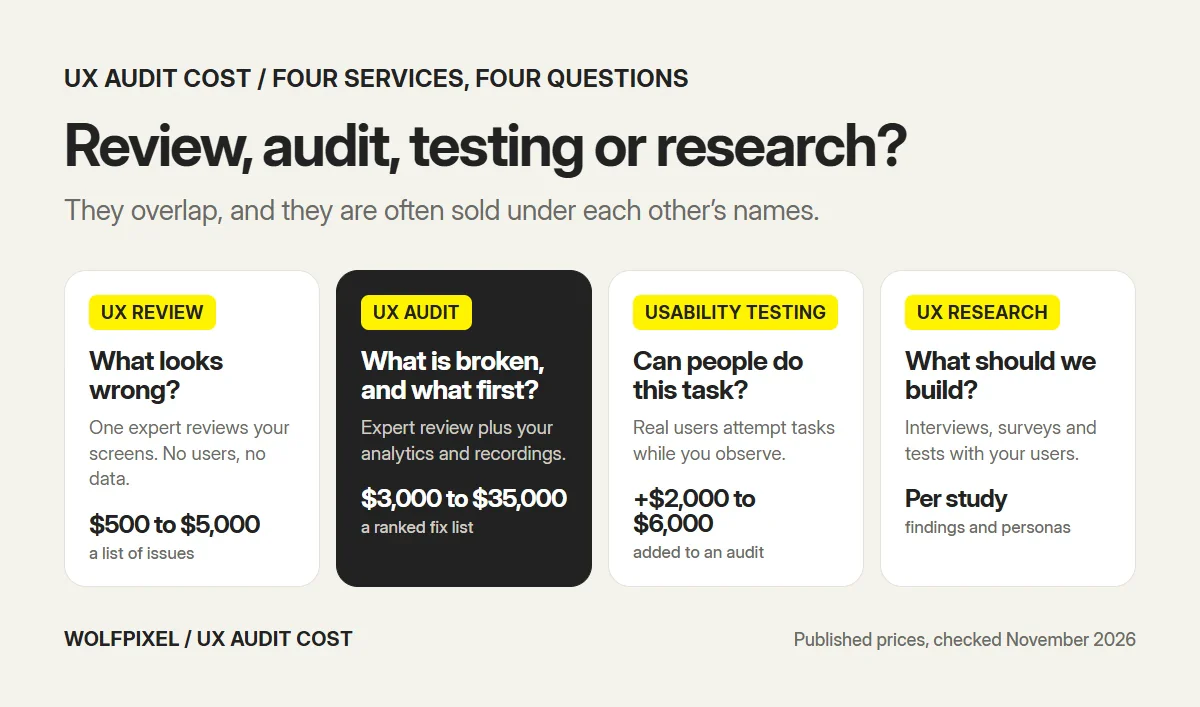
The testing figure is Design Studio UI/UX’s estimate for moderated sessions with five to eight users. You don’t need a large panel. Nielsen Norman Group’s well-known guidance on testing with five users is that the best results come from small tests run often.
A simple way to choose: buy a review when you want a quick sanity check, an audit when a live metric is stuck, testing when you need to see real people use a specific flow and UX research when you’re deciding what to build.
AI UX audit tools vs an expert audit
AI audit tools have become good enough that it’s fair to ask whether you still need a person. Our answer is that they do different jobs, and the cheapest good setup uses both.
| AI or automated tool | Expert audit | |
|---|---|---|
| Speed | Minutes | 1 to 4 weeks |
| Price | $0 to $499 a month | $2,500 to $35,000 |
| Good at | Contrast, labels, spacing, consistency, obvious heuristic issues on one screen | Multi-step flows, role logic, pricing and onboarding decisions |
| Sees your data | No, or only what you paste in | Analytics, recordings, support tickets |
| Ranks by business impact | No | Yes |
| Designs the fix | Suggests one in words | Can redesign the screens |
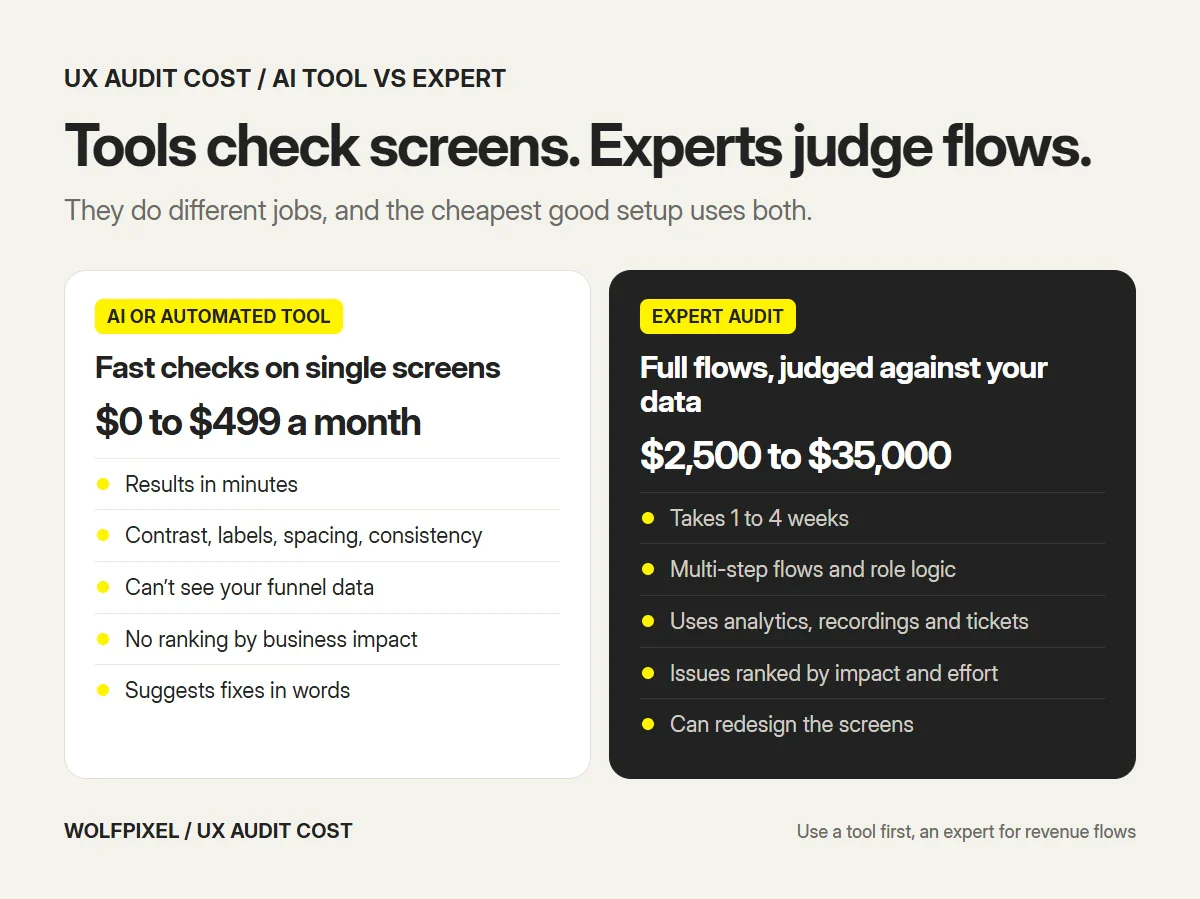
A tool looks at a screen and compares it with rules. It doesn’t know that 40% of your trials leave at step three, that your buyer is an operations manager who never sees the admin view or that the confusing setting exists because of a billing constraint. Those are the facts that turn a list of issues into a decision about what to ship next sprint.
A sensible way to combine them:
- Run an automated scan first and fix what it flags. It’s cheap, and it removes noise.
- Pull your funnel numbers and find the step that loses the most people.
- Bring in an expert audit for that flow only.
This way you pay senior rates for judgment and not for spotting a low-contrast button. It’s also the fastest route to an answer when a SaaS product isn’t converting and nobody can say why.
Is a UX audit worth the cost? The payback math
You don’t have to guess whether an audit will pay for itself. You can work out what it would need to achieve and decide whether that’s realistic.
Revenue uplift needed to break even = (audit cost + cost of fixes) ÷ yearly revenue through the flow
This is a revenue-based break-even estimate, and the uplift is relative, not percentage points. If a checkout converts at 10% today, a 2.8% uplift means it has to reach about 10.3%, not 12.8%. The formula tells you what the audit has to achieve. It doesn’t promise that it will.
Take an illustrative total of $14,000: a $6,000 audit and $8,000 of design and development to ship the top fixes. Here’s the improvement you’d need in the first year to cover it.
| Yearly revenue through the flow | Relative revenue uplift needed |
|---|---|
| $100,000 | 14% |
| $250,000 | 5.6% |
| $500,000 | 2.8% |
| $1,000,000 | 1.4% |
| $2,000,000 | 0.7% |
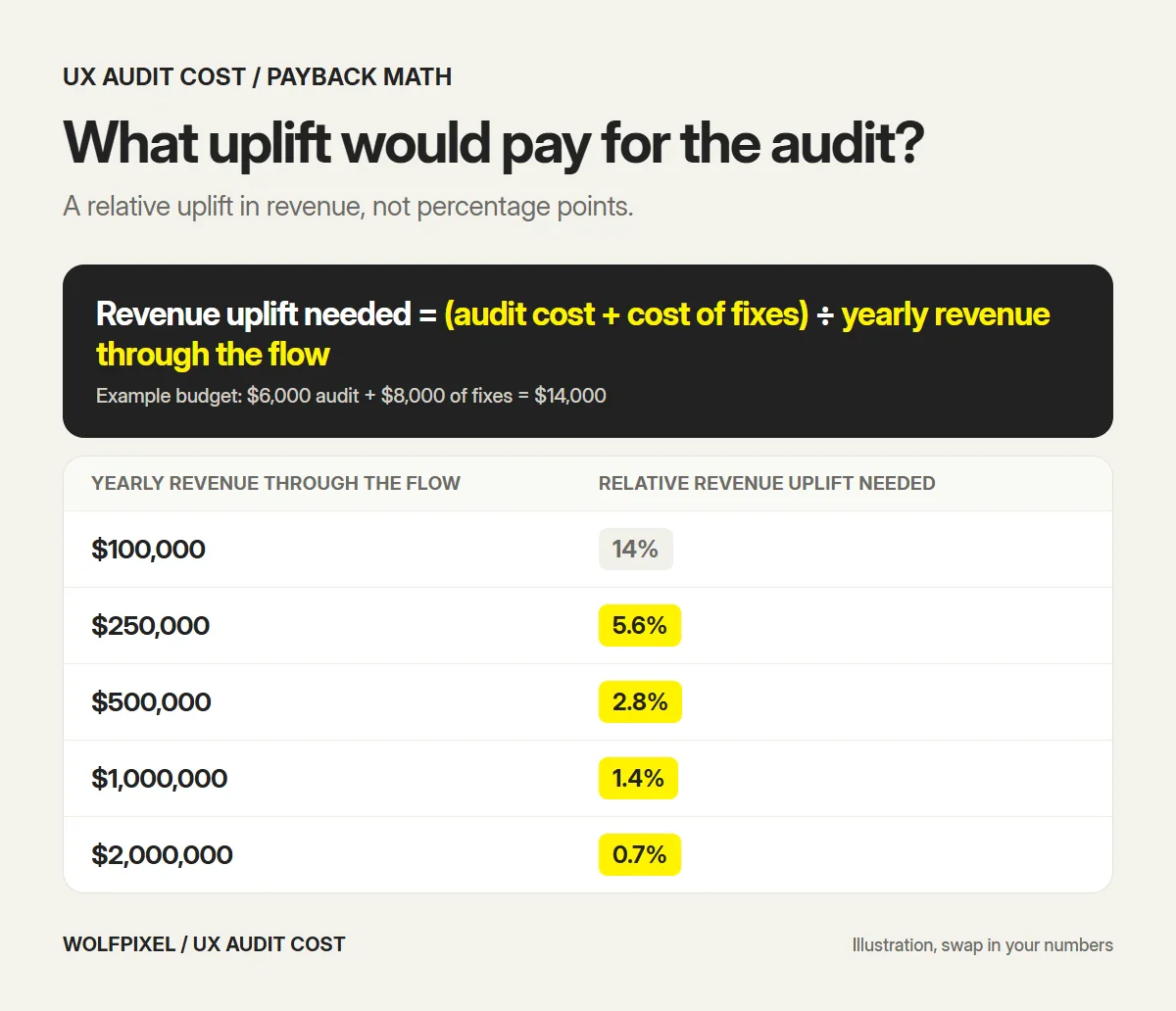
Read it this way. If the flow carries $1 million a year, a 1.4% relative improvement pays for everything. That’s a small ask of a flow with a known drop-off. If the flow carries $100,000, you’d need a 14% uplift, which is possible but far from certain. As a rule of thumb, when the required uplift is above about 10%, consider narrowing the audit scope or fixing the most obvious problems first. It isn’t a hard limit: a badly broken flow, or one with high-value enterprise customers, can justify a bigger target.
How big can an uplift be? It depends on how broken the flow is, and nobody can promise a number. As one reference point, Baymard Institute estimates that the average large e-commerce site can gain a 35.26% increase in conversion rate through better checkout design. That figure is for checkout on large stores, so treat it as a ceiling for that case and not a forecast for yours.
For SaaS, run the same math on the flow that matters most:
- Trial to paid. Revenue through the flow is new subscription revenue from trials. See our guide to SaaS user onboarding for the steps that usually leak.
- Retention. A fix that keeps customers longer is worth the revenue you would have lost. Our guide on how to reduce SaaS churn covers the UX causes.
- Pricing and upgrade. If the leak is on the pricing page, SaaS pricing page design shows the patterns that help.
One more check: ask the provider how the result will be measured after the fixes ship. If nobody names a metric before the audit starts, nobody will be able to say whether it worked.
How to compare two UX audit quotes
Two quotes rarely describe the same job. Before you compare prices, put both on the same footing with these eight questions.
- Which flows, roles and platforms are in scope? Listed by name, not “the product.”
- How many hours, and whose? Divide the price by the hours to see the rate, and ask who does the review.
- How many evaluators? One reviewer, or two with a senior check?
- What evidence is used? Heuristics only, or analytics, recordings and user tests as well?
- How are issues ranked? By impact and effort, with the reasoning shown?
- What do you receive? A PDF, an editable file, a backlog your team can import, redesigned screens?
- How many calls are included? A kickoff, a check-in and a walkthrough, or delivery by email?
- What happens if scope changes? A fixed price with a change process, or open-ended hours?
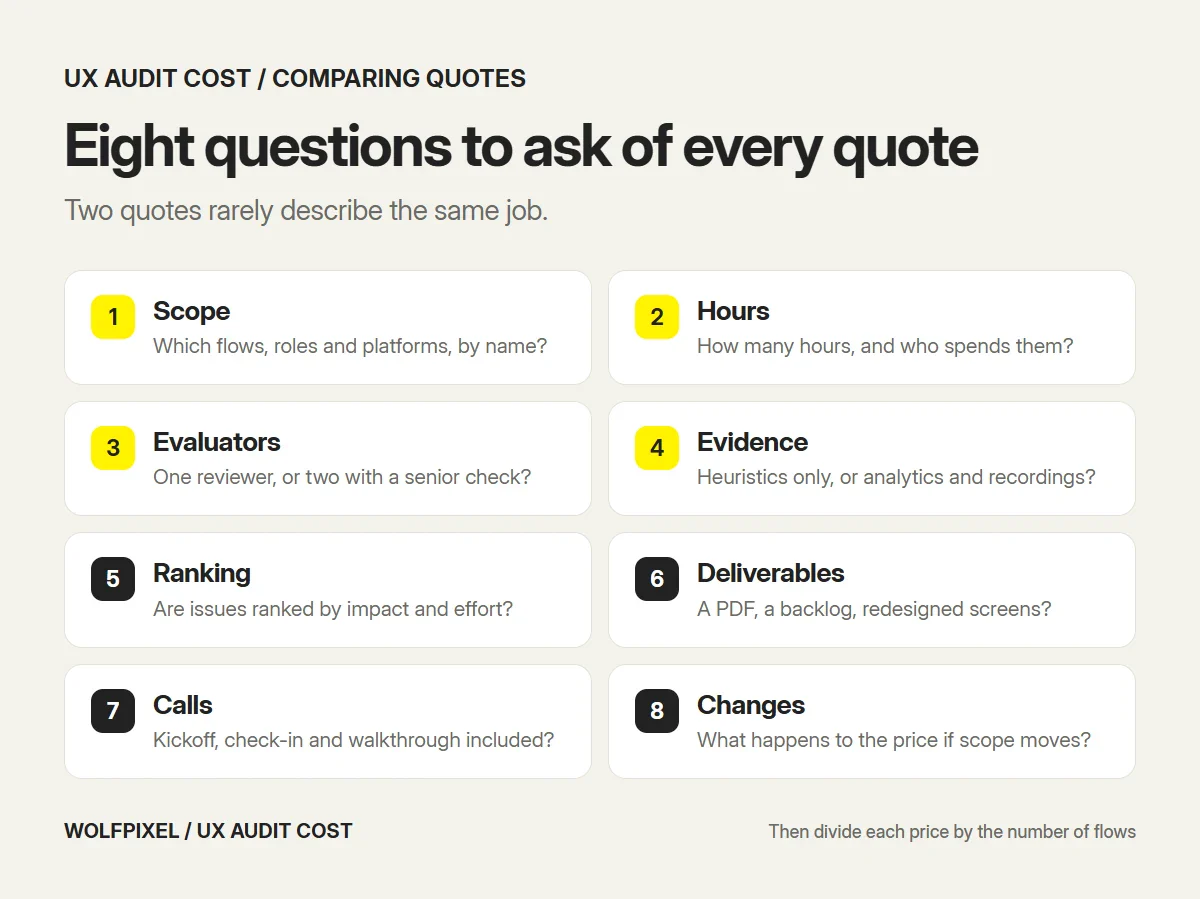
Then divide each price by the number of flows. A $9,000 quote for three flows with data is $3,000 a flow. A $4,000 quote for one flow from heuristics alone costs more per flow and gives you less proof.
A few red flags are worth walking away from:
- A price with no list of flows or screens behind it.
- A promised conversion lift. Nobody can guarantee one before seeing your data.
- A sample report where every issue has the same severity.
- No access to your analytics requested. That means the audit is opinion only.
- A report nobody will present to your team.
How to lower the cost before you ask for a quote
You control more of the price than you might think. Most of the savings come from doing the cheap preparation yourself.
- Bring one question. “Why do trials drop at step three?” is a one-flow audit. “Review our product” is a full one.
- Name the metric. Trial-to-paid, checkout completion, time to first value. It focuses the hours.
- Have analytics access ready. Funnels set up in advance save the auditor hours of digging.
- Share session recordings. If you use a recording tool, export the sessions for the flow in question.
- Set up test accounts. One login per user role, with realistic data, on staging or production.
- Send your support themes. The ten most common “how do I” tickets point straight at usability problems.
- Start with one flow. You can extend the audit to the rest of the product later, and the second round is faster because the team already knows your product.
Preparation also makes the audit better. An auditor who gets data on day one spends the hours on findings, not on waiting for access.
The cost after the audit: fixing what it finds
The audit is the smaller bill. What it finds has to be designed, built and tested, and that’s where most of the budget goes. A useful audit sorts its findings into three groups so you can price them.
| Type of fix | Examples | Who does it | Relative cost |
|---|---|---|---|
| Quick wins | Labels, error messages, button copy, default settings | Your developers | Low |
| Screen-level redesign | A clearer form, a better empty state, a reworked pricing table | A designer and your developers | Medium |
| Structural change | New onboarding flow, navigation, information architecture | A design project | High |
Ask for an effort estimate on every finding. Without one, you can’t tell a two-hour fix from a two-month one, and the ranking is only half useful.
When most findings fall in the third group, the product has outgrown its structure, and patching screen by screen costs more than it saves. That’s the point where a planned SaaS redesign is the cheaper route, and our SaaS redesign guide explains how to do it without losing existing users. If the findings are mostly inconsistent components and styles, the fix is a shared library, and our guide to design system cost covers what that takes.
What a UX audit costs at Wolfpixel
Our UX audits start at $2,500 and take 1 to 3 weeks. The price is fixed before we start, so you know the full cost up front.
What the starting price is for. $2,500 is a single-flow audit: one journey, such as signup, onboarding or checkout, on one platform and for one user role, with the screens behind that flow’s top issues redesigned. More flows, user roles and platforms raise the price, and your written quote names each one, so nothing in the list below is open-ended.
Every audit includes:
- A heuristic review of each flow in scope, tied to the screen and step where each issue happens.
- Funnel analysis from your analytics, and a review of real session recordings.
- An accessibility check against WCAG 2.2 AA and a competitor benchmark of your key flows.
- A fix list ranked by user impact, business value and effort.
- The screens behind your highest-impact issues redesigned in Figma, ready for your team to build.
- A mid-audit check-in and a walkthrough call, with the report in Figma and PDF.
The redesigned screens are the part most audits leave out. We include them because a ranked list still leaves your team with the hardest work, and a designed fix can go into the next sprint.
A few things aren’t part of an audit: a full product redesign, front-end development and ongoing analytics setup. If you need the rest designed after the audit, that continues as a UI/UX design project with the same team, whether the product is a web app or a mobile app.
Senior designers with 5+ years of experience run every audit, and we sign an NDA before you share access. To get a number for your product, send the flow you’re worried about through our UX audit services page. You’ll have a written quote after a free 30-minute call or within 4 business hours.
Sources and method
We reviewed every source below in November 2026. Prices are quoted as published and may have changed since.
Published prices
- Design Studio UI/UX: UX audit cost, for prices by scope and product type, role and testing add-ons and tool pricing.
- ArtVersion: what does a UX audit cost, for agency tiers with hours.
- Krux: how much does a UX audit cost, for scope ranges, freelance pricing and internal time.
- UXAudit.Now: UX audit pricing models, for audit tool subscriptions.
- Ronas IT: UX audit services guide, for an entry-level audit price.
- Eleken: UX audit agencies, for the enterprise range.
- Nielsen Norman Group: expert review pricing, for the research firm starting price of $60,000.
Usability research
- Nielsen Norman Group: how to conduct a heuristic evaluation, for three to five evaluators and the limits of heuristics.
- Nielsen Norman Group: severity ratings for usability problems, for single-evaluator reliability.
- Nielsen Norman Group: why you only need to test with 5 users, for test size.
- Baymard Institute: cart abandonment rate statistics, for the checkout conversion estimate.
Our own estimates
- The hours for a single-flow audit and the three example rates.
- The break-even table, built on an example budget of $14,000.
- The tier matrix and the comparison of tools, reviews, audits, testing and research, which summarize how these services are usually sold.
- Wolfpixel’s starting price and scope, which come from our own pricing page.
UX Audit Cost FAQs
How much does a UX audit cost?
Published 2026 price guides put a UX audit between about $500 and $80,000 or more. A one-person heuristic review of a few screens sits at the bottom, a single-flow audit with analytics and session review usually costs $3,000 to $15,000, a full product audit $8,000 to $35,000, and enterprise or research-firm audits start around $18,000 and pass $60,000.
Why do UX audit quotes vary so much?
A quote is hours multiplied by a rate, and both change a lot. The hours depend on how many flows, user roles and platforms are reviewed and on the evidence used, such as analytics, session recordings and user testing. The rate depends on who does the work. The same 50 hours costs $3,000 at $60 an hour and $10,000 at $200 an hour.
How long does a UX audit take?
Most audits take 1 to 4 weeks. A heuristic review of one flow can be done in a few days, a single-flow audit with data usually takes 1 to 2 weeks, and a full product with several user roles takes 2 to 4 weeks. Enterprise audits with user testing can run 4 to 8 weeks.
Is a cheap UX audit worth it?
It can be, if you treat it as a first pass. A low-cost audit is usually one evaluator applying a checklist, without your analytics or recordings. It finds visible usability problems, but it can’t tell you which ones cost you money, and Nielsen Norman Group warns that severity ratings from a single evaluator are unreliable.
Can an AI tool replace a UX audit?
Not fully. AI and automated tools are good at fast, repeatable checks such as contrast, missing labels, layout consistency and obvious heuristic issues on a single screen. They don’t see your funnel data, your users’ goals or the logic of a multi-step flow, so they can’t rank problems by business impact. Many teams run a tool first and bring in an expert for the flows that carry revenue.
What is the difference between a UX audit and usability testing?
A UX audit is an expert review of your product, backed by your analytics and session recordings, with no new participants. Usability testing puts real users in front of the product and watches them attempt tasks. An audit is faster and finds what is broken. Testing shows whether people can actually complete a task. One published guide says adding moderated testing raises an audit’s price by $2,000 to $6,000.
Is the UX audit report included in the price?
Yes. The report is the main deliverable at every price level, so a UX audit report cost is not usually a separate line. What changes with price is the depth of the report. A light review gives a list of issues, while a full audit gives annotated screens, evidence for each finding, a ranked backlog and a walkthrough call. Redesigned screens are often priced separately.
What should a UX audit quote include?
It should name the flows, user roles and platforms in scope, the evidence that will be used, how many evaluators review the product, the deliverables, the number of calls, the timeline and what happens to the price if scope changes. It should also say whether redesigned screens are included or priced separately.
How much does it cost to fix what a UX audit finds?
Often more than the audit itself. Copy, labels and settings changes can cost little, redesigning a handful of screens is a small design project, and structural changes such as a new onboarding flow or navigation are a redesign project. Ask for effort estimates on every finding so you can budget the fixes before you approve the audit.
Is a UX audit worth the cost?
It is when the flow under review carries enough revenue. Divide the cost of the audit and its fixes by the yearly revenue that passes through the flow. If the result is a revenue uplift of a few percent, the audit has a realistic chance to pay back. If you would need an uplift above about 10% to break even, consider narrowing the scope or fixing the most obvious problems first.
How much does a UX audit cost at Wolfpixel?
Wolfpixel UX audits start at $2,500 and take 1 to 3 weeks. The starting price is for a single flow on one platform with one user role, and more flows, platforms and roles raise it. Every audit is run by senior designers and includes a ranked fix list and the screens behind your highest-impact issues redesigned in Figma. You get a written quote after a free 30-minute call or within 4 business hours.
Want a fixed price for your UX audit?
Send us the flow or product you want reviewed. A senior designer replies within 4 business hours with the scope and a written quote, and we’re happy to sign an NDA before you share anything.

Was this article helpful?

Written by
Maniruzzaman Jubayer
Co-founder & COO | Product Design Specialist at Wolfpixel
Maniruzzaman Jubayer is Wolfpixel’s Co-founder & COO and a product design specialist with 7 years of experience. He personally oversees website, app, dashboard and digital product design at Wolfpixel. This guide compares published UX audit prices and explains the scope, hours and evidence behind a quote. Wolfpixel offers the UX audit services discussed in the article.
View all articles