







 18 min read
 Published

A UX research strategy decides what your team will learn about users, in what order and why. Without one, research happens when someone has time or when a launch is already in trouble. The questions that matter most, such as why trials don’t convert or why accounts churn after the first renewal, never get studied properly because there is always a sprint in the way.
I’m Maniruzzaman Jubayer, Co-founder & COO and Product Design Specialist at Wolfpixel, with 7 years of experience. Most guides to research strategy are written for research teams inside large companies. This one is for SaaS founders, product leads and design leads who may not have a researcher at all, and who need research to keep up with a product that ships every week.
The short answer: to build a UX research strategy for a SaaS product, tie research to the metrics your company is trying to move, list and score the questions the team can’t yet answer, choose methods and a regular cadence, set up lightweight recruiting and a place to store findings, plan the next 12 months by quarter and track the decisions research changes. Keep the whole thing on one page.
Key takeaways:
- Start from decisions and metrics, not methods. Research that can’t change a decision is a report nobody reads.
- Score research questions by impact, uncertainty and timing. Research the top three first and say no to the rest for now.
- Mix two tempos: weekly customer conversations and a monthly analytics review, plus one or two deeper studies each quarter.
- In B2B SaaS, the buyer, the admin and the daily user are different people. Plan research for each.
- Measure impact in decisions changed and metrics moved, not in studies completed.
How we wrote this: we reviewed the pages ranking for this topic in November 2026, including User Interviews, Maze, Nielsen Norman Group, UXinsight, UXR Institute and Survicate, and read the research reports behind their figures. Statistics are linked to the original publisher. The 7-step process, the scoring model, the stage table, the roadmap and the template are our own recommendations from planning research with SaaS teams at Wolfpixel, and we label them that way. The full list is in Sources and method.
What is a UX research strategy?
A UX research strategy is a plan for the learning your product team needs over the next six to twelve months. It answers five questions: why research is done (which goals and decisions it supports), what the team needs to learn, who it learns from, how and when the research happens, and how findings turn into decisions.
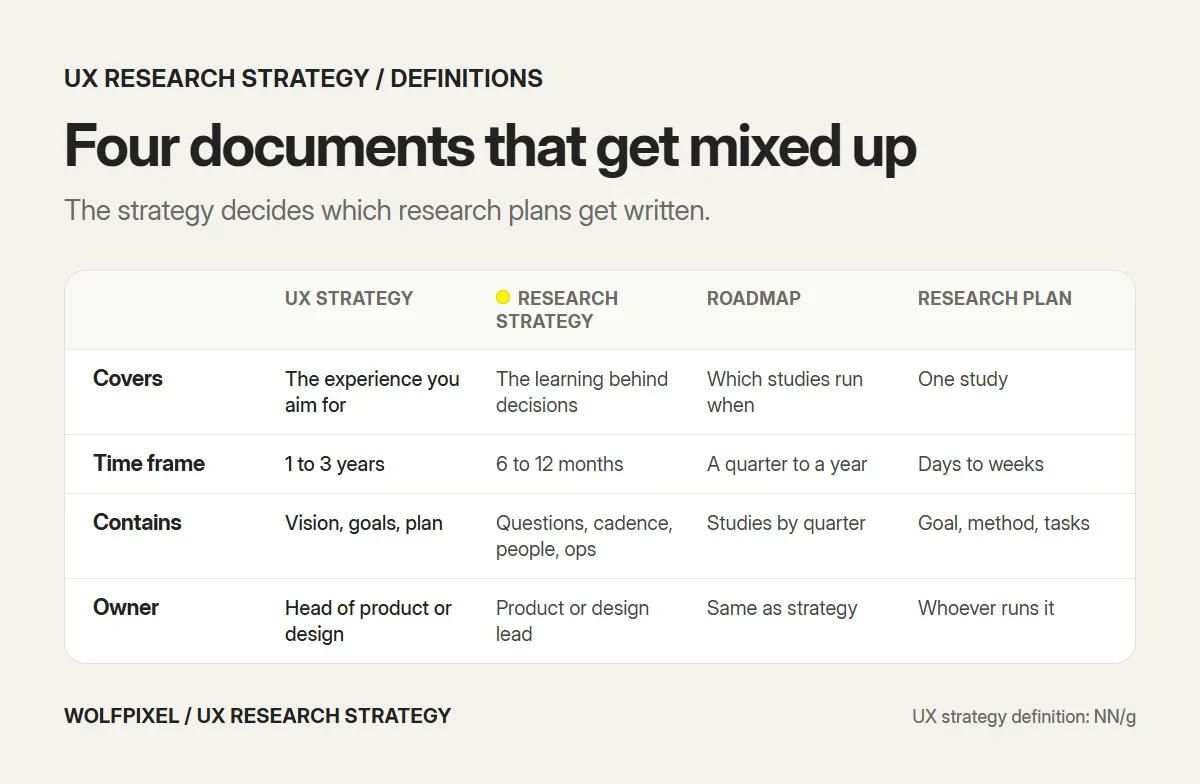
It sits between two things that are often confused with it:
| UX strategy | UX research strategy | Research roadmap | Research plan | |
|---|---|---|---|---|
| What it covers | The experience you are building toward | The learning that feeds product decisions | Which studies run when | One study |
| Time frame | 1 to 3 years | 6 to 12 months | A quarter to a year | Days to weeks |
| Key content | Vision, goals and measures, plan | Questions, priorities, cadence, people, operations | Studies by quarter | Goal, method, participants, tasks |
| Typical owner | Head of product or design | Product or design lead, or a researcher | Same as the strategy | Whoever runs the study |
Nielsen Norman Group defines a UX strategy as “a plan of actions designed to reach an improved future state”, made of a vision, goals and measures, and a plan. The research strategy is the part of that plan that decides what the team must learn to get there. The roadmap and the research plans are how it gets done.
Strategic vs tactical research
A good strategy balances two kinds of research:
- Tactical research answers near-term questions about a specific design: can people complete setup, which label works, why this step fails. It keeps sprints honest.
- Strategic research answers bigger questions about where the product should go: which segment to focus on, why accounts churn, what jobs the product is hired for. It shapes the roadmap.
Teams without a strategy end up doing only tactical research, because it is always urgent. A strategy reserves time for the strategic questions before they become emergencies.
Why SaaS products need their own research strategy
Most research strategy advice assumes a large company with a research team. A SaaS product has different pressures:
- Revenue depends on behavior after the sale. Activation, retention and expansion are all user behaviors, so research has to keep going after signup.
- The product ships constantly. Research has to keep pace with weekly releases, not run as an annual project.
- B2B buyers are a group. The person who buys, the admin who sets the product up and the people who use it daily want different things. Our guide to B2B SaaS UX covers how those roles change the design.
- Your users are reachable. Unlike many products, a SaaS team can email, message and schedule calls with its own users. Recruiting is easier than most teams assume.
Research is also gaining ground with leadership. In Maze’s 2026 report, the share of organizations where research is essential to all levels of business strategy rose from 8% in 2025 to 22% in 2026. But proving its value is still hard: in User Interviews’ 2025 survey of researchers, only 21% found their approaches to tracking research impact satisfactory. A strategy that ties each study to a decision fixes most of that problem.
How to build a UX research strategy in 7 steps
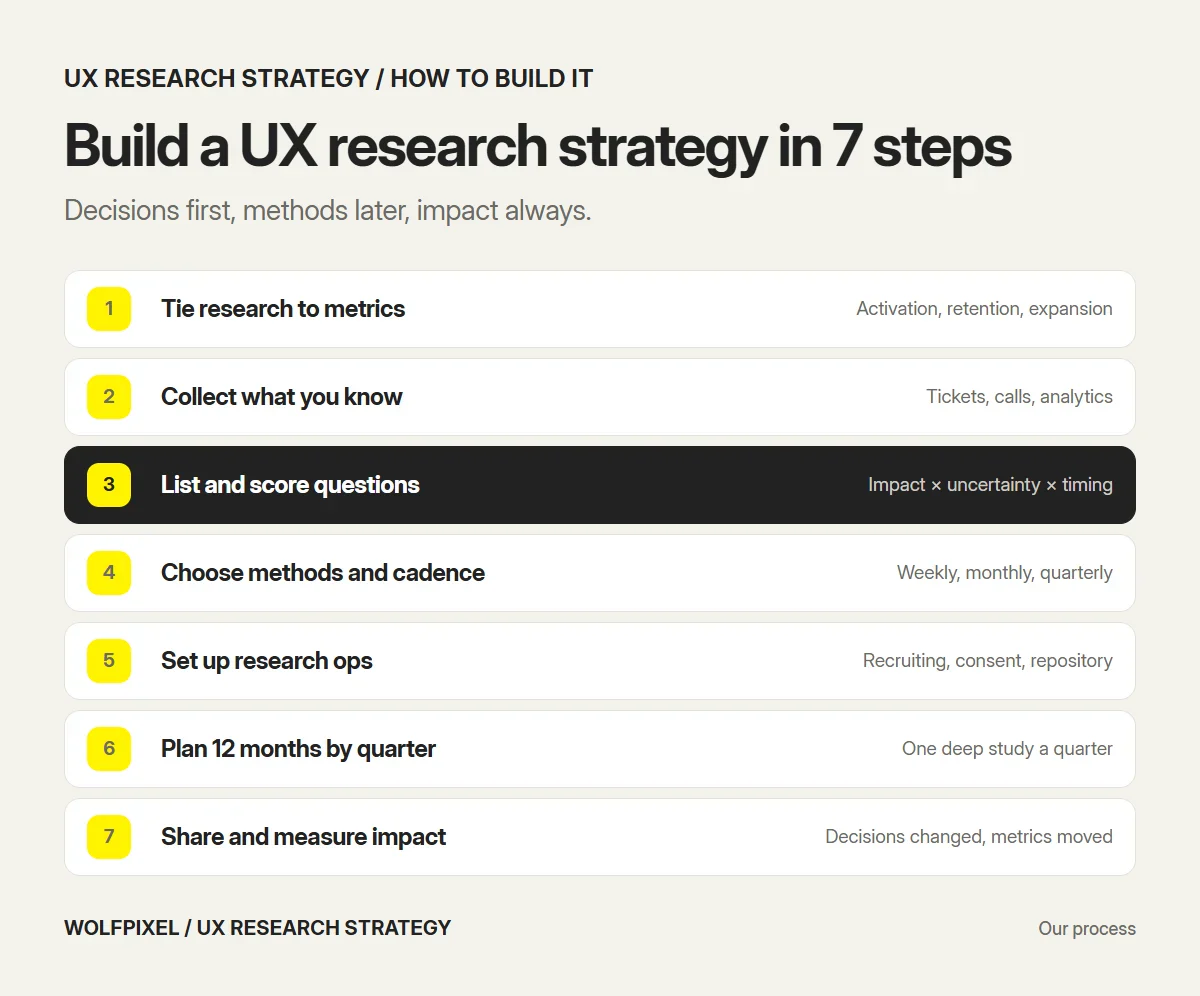
This is the process we use when a SaaS team asks us to plan its research. It produces a one-page strategy and a 12-month roadmap.
Step 1: Tie research to the metrics your company is trying to move
Start with the two or three goals leadership already cares about this year, and the metric for each. For most SaaS products, they come from the same short list:
- Acquisition: visitor-to-trial or visitor-to-demo conversion.
- Activation: the share of new accounts that reach first value, and how long it takes.
- Retention: logo churn, revenue churn, usage in the first 90 days.
- Expansion: seat growth, upgrades, adoption of paid features.
- Efficiency: support tickets per account, time to onboard a customer.
Every research question in your strategy should connect to at least one of these. If the company goal is “reduce churn in the first year”, research on churned accounts and early usage belongs at the top. A redesign of the settings page probably does not.
Step 2: Collect what you already know
Before you recruit anyone, gather the evidence the company already has. Most SaaS teams are sitting on more user insight than they think:
- Support tickets and chat logs, tagged by topic.
- Sales call notes and lost-deal reasons.
- Cancellation reasons and churn surveys.
- Product analytics: funnels, feature usage, retention cohorts.
- Session recordings of key flows.
- Past research, even if it is scattered across documents.
Write down what this evidence says, and where it disagrees. The gaps and contradictions become your research questions. This step alone often answers a few questions without any new research.
Step 3: List the research questions and score them
Ask product, design, engineering, sales and customer success the same question: what do we need to know about users to make our next big decisions well? You will get far more questions than you can research. Write each one as a question with a decision attached (“Why do admins stop at the data import step, so we can decide whether to rebuild it or add a migration service?”).
Then score each question from 1 to 3 on three factors:
- Impact: how big is the decision it informs, measured against the metrics from step 1?
- Uncertainty: how unsure is the team? If everyone would make the same decision whatever the answer, research is waste.
- Timing: how soon will the decision be made? Research that arrives after the decision is decoration.
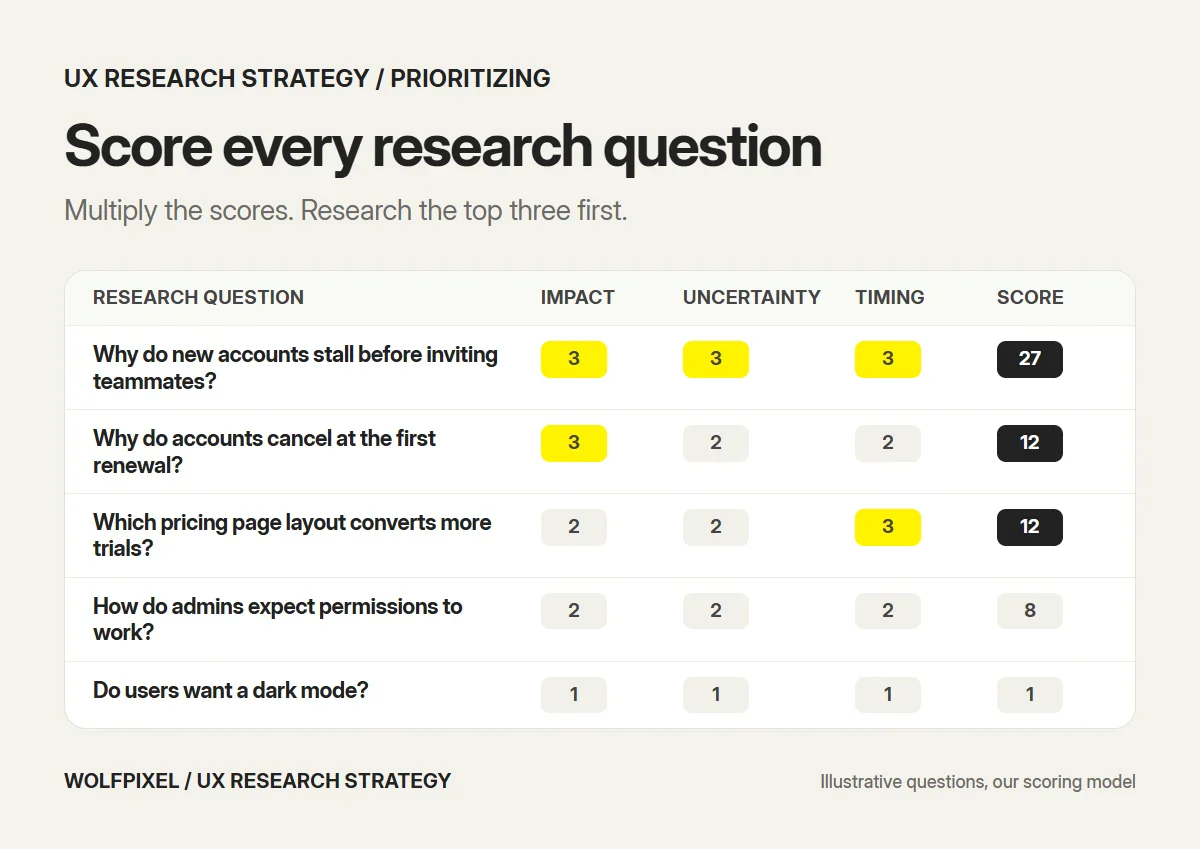
| Example research question (illustrative) | Impact | Uncertainty | Timing | Score |
|---|---|---|---|---|
| Why do new accounts stall before inviting teammates? | 3 | 3 | 3 | 27 |
| Why do accounts cancel at the first annual renewal? | 3 | 2 | 2 | 12 |
| Which pricing page layout converts more trials? | 2 | 2 | 3 | 12 |
| How do admins expect roles and permissions to work? | 2 | 2 | 2 | 8 |
| Do users want a dark mode? | 1 | 1 | 1 | 1 |
We multiply the scores, so a question has to do well on all three to reach the top. Research the top three. Park the rest, and revisit the list every quarter. Saying no to low-scoring requests is part of the strategy, not a failure of it.
Step 4: Choose methods and a cadence
Each priority question now needs a method. The method follows from the question: reasons need interviews or usability tests, numbers need surveys or analytics, and behavior is best observed rather than asked about. Our guide to the types of UX research covers 12 methods with participant numbers and a decision table.
Then set a cadence with two tempos:
- Always-on research, small and regular. Teresa Torres defines continuous discovery as “weekly touch points with customers by the team building the product”. For a SaaS team, that can be two or three customer conversations a week, a monthly review of analytics and recordings, and a few usability tests whenever a significant design is ready.
- Deep studies, one or two per quarter, aimed at the top-scored strategic questions: a churn interview study, a diary study of onboarding, a navigation card sort before a redesign.
Step 5: Set up lightweight research operations
Research operations is everything that makes research repeatable. A small SaaS team needs only the basics, but it needs all of them:
- Recruiting: a way to reach each user group. In-app prompts and customer success introductions work well for current users. Churned users and buyers who never signed up are harder, so plan for them.
- Incentives: a standard amount per session for each user group, approved in advance so nobody negotiates it every time.
- Consent and privacy: a consent form, a rule for how recordings are stored and deleted, and care with customer data. Large B2B customers may need their own approval before their staff take part.
- A repository: one searchable place for findings, tagged by user group, product area and metric. A well-organized document or database is enough to start.
- Templates: a research plan, a discussion guide, a usability test script and a findings format, so each study does not start from zero.
Step 6: Plan the next 12 months by quarter
Put the always-on research and the deep studies on one timeline. Tie each quarter’s deep study to a decision coming up that quarter, such as a pricing change, a new segment or an onboarding redesign.
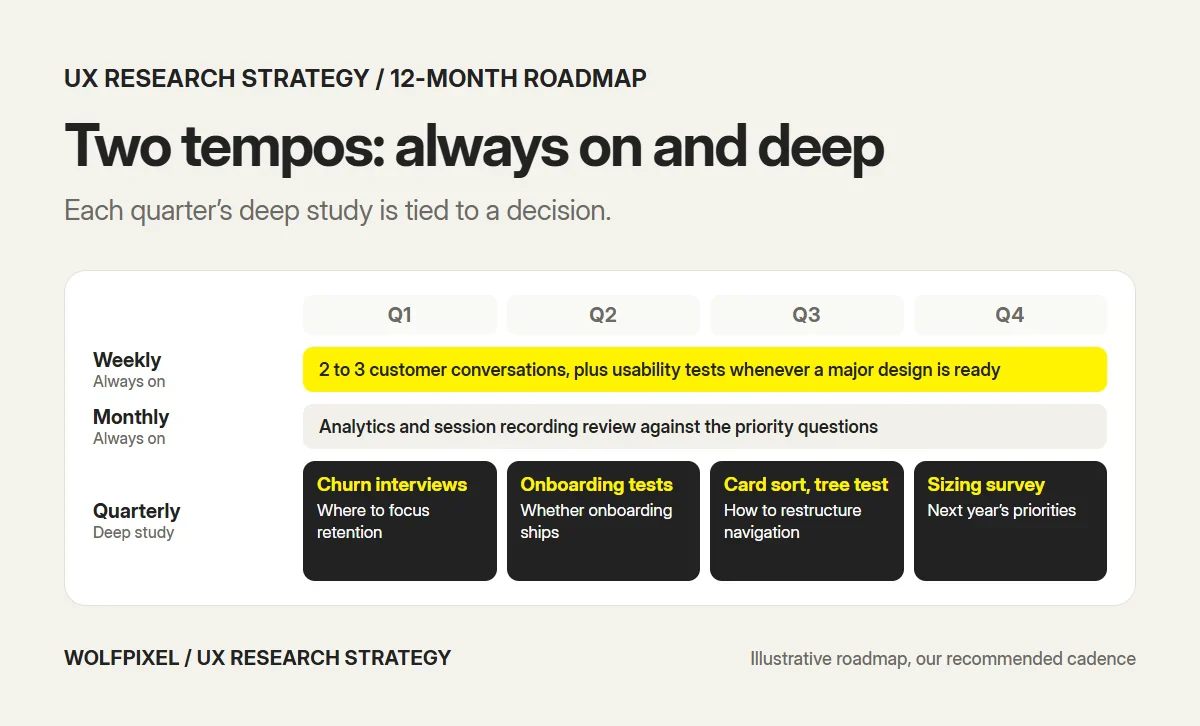
| Quarter | Deep study (illustrative) | Decision it informs | Always-on |
|---|---|---|---|
| Q1 | Interviews with churned and retained accounts | Where to focus retention work | Weekly customer calls, monthly analytics review |
| Q2 | Usability tests of the redesigned onboarding | Whether the new onboarding ships | Same, plus tests of each major design |
| Q3 | Card sort and tree test of the navigation | How to restructure the product as features grow | Same |
| Q4 | Survey to size the top problems found this year | Next year’s roadmap priorities | Same, plus the annual strategy review |
Leave room. New questions will appear, and a roadmap with no slack turns every new question into a fight.
Step 7: Share findings and measure impact
Findings only matter if they reach the people who decide, in time. Share them as you go rather than in one big deck at the end. Each finding should state the evidence, the decision it informs and a recommended next step.
To show research is worth it, keep a simple impact log:
- Decisions changed: what the team did differently because of a finding.
- Bets stopped: features or projects research showed were not worth building.
- Metrics moved: the change in activation, retention or support volume after a research-led change ships.
That log, reviewed every quarter, is the strongest argument for continuing to invest in research.
A UX research strategy by SaaS stage
The right strategy depends on the company’s stage. A pre-product-market-fit startup and a scaling SaaS company have very different questions.
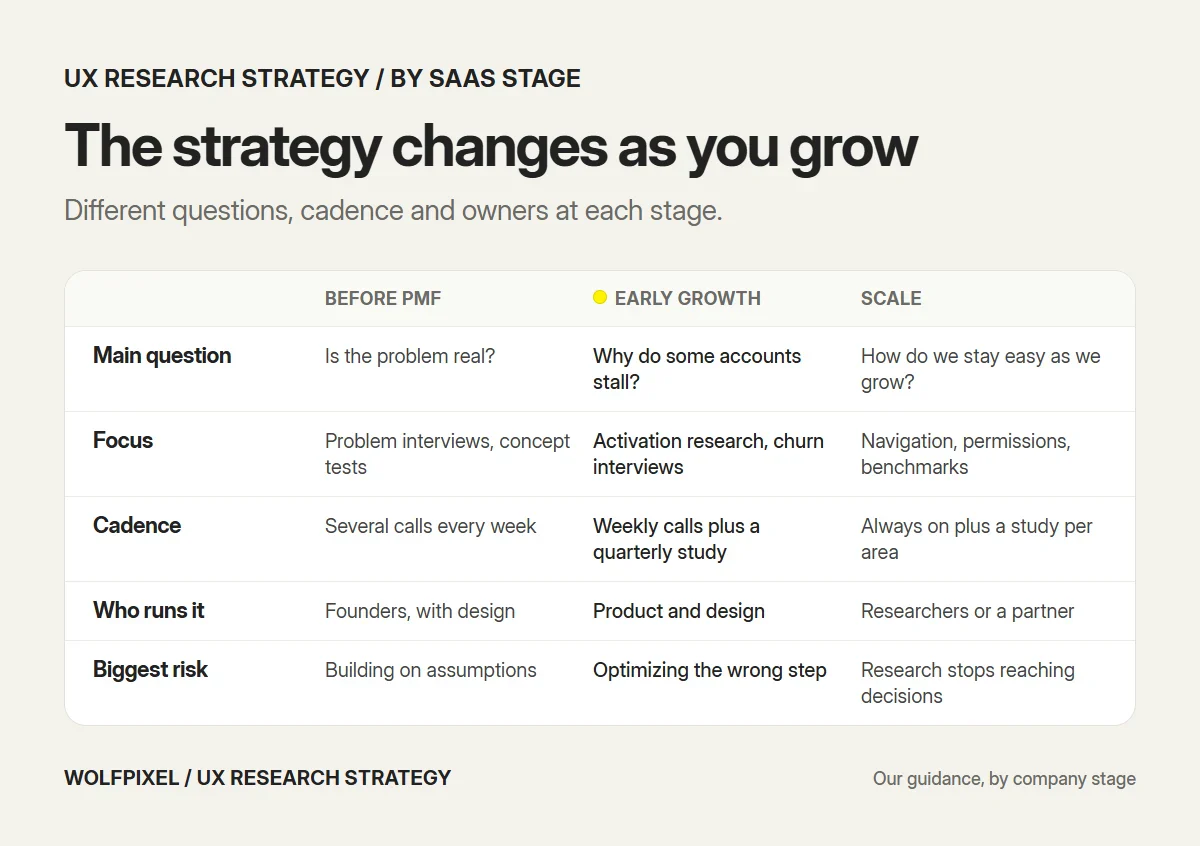
| Before product-market fit | Early growth | Scale | |
|---|---|---|---|
| Main question | Are we solving a real problem for a specific customer? | Why do some accounts activate and others stall? | How do we keep a complex product easy as it grows? |
| Research focus | Problem interviews, concept and prototype tests | Onboarding and activation research, churn interviews | Navigation, permissions, admin experience, benchmarks |
| Cadence | Several conversations every week | Weekly conversations plus a quarterly study | Always-on research plus a study per product area |
| Who runs it | Founders, with design support | Product and design, with a shared process | Dedicated researchers or a partner, with research operations |
| Biggest risk | Building on assumptions | Optimizing the wrong step | Research that no longer reaches decisions |
Nielsen Norman Group’s UX maturity model describes six stages, from absent to user-driven. In its quiz of 5,371 UX professionals, about half placed their organization at stage 3, emergent, where UX work is functional but inconsistent. NN/g notes those respondents are not a representative sample. A research strategy is one of the most direct ways to move a team from inconsistent research to a repeatable process.
A one-page UX research strategy template
Keep the strategy short enough that people actually read it. This is the template we use. Copy it into a document and fill in each line.
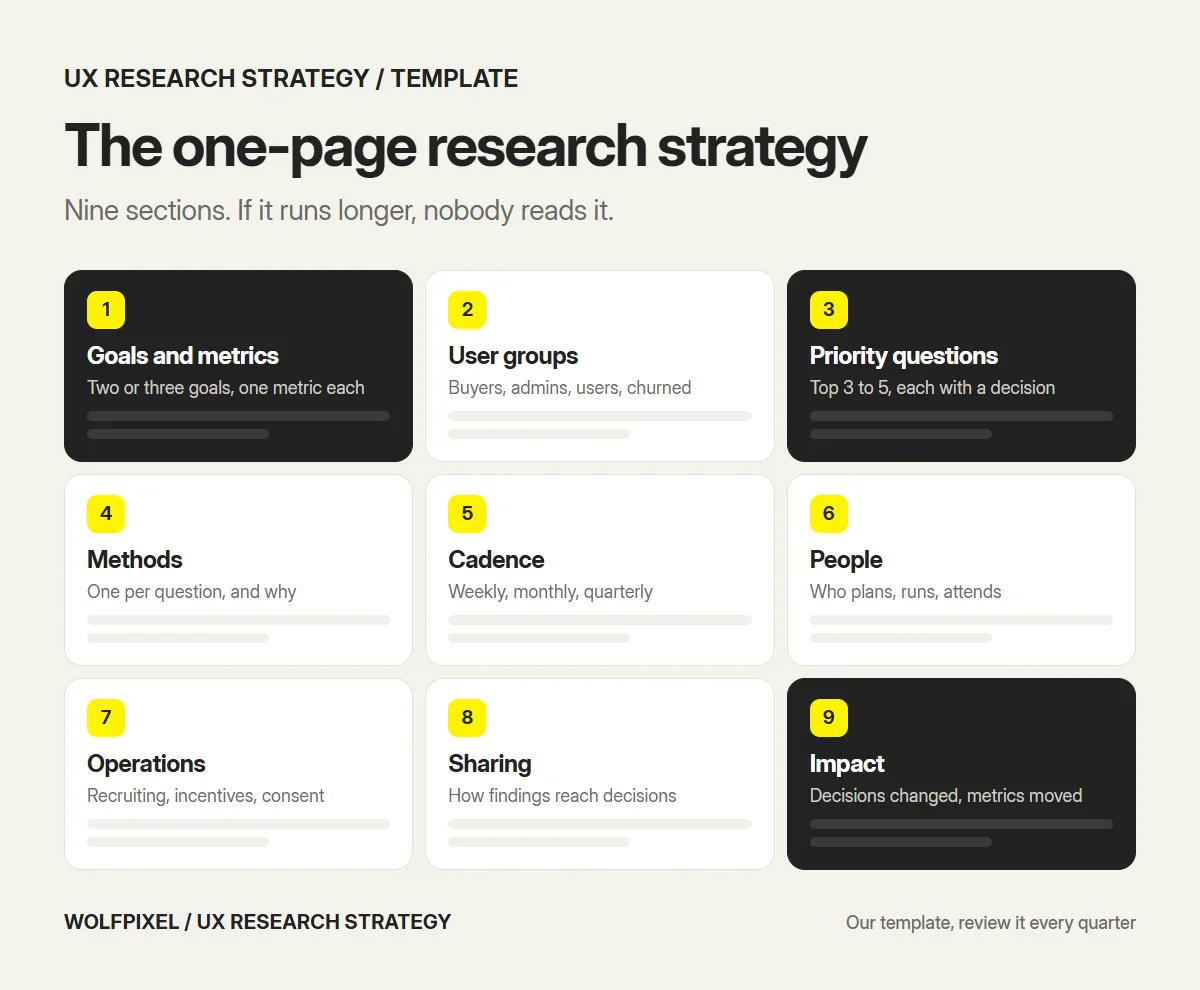
| Section | What to write |
|---|---|
| 1. Goals and metrics | The two or three company goals research supports, with the metric for each |
| 2. User groups | Who you learn from: buyers, admins, daily users, trial users, churned accounts |
| 3. Priority questions | The top three to five scored questions, each with the decision it informs |
| 4. Methods | The method for each priority question, and why |
| 5. Cadence | Always-on research (weekly, monthly) and deep studies (quarterly) |
| 6. People | Who plans, runs and analyzes research, and who must attend sessions |
| 7. Operations | Recruiting channels, incentives, consent, repository, templates |
| 8. Sharing | How and when findings reach decision-makers |
| 9. Impact | What you will track: decisions changed, bets stopped, metrics moved |
Review it every quarter, when you re-score the questions and plan the next deep study.
Common UX research strategy mistakes
- Starting with methods. “We should do more usability testing” is a tactic, not a strategy. Start with the decisions.
- Researching only what is easy to recruit. Current happy users are easy to reach. Churned accounts and lost deals are where the expensive problems are.
- Treating the buyer as the user. In B2B SaaS, the person who signed the contract may never log in. Research both.
- A strategy nobody reads. Twenty pages will be skimmed once. One page gets used.
- No owner. A research strategy without a named owner turns into a document from last year.
- Measuring output instead of impact. “We ran 14 studies” means little to leadership. “Research stopped two features and cut onboarding time” means a lot.
Who should run research in a SaaS team?
You don’t need a research department to have a research strategy. In early-stage teams, founders, product managers and designers run most of the research, and that works when the process is clear. As the product grows, the questions get harder and the cost of getting them wrong rises. That is usually when a dedicated researcher or an outside partner pays for itself.
Bring in a partner when research questions pile up faster than the team can answer them, when a high-stakes decision needs evidence quickly, such as a redesign or a new segment, or when the people who would run the research are also the people who designed the product and are too close to it.
In our UX research projects, senior product designers plan the study, recruit participants (including hard-to-reach B2B roles), run the sessions and share findings at weekly check-ins, each tied to the decision it informs. Because the same team can design the fixes, nothing is lost in a handover. If the product is already live and you need to know what to fix first, a UX audit is often a faster start, and our SaaS design team can carry the findings into the product.
Sources and method
We reviewed every source below in November 2026.
- Nielsen Norman Group: UX strategy, definition and components (Anna Kaley and Sarah Gibbons, March 20, 2022), for the definition and the three components.
- Nielsen Norman Group: The 6 levels of UX maturity (June 13, 2021, reviewed January 2024), for the six stages of the maturity model.
- Nielsen Norman Group: The state of UX maturity, data from our online quiz (Kate Moran, January 16, 2022), for the 5,371 respondents and the share at stage 3.
- Product Talk: Continuous discovery (Teresa Torres, undated), for the definition of continuous discovery.
- Maze: The future of user research report 2026 (March 11, 2026), for the rise from 8% to 22% of organizations where research is essential to business strategy.
- User Interviews: State of research strategy 2025 (October 22, 2025), for the 21% satisfied with their impact tracking.
Our own recommendations
- The 7-step process, the scoring model and example scores, the cadence, the operations checklist, the stage table, the example roadmap, the template and the list of mistakes, based on how we plan research with SaaS teams at Wolfpixel. The example questions and roadmap are illustrations, not data from a client.
UX Research Strategy FAQs
What is a UX research strategy?
A UX research strategy is a plan for what your team will learn about users, why, when and how, tied to the business decisions and metrics that matter most. It covers the research questions in priority order, the methods and cadence, who does the work, how participants are recruited and how findings reach the people who decide.
What is the difference between a UX research strategy and a research plan?
A research plan covers one study, with its goal, method, participants, tasks and timeline. A research strategy covers all research over six to twelve months, with the questions in priority order, the cadence, the people and the operations behind them. The strategy decides which research plans get written.
What is the difference between UX strategy and UX research strategy?
UX strategy is the plan for the user experience itself. Nielsen Norman Group describes it as a vision, goals and measures, and a plan to reach an improved future state. A UX research strategy is narrower. It plans the learning that feeds that strategy and the product decisions along the way.
What should a UX research strategy include?
At minimum, the business goals and metrics research supports, the user groups to learn from, a ranked list of research questions, the methods and cadence, the people responsible, the recruiting and consent process, where findings are stored, and how you will know research made a difference.
How do you prioritize UX research questions?
Score each question on how big the decision is, how uncertain the team is and how soon the decision will be made. Multiply or add the scores, research the highest first, and drop questions where the team would make the same decision whatever the answer.
Do you need a dedicated UX researcher to have a research strategy?
No. Many SaaS teams run research through designers and product managers, with a clear strategy, a shared recruiting process and a simple repository. A dedicated researcher or an outside partner becomes worth it when research questions pile up faster than the team can answer them, or when the stakes of a decision are high.
How often should a SaaS team do user research?
Small, regular research beats occasional big studies. Product coach Teresa Torres defines continuous discovery as weekly touch points with customers by the team building the product. A practical starting point is a few conversations a week, a monthly review of analytics and recordings, and one larger study per quarter.
How do you measure the impact of UX research?
Track the decisions research changed, the bets it stopped, and the product metrics that moved after research-led changes, such as activation, retention or support tickets. A simple log of findings, decisions and outcomes is more convincing to leadership than a count of studies run.
How much should a SaaS company spend on UX research?
There is no standard percentage. Budget by questions, not by headcount. Estimate the studies your top three questions need, add participant incentives and tools, and compare that with the cost of building the wrong thing. For many early-stage teams, one focused study per quarter plus weekly customer conversations is enough.
Want a research plan built around your next big decision?
Tell us what your team needs to decide this quarter. A senior designer replies within 4 business hours with the questions we would research first, the methods and a fixed quote.

Was this article helpful?

Written by
Maniruzzaman Jubayer
Co-founder & COO | Product Design Specialist at Wolfpixel
Maniruzzaman Jubayer is Wolfpixel’s Co-founder & COO and a product design specialist with 7 years of experience. He personally oversees website, app, dashboard and digital product design at Wolfpixel, including the user research that comes before the design. This guide shows SaaS product leads how to plan research around the decisions that matter. Wolfpixel offers the UX research services discussed in the article.
View all articles