


 18 min read
 Published
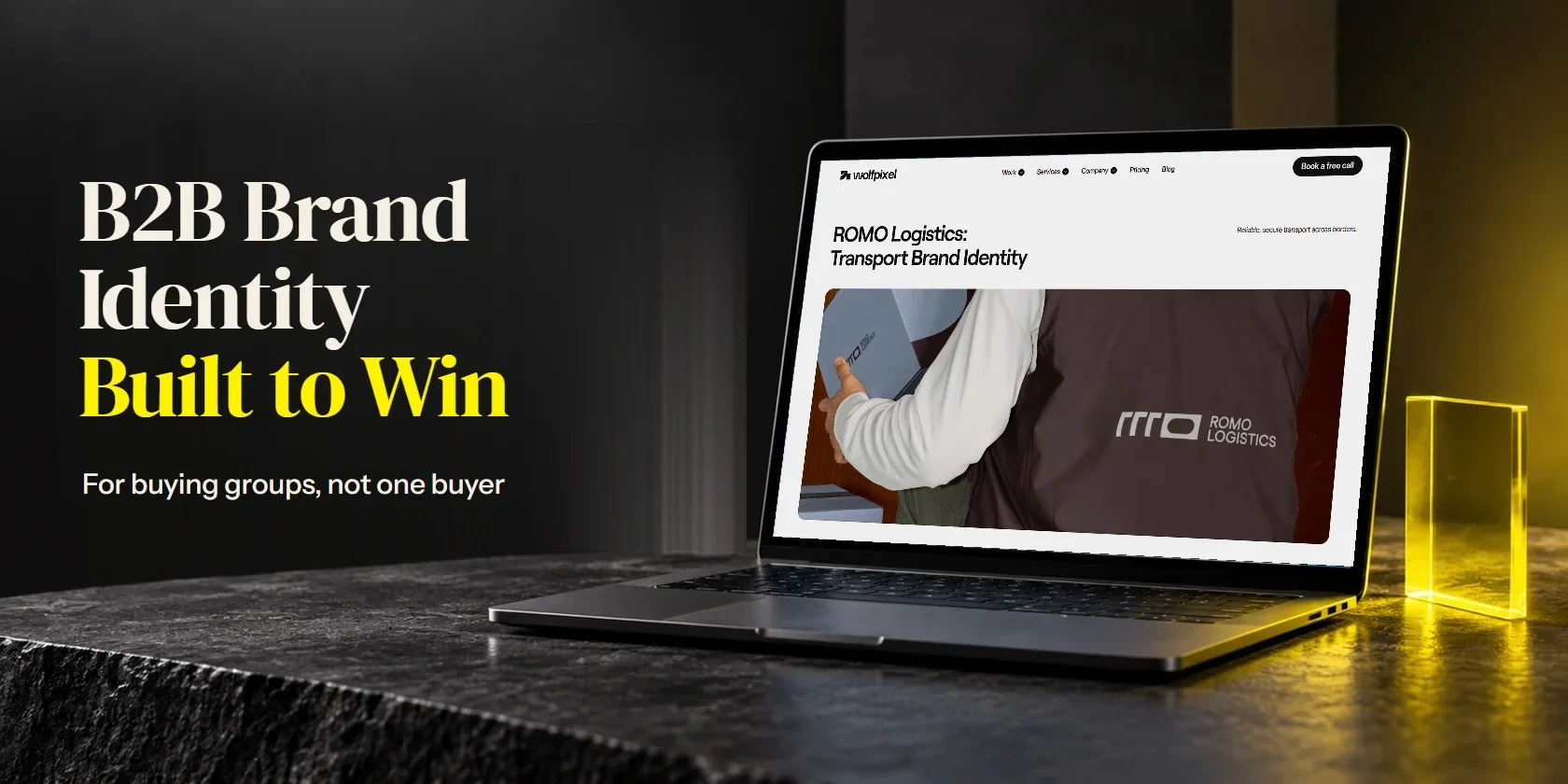
A B2B brand identity is the set of strategic, verbal and visual elements a company that sells to other businesses controls so that buyers recognize it, understand it and trust it. That includes your positioning and messaging, your logo, color and type, and the templates and rules that carry them into sales decks, proposals, security pages, documentation and the product itself.
I’m Masuder Rahaman, Founder & CEO of Wolfpixel and Brand Design Director, with 8+ years of experience. Most articles on this topic stop at the logo and a list of brand values. In B2B, the identity is judged by a whole buying group, often in places the brand team never sees: a procurement form, a security review, a proposal forwarded to the CFO. This guide is about building an identity that holds up in those places.
The short answer: a strong B2B brand identity is built for a group, not a person. Forrester reports that on average 13 people are involved in a B2B buying decision. Each of them meets your brand somewhere different, so the identity has to be a system: one clear position, a distinctive visual and verbal identity, and templates that make every touchpoint look like the same trustworthy company.
Key takeaways:
- B2B identity is designed for a buying group. The finance lead, the security reviewer and the end user each need different proof from the same brand.
- B2B buyers are not purely rational. In one large study of 3,000 buyers, emotional attachment to the chosen brand was higher in B2B than in B2C, so “safe but generic” is not a winning strategy.
- The sales deck, the proposal, the security page and the product interface are where enterprise buyers actually judge your identity. Design them as carefully as the homepage.
- Distinctive assets work only if they are unique and used consistently for years. Most B2B identities fail on consistency, not on the logo.
- If you sell more than one product, decide your brand architecture before you design product logos.
How we wrote this: we reviewed the pages ranking for “B2B brand identity” in November 2026, including Directive, Branding Business, Focus Lab, Good Brand Consultants and DeSantis Breindel, and read the research behind them: Forrester’s 2024 State of Business Buying, Gartner’s 2025 buying group survey, the CEB and Google “From Promotion to Emotion” study, Bain’s B2B Elements of Value and the Ehrenberg-Bass Institute’s work on distinctive assets. Where a study is older, we say so. Figures are linked to the original publisher. The buying group map, the touchpoint checklist and the process are our own, based on how we build identities at Wolfpixel. The full list is in Sources and method.
What is a B2B brand identity?
Brand identity is the part of your brand you control. Your brand image is what buyers actually think of you. The identity is how you try to shape that image, deliberately and the same way every time.
A complete B2B brand identity has three layers:
- Strategy: who you serve, what you do better than the alternatives and why a buyer should believe it. This is the positioning.
- Expression: how that position sounds and looks. Messaging, tone of voice, name, logo, color, type, imagery and icons.
- System: the templates, product tokens and guidelines that let a growing team apply the expression without a designer in the room.
Most identities that fail in B2B fail at the third layer. The logo is fine. Then the sales team builds its own deck, the product team picks its own blue, and two years later the company looks like five companies. If you are new to the basics, our guide to what brand identity is covers the general definition and elements. This guide focuses on what changes when your buyers are businesses.
How B2B brand identity differs from B2C
The elements are the same. The job is different.
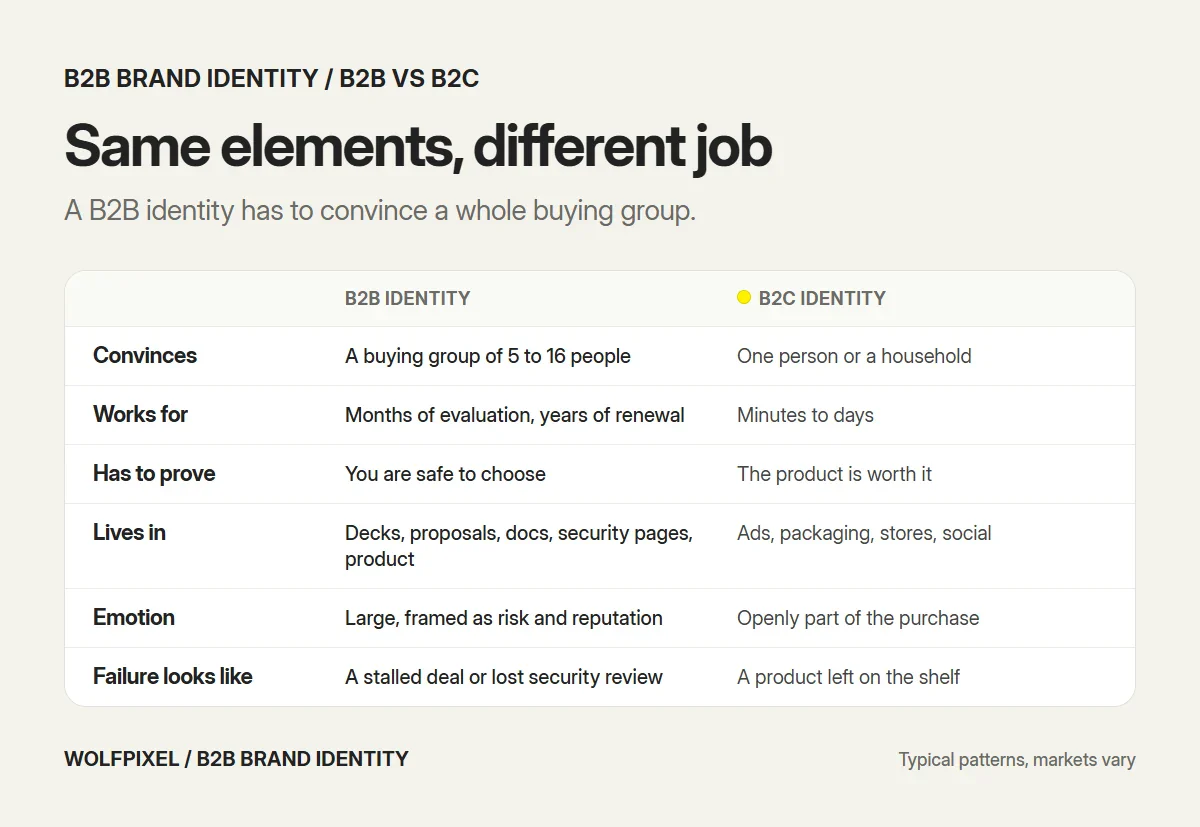
| B2B brand identity | B2C brand identity | |
|---|---|---|
| Who it has to convince | A buying group: users, finance, IT, security, procurement, executives | Usually one person or a household |
| How long it has to work | Weeks to months of evaluation, then years of renewal | Often minutes to days |
| What it has to prove | That the company is safe to choose and will still be there next year | That the product is desirable and worth the price |
| Where buyers meet it | Sales decks, proposals, demos, documentation, security pages, the product, peers | Ads, packaging, stores, social media |
| Role of emotion | Large, but expressed as risk reduction and personal reputation | Openly part of the purchase |
| What failure looks like | A stalled deal, a lost security review, a forwarded deck that looks amateur | A product left on the shelf |
Three findings explain why the B2B column looks the way it does.
- The group is large and it disagrees. Gartner describes buying groups ranging from five to 16 people across as many as four functions, and found that 74% of buyer teams show unhealthy conflict during the decision. Forrester found that 89% of purchases involve two or more departments.
- Emotion matters more, not less. In a 2013 study of 3,000 B2B buyers, still one of the largest on the topic, CEB and Google found that a greater proportion of B2B customers are emotionally attached to the brand they purchased than B2C consumers are, and that personal value, such as confidence and professional reputation, has twice the impact of business value.
- Business value alone no longer separates you. The same 2013 study found that only 14% of buyers see enough difference between suppliers’ business value to pay extra for it. Bain’s B2B Elements of Value model makes the same point from another angle: alongside price and performance, whether a product can enhance the buyer’s reputation or reduce anxiety plays a large role.
The CEB and Google research is older than the Forrester and Gartner figures, but the newer buyer studies point the same way: larger groups, more internal disagreement and more personal risk for whoever champions a vendor. Put together: a B2B identity has to make a group of people with different worries feel that choosing you is safe for their career. That is a design brief, not only a marketing one.
The elements of a B2B brand identity
These are the elements we define on every B2B identity project, and what each one has to do for business buyers.
| Element | What it includes | What it has to do in B2B |
|---|---|---|
| Positioning | Who you serve, the problem you solve, why you are better, the proof | Give every member of the buying group the same one-sentence reason to choose you |
| Messaging | A value proposition, messaging pillars, proof points per audience | Answer different questions for finance, IT and users without contradicting itself |
| Tone of voice | How you write, with examples of do and don’t | Sound expert and clear in a contract, a release note and a LinkedIn post |
| Name and architecture | Company name, product names, how they relate | Stay understandable as you add products, markets and acquisitions |
| Logo system | Primary logo, symbol, lockups, clear space, minimum sizes | Work at 16 pixels in a browser tab and on a conference stage |
| Color | Primary, secondary and functional colors with values | Be distinctive in the category and pass accessibility contrast in the product |
| Typography | Brand and interface typefaces, hierarchy | Stay legible in dense tables, documents and dashboards |
| Imagery and icons | Photography direction, illustration, icon set, diagrams | Explain complex products without stock-photo handshakes |
| Proof assets | Case study, testimonial, security and data page templates | Make evidence easy to find and easy to forward |
| Templates and tokens | Sales deck, proposal, documents, email, product UI tokens | Let every team produce on-brand work without a designer |
| Guidelines and governance | Rules, owners, a brand hub, a review cadence | Keep the identity consistent after launch |
Two elements deserve more attention in B2B than they usually get.
Accessible color. B2B products are used for hours a day, often in dense interfaces. If your brand color fails contrast, the product team will quietly stop using it. WCAG 2.2 requires a contrast ratio of at least 4.5:1 for normal text, so test the palette in the product before you approve it, not after.
Proof assets. In consumer branding, proof is a review score. In B2B, it is a case study a champion can forward, a security page that answers the IT lead’s questions and a reference customer in the same industry. These are brand assets and they should be designed as part of the identity.
Design the identity for the buying group, not one buyer
This is the step most B2B identity guides skip. Map who is in your buying group, what each person worries about and where they will meet your brand. Then check that the identity gives each of them what they need.
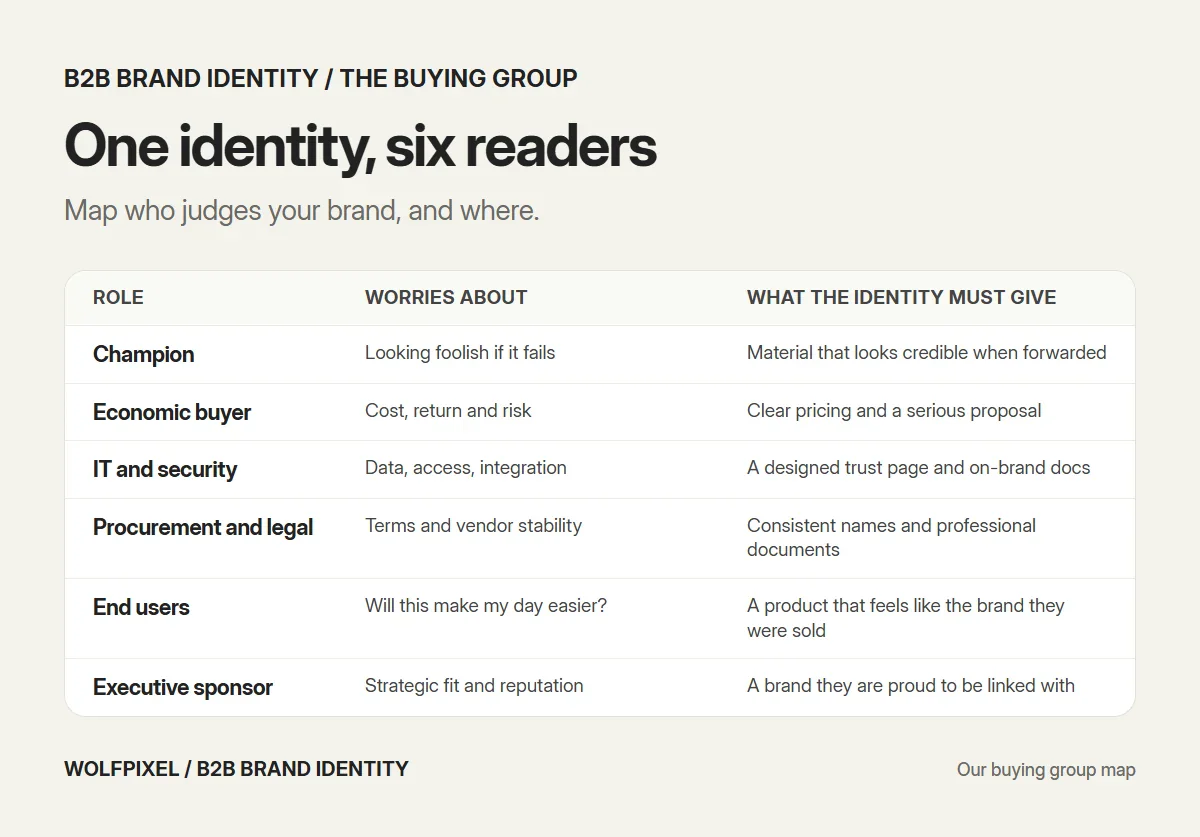
| Role | What they worry about | Where they meet your brand | What the identity must give them |
|---|---|---|---|
| Champion | Looking foolish if the choice goes wrong | Website, demo, case studies, the deck they forward | Material that looks credible when they forward it internally |
| Economic buyer (CFO or budget owner) | Cost, return and risk | Proposal, pricing page, ROI summary | Clear pricing and a proposal that looks like a serious vendor |
| IT and security | Data, access, integration | Security page, documentation, questionnaires | A designed trust center and docs that match the brand |
| Procurement and legal | Terms, compliance, vendor stability | Contracts, vendor forms, invoices | Consistent legal entity names and professional documents |
| End users | Will this make my day easier or harder? | Product interface, onboarding emails, help center | A product that feels like the brand they were sold |
| Executive sponsor | Strategic fit and reputation | A one-page summary, peer references, events | A brand they are comfortable being associated with |
You don’t need a separate identity for each role. You need one identity that is applied with care in all of these places. Our guide to the B2B customer journey map shows how to map these roles in more detail before you design.
The touchpoints where B2B buyers judge your identity
Ask a B2B company where its brand lives and most will say the website and LinkedIn. Ask its buyers and you will hear about the deck, the proposal and the security review. These are the touchpoints we design or template on every B2B identity, roughly in the order buyers meet them.
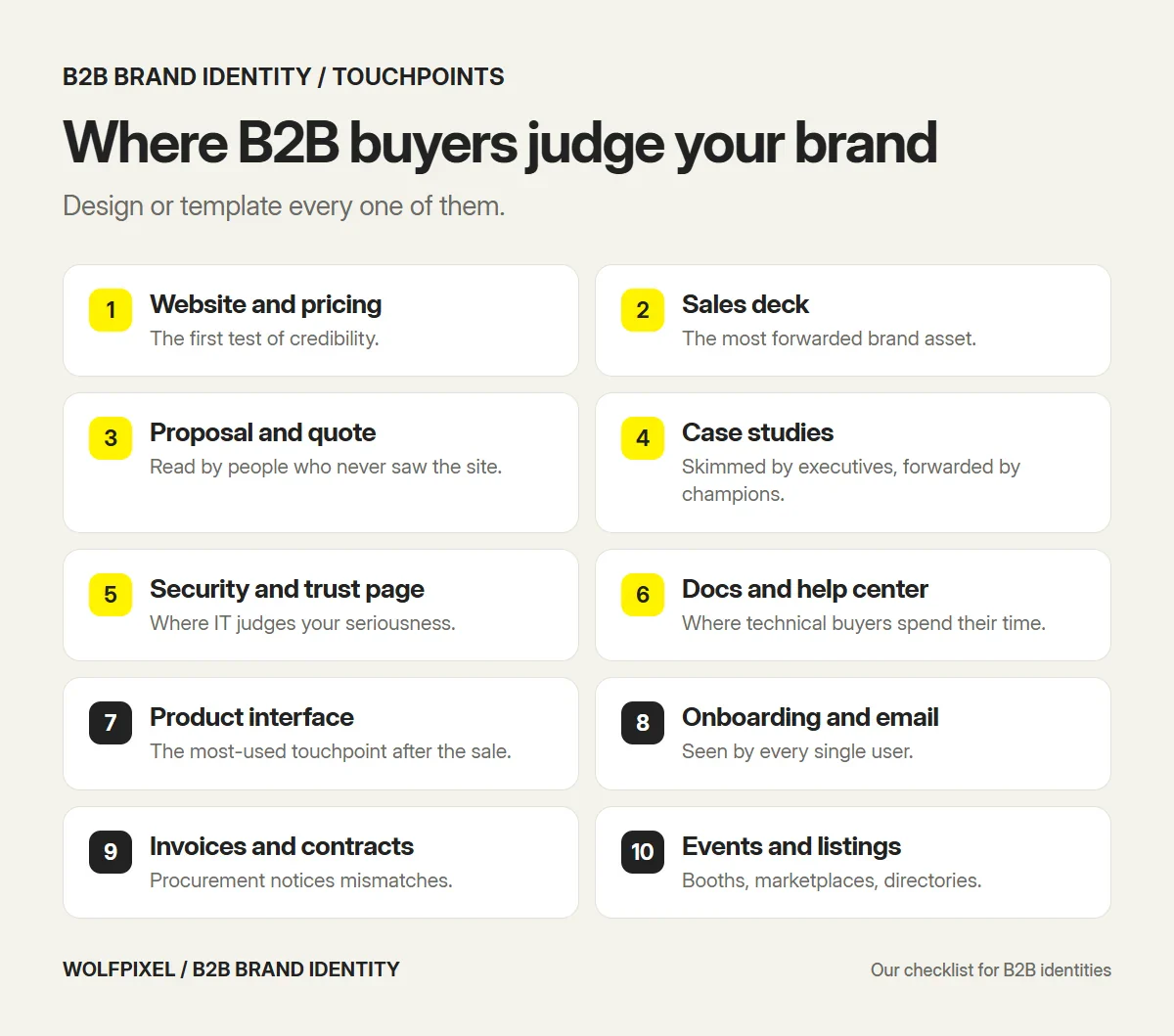
- Website and pricing page. The first test of credibility, and usually the champion’s first link to colleagues.
- Sales deck. The most forwarded brand asset in B2B. If sales builds its own, the identity is already fragmenting.
- Proposal and quote. Often read by people who never saw the website. It should look like it came from the same company.
- Case studies. Designed to be skimmed by a busy executive and forwarded by a champion.
- Security and trust page. IT and security reviewers judge your seriousness here. A plain, well-structured page in your brand beats a PDF nobody can find.
- Documentation and help center. Technical buyers spend more time here than on your homepage.
- Product interface. For a software company, this is the most-used brand touchpoint after the sale. Color, type and tone should carry into the product through shared design tokens, which is where the brand and product design meet.
- Onboarding and transactional email. Sign-up, invites, invoices and password resets are seen by every user.
- Invoices, contracts and vendor forms. Procurement notices when the legal name, the logo and the documents don’t match.
- Events and partner listings. Booth graphics, integration marketplace listings and directory profiles.
A practical test: put your homepage, your latest sales deck, a recent proposal and a product screenshot side by side. If a buyer couldn’t tell they came from the same company, the identity system isn’t working yet.
How to build a B2B brand identity in 8 steps
This is the process we use. Steps 1 to 3 are strategy, 4 to 6 are design and 7 to 8 make it last.
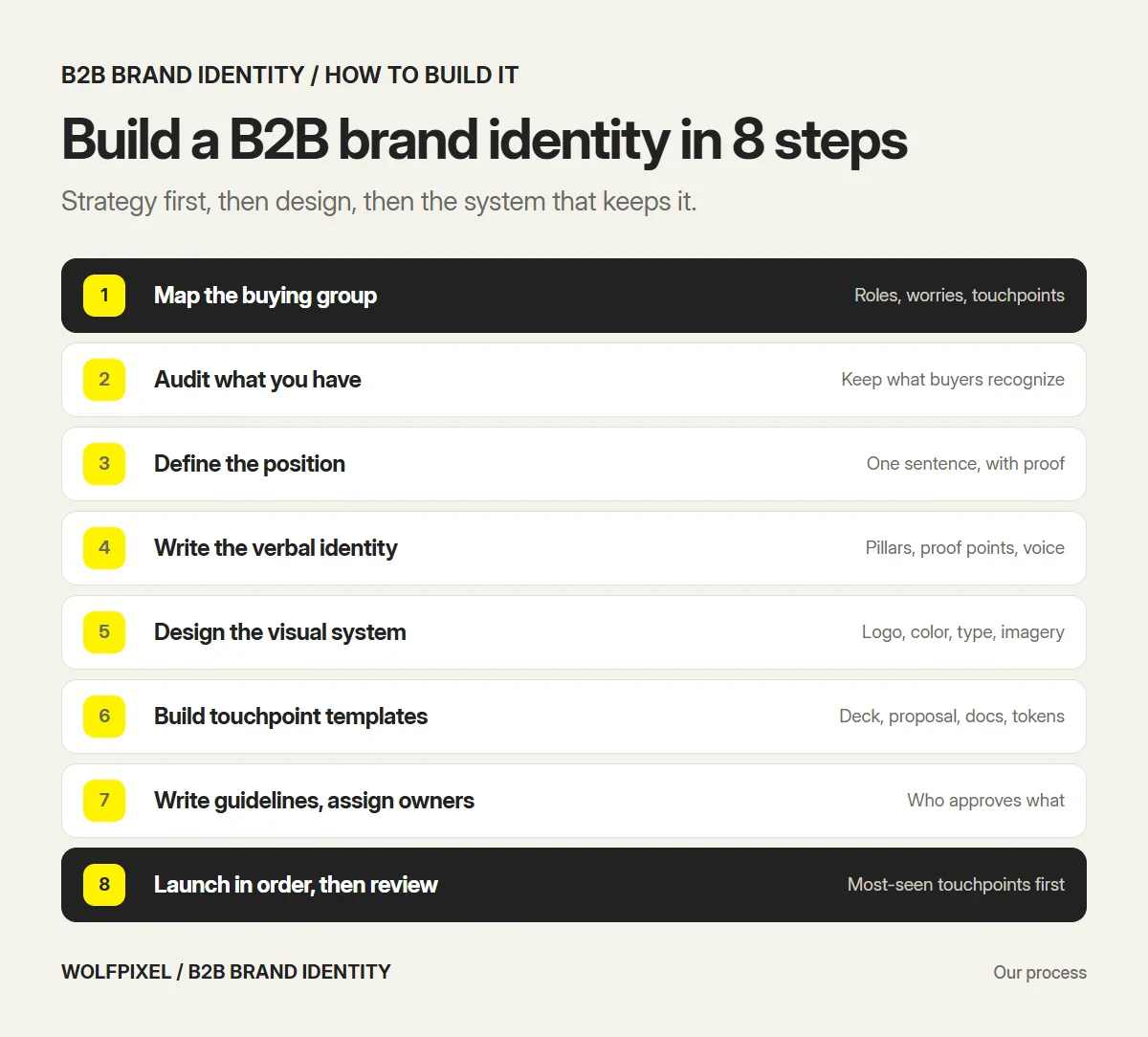
- Map the buying group. List the roles involved in a typical deal, what each worries about and where they meet your brand, as in the table above. Interview a few recent customers, including one deal you lost.
- Audit what you already have. Collect the website, decks, proposals, product screens, documents and emails. Note what buyers already recognize. If you are not starting from zero, keep the assets that carry recognition. Our guide to B2B brand equity explains how to measure what is worth keeping.
- Define the position. One sentence: who you serve, what you do better and why it is true. Every later decision is checked against it.
- Write the verbal identity. Messaging pillars, proof points for each role in the buying group and a tone of voice with real examples. Do this before the visuals, because the visuals have to express it.
- Design the visual system. A logo system with lockups, color with accessible values, type for marketing and interface, imagery, icons and diagrams. Test everything at small sizes, in dark mode and in a dense product screen. Our guide to logomarks, wordmarks and combination marks covers the logo choices.
- Build the touchpoint templates. Sales deck, proposal, case study, one-pager, security page, document and email templates, plus design tokens the product team can use. This is where the identity becomes something a team can actually use.
- Write guidelines and assign owners. Who approves new assets, where the files live and how often the system is reviewed. In Lucidpress data published by Marq, 69% of companies said their brand guidelines aren’t widely adopted or don’t exist at all. Our brand guidelines guide shows what to include.
- Launch in a planned order and review. Launch the website, product, deck and proposal first, because buyers see those most. Replace secondary material as it runs out. Review adoption after three months.
For the general step-by-step process, including workshops and deliverables, see how to create a brand identity. The steps above add the B2B parts: the buying group, the proof assets and the sales and product templates.
Brand architecture for multi-product B2B companies
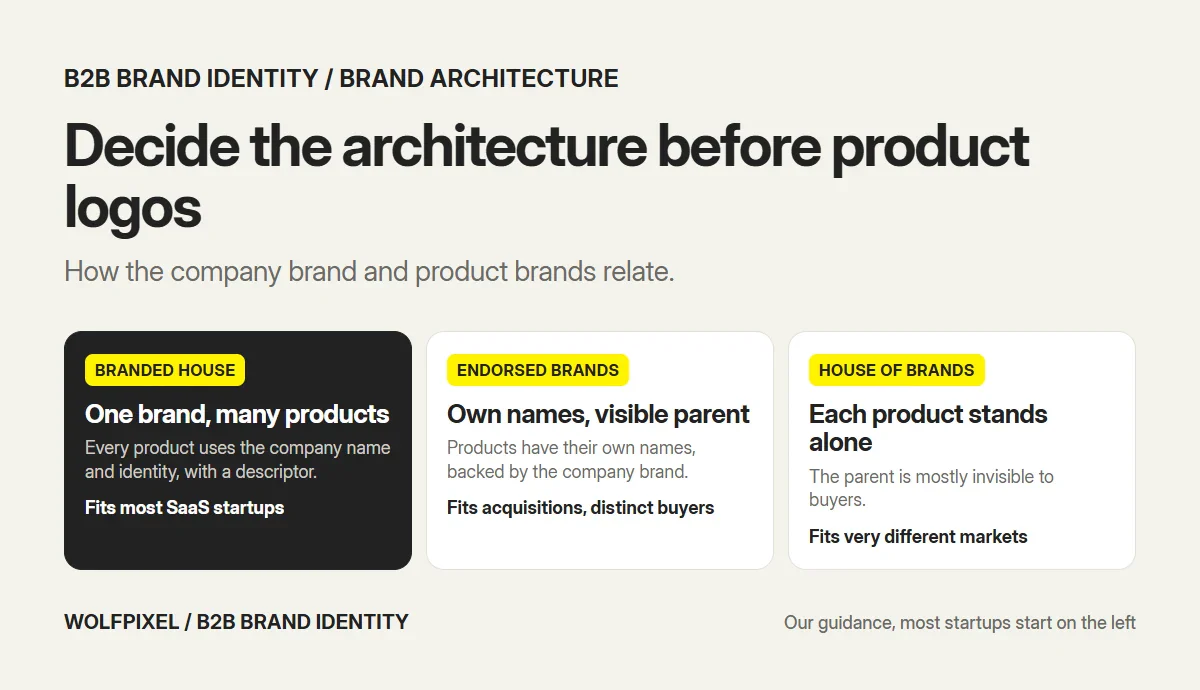
As soon as you sell a second product, you need to decide how the company brand and the product brands relate. Decide this before anyone designs a product logo, because it is expensive to undo.
| Model | How it works | When it fits | Trade-off |
|---|---|---|---|
| Branded house | Every product uses the company name and identity, with a descriptor | Most startups and SaaS companies, and products sold to the same buyers | Simple and cheap, but every product shares one reputation |
| Endorsed brands | Products have their own names, visibly backed by the company | Acquisitions, or products for clearly different buyers | More flexible, but each product needs its own identity work |
| House of brands | Each product stands alone, the parent is mostly invisible | Very different markets, or products you may sell later | Maximum separation, but no shared brand equity |
Most B2B companies should start as a branded house. Atlassian is a good example of designing for growth: when it rebranded in 2017, its CEO wrote that the company needed a visual system that stretches across 14+ products and could take in acquisitions, with each product logo anchored in a core value or benefit.
If a new product, an acquisition or a move upmarket also calls for a new name, settle the architecture first and then the brand naming, so the name fits the system it has to live in.
B2B brand identity examples
These examples are well documented by the companies themselves, which is why we chose them over prettier ones.
| Company | What they did | The lesson for B2B identity |
|---|---|---|
| IBM | Created a corporate design program in 1956 and kept Paul Rand’s 8-bar logo, released in 1972, for decades | Consistency is what turns a logo into a distinctive asset |
| Slack | Redesigned its logo in 2019 because the original was 11 different colors and every app button looked different | An identity has to survive real use at small sizes and on other backgrounds |
| Atlassian | Rebuilt its identity in 2017 to cover more than 14 products and future acquisitions | Plan the brand architecture before the product logos |
| Gusto | Renamed from ZenPayroll in 2015 because “payroll” boxed the company into one product, and rolled the change out in stages | A name and identity should leave room for what you will sell next |
| Brex | Rebranded in 2020 when its previous brand had become too limiting as it moved beyond startups, with a new flag mark, website, dashboard and app | Moving upmarket is a common reason to rebuild a B2B identity |
Gusto’s rename is documented in detail by First Round Review, including how the team shortlisted names and why it chose a warm red for a payroll company.
Examples from our own work
These are B2B identities we designed. Two are concept projects, and we say so.
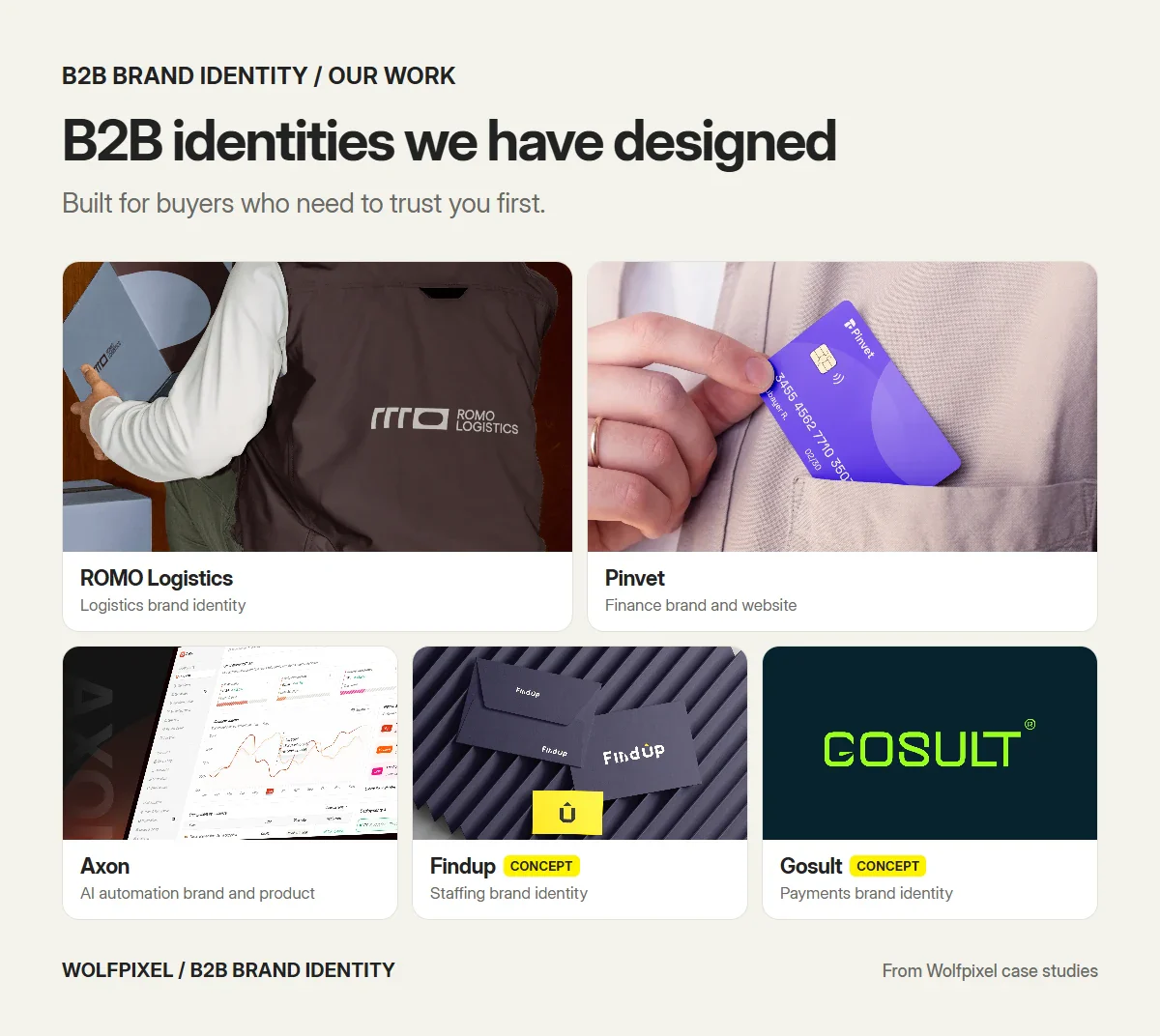
- ROMO Logistics. Logistics is a trust business: shippers choose carriers they believe will deliver safely. We built an identity around reliability and international reach, with a symbol that works on its own on parcels and a deep brown, steel blue and off-white palette that stays recognizable on cardboard, fabric, vehicles and screens.
- Pinvet. A finance management startup competing with banks that have decades of trust. We designed the brand and website as one system and carried it onto the payment card, the app icon and outdoor advertising, so the company looks equally established everywhere.
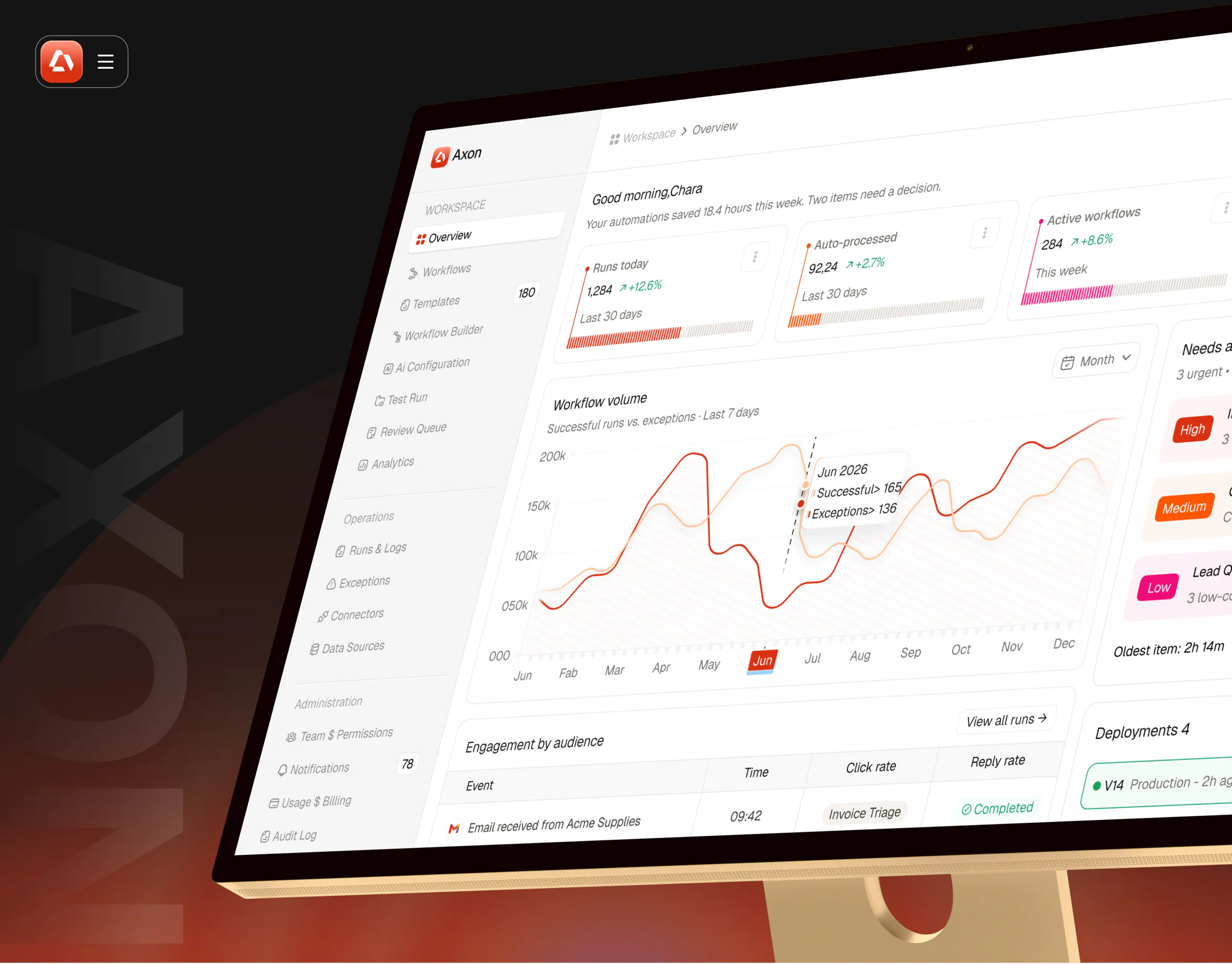
- Axon. An AI automation platform for finance and operations teams, who don’t trust black-box tools. We designed the brand system and the product together, so the trust the website promises shows up in the product as confidence scores and a review queue.
- Findup (concept). A staffing company that has to win two audiences at once, employers and job seekers. Every color in the palette was given one meaning for one of those audiences.
- Gosult (concept). A payments brand that had to look as safe as a bank and as current as a fintech. A navy base carries the trust, and violet and lime keep it modern.
How to tell if your B2B identity is working
You don’t need a brand tracking study to check an identity. Start with three tests.
The distinctiveness test. The Ehrenberg-Bass Institute defines a distinctive brand asset as one that is both unique and famous: buyers link it to you and only you, and many of them know it. Show your color, symbol or tagline without the name to a few target buyers and ask whose it is. If they name a competitor, the asset isn’t doing its job.
The consistency test. Collect ten recent pieces: two decks, two proposals, the website, three product screens and two emails. Count how many follow the guidelines. Below eight out of ten, fix the templates before you design anything new.
The sales test. Ask your sales team which material they are proud to send and which they rebuild themselves. Rebuilt decks show you where the identity system is missing a template.
To track brand strength over time, with share of search, win rate and price realization, use the scorecard in our B2B brand equity guide.
Common B2B brand identity mistakes
- Designing for the CEO, not the buying group. The identity looks great in the board deck and falls apart in a security questionnaire.
- Copying the category. If every competitor is navy with a geometric mark, yours will be forgotten. Secure-looking and generic are not the same thing.
- A logo without a system. No deck template, no proposal template and no product tokens, so every team improvises.
- Ignoring the product. For a SaaS company, the interface is where customers meet the brand most. If the product uses different colors and type, the brand promise stops at the login screen.
- Forgetting accessibility. A brand color that fails contrast gets dropped by the product team, and the identity splits in two.
- Changing too often. Every unnecessary redesign resets the recognition you have built. Refresh what is broken and keep what buyers recognize.
If you are deciding between keeping your identity and starting again, our guides to rebranding strategy and what a rebrand costs cover the decision and the budget. When the position still works and only the look is dated, a brand refresh is usually the better choice than a full rebrand.
What you get from a Wolfpixel B2B brand identity project
We work mostly with SaaS, fintech and technology companies, so we design the identity, the touchpoint templates and the product UI as one system. Every project starts from the buying group map above. These are the deliverables, and the service each one belongs to.
| Deliverable | What it includes | Related service |
|---|---|---|
| Brand strategy and positioning | Buying group map, positioning statement, proof points by role | Brand identity |
| Messaging and tone of voice | Value proposition, messaging pillars, voice guide with examples | Brand identity |
| Visual identity system | Logo and lockups, accessible color, typography, imagery, icons and diagrams | Logo design and brand identity |
| Name and architecture | Company or product names and how the brands relate, when needed | Brand naming |
| Sales and marketing templates | Sales deck, proposal, case study, one-pager, security page and document templates | Brand identity |
| Brand guidelines and governance | Usage rules, owners, a review cadence and a shared file library | Brand guidelines |
| Product consistency | Design tokens and components so the product matches the brand | Design system and SaaS design |
How it fits together in practice. For Core.hr, an HR platform, we created the brand identity and guidelines, the website, the web dashboards and the mobile app on one design system in 18 days, so the brand HR teams see on the website is the one employees use on their phones every day. If you are already established and only the look is dated, we usually recommend a brand refresh instead of a full identity project.
You can see how we approach fintech and SaaS brands on our industry pages, or book a free call to talk through your buying group and what your identity needs to do.
Sources and method
We reviewed every source below in November 2026.
- Forrester: The State of Business Buying, 2024 (December 4, 2024), for buying group size and purchases across departments.
- Gartner: 74% of B2B buyer teams demonstrate unhealthy conflict (May 7, 2025, survey of 632 B2B buyers), for buying group size and conflict.
- CEB and Google: From Promotion to Emotion (2013, third-party copy of the original PDF), for emotional attachment, personal vs business value and perceived differences between suppliers.
- Bain and Harvard Business Review: The B2B Elements of Value (February 20, 2018), for reputation and anxiety in B2B buying.
- Ehrenberg-Bass Institute: Brands of distinction (Jenni Romaniuk), for the definition of distinctive brand assets.
- Marq: Brand statistics (page updated October 2026), for Lucidpress data on the adoption of brand guidelines.
- W3C: Understanding WCAG 2.2, Contrast (Minimum), for the 4.5:1 contrast requirement.
- Atlassian: Our bold new brand (2017), for the multi-product identity system.
- IBM: The IBM logo and IBM: Design program, for the 8-bar logo and the corporate design program.
- Slack: Say hello to our new logo (January 16, 2019), for the logo redesign.
- First Round Review: An inside look at Gusto’s reinvention, for the ZenPayroll rename.
- Brex: Rebranding Brex (2020), for the rebrand and new mark.
- Big Red Jelly: Cost to rebrand a business and Clutch: Branding agency pricing, for published brand identity and branding project costs.
Our own recommendations
- The B2B vs B2C comparison, the elements table, the buying group map, the touchpoint list, the eight steps, the architecture guidance and the three tests are our own, based on how we build identities at Wolfpixel. Project details come from our case studies.
B2B Brand Identity FAQs
What is a B2B brand identity?
A B2B brand identity is the set of strategic, verbal and visual elements a company that sells to other businesses controls to be recognized and trusted. It includes positioning, messaging and tone of voice, the logo, color, type and imagery, and the templates and rules that apply them to sales material, the website and the product.
What is the difference between B2B and B2C brand identity?
A B2C identity usually has to persuade one person, often quickly. A B2B identity has to work for a buying group of several people with different worries, over a long decision, and it is judged in places consumer brands rarely think about, such as sales decks, proposals, security pages, documentation and the product interface.
What should a B2B brand identity include?
At minimum, a positioning statement, messaging and a tone of voice, a logo system with lockups, a color palette that passes accessibility contrast, typography, imagery and icon rules, templates for the sales deck, proposal and documents, product UI tokens, and brand guidelines that say who owns the brand and how it is used.
How long does it take to build a B2B brand identity?
A focused identity for a startup can take a few weeks. A strategy-led identity for a growing company usually takes two to four months, and the rollout across the website, product and sales material takes longer than the design work itself. Plan the rollout before you approve the logo.
What is the difference between B2B branding and B2B brand identity?
B2B branding is the whole effort to shape how business buyers perceive a company, including strategy, reputation, customer experience and marketing. B2B brand identity is the part the company designs and controls, such as the positioning statement, messaging, name, logo, colors, type and templates. The identity is the tool, and branding is the ongoing work of using it.
What makes a B2B brand identity successful?
A successful B2B brand identity is clearly positioned, distinctive in its category and applied consistently wherever buyers meet it, including sales decks, proposals, security pages, documentation and the product. It works for every member of the buying group, passes accessibility checks and comes with templates and owners, so it stays consistent as the company grows.
How much does B2B brand identity design cost?
Published ranges vary widely. Big Red Jelly puts a brand identity system at about $2,000 to $20,000, and Clutch reports that branding projects on its platform typically cost $10,000 to $49,999. A B2B identity costs more when it includes positioning, messaging, sales templates and product design tokens, and the rollout is usually budgeted separately. Our guide to what a rebrand costs breaks the budget down line by line.
Do B2B brands need to be boring?
No. B2B buyers are people, and a 2013 study by CEB and Google found that a greater share of B2B customers are emotionally attached to the brands they buy than B2C consumers are. A B2B identity should feel credible and safe to choose, but credible does not mean generic. Looking like every competitor is the bigger risk.
What is a B2B brand identity template?
There is no template that creates a distinctive identity, but a template helps you check you have everything. Use a checklist that covers strategy, verbal identity, the visual system, brand architecture, proof assets, sales and product templates, and governance, then fill it with decisions specific to your company.
When should a B2B company rebrand its identity?
Consider a new identity when the current one limits growth, for example when the name ties you to one product, when a merger or new product line breaks the brand architecture, or when you move upmarket and the brand no longer looks credible to larger buyers. If the position still works and only the look is dated, a refresh is usually enough.
Need a brand identity your whole buying group trusts?
Get positioning, a visual identity system, brand guidelines, and sales and product templates in one project. Tell us who buys from you, and a senior designer replies within 4 business hours with a plan and a fixed quote.

Was this article helpful?

Written by
Masuder Rahaman
Founder & CEO | Brand Design Director at Wolfpixel
Masuder Rahaman is the Founder & CEO of Wolfpixel and the Brand Design Director with 8+ years of experience. He personally leads branding work at Wolfpixel. In this article, he explains what makes a B2B brand identity different, where enterprise buyers actually judge it and how to build one step by step. Wolfpixel offers the brand identity services discussed in the article.
View all articles