
 12 min read
 Published
B2B SaaS (business-to-business software as a service) is software that a company hosts in the cloud and sells to other businesses on a subscription. The customer’s team uses it through a browser or app, and the vendor runs, secures and updates it for every customer at once. Salesforce, Slack and QuickBooks Online are well-known examples.
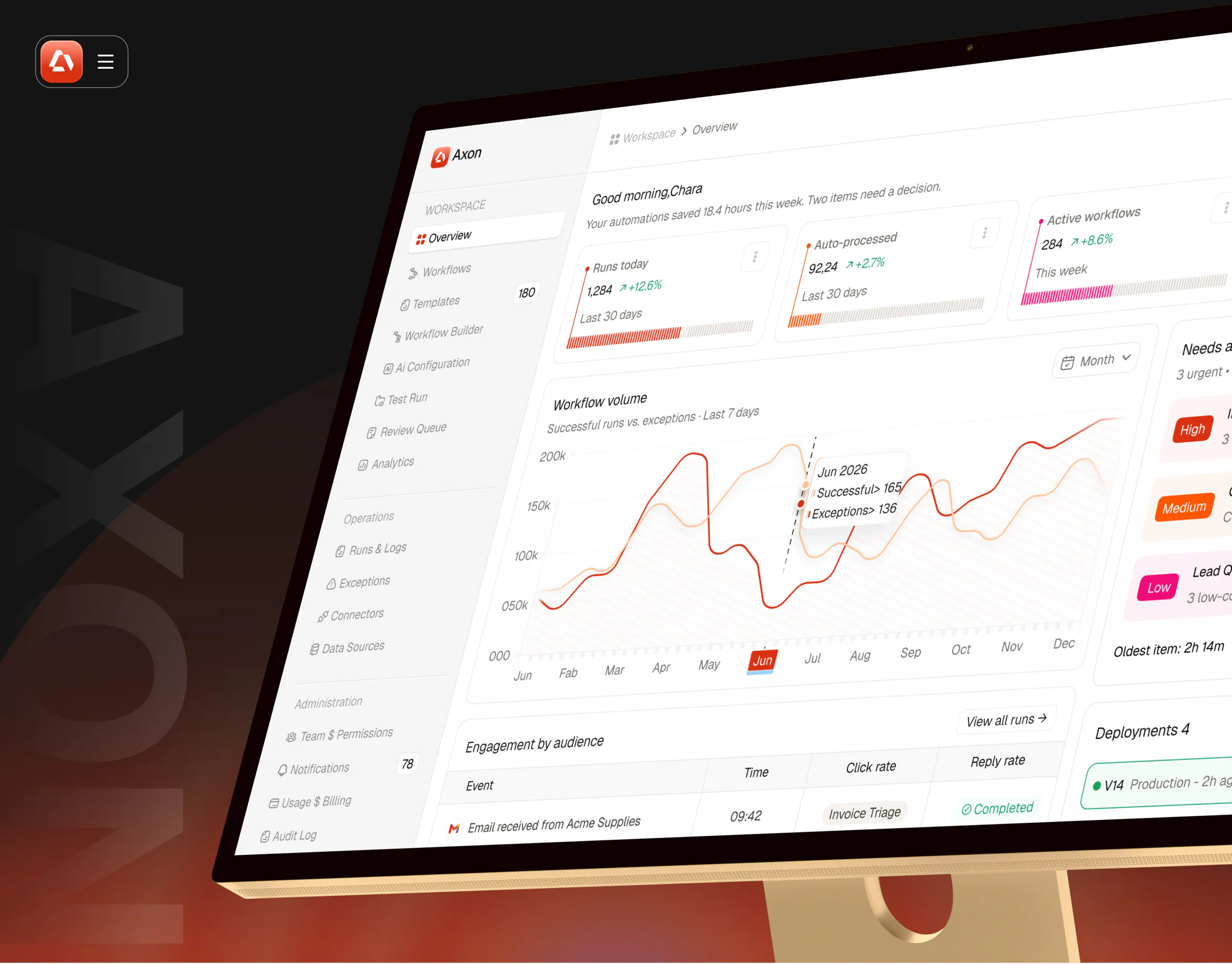
I’m Maniruzzaman Jubayer, Co-founder & COO and Product Design Specialist at Wolfpixel, with 7 years of experience. Most of the products we design are B2B SaaS, from sales CRMs like Alignify to AI workflow tools like Axon. This guide explains what B2B SaaS is, how the business model works, who buys it and how that changes the product.
The short answer: B2B SaaS is cloud software sold to companies on a recurring subscription. It differs from consumer software in three ways: a group of people decides to buy it, the people who buy it are often not the people who use it, and revenue depends on customers staying and expanding year after year.
Key takeaways:
- B2B SaaS is a business model as much as a technology. The vendor hosts the software and sells access, not copies.
- Buying decisions involve several roles: a budget owner, a champion, IT and security, admins and end users.
- Pricing is usually per seat, by usage, by tier or a mix, and contracts are often annual.
- Retention matters more than acquisition. A customer who leaves after six months rarely pays back what it cost to win them.
- The product has to serve the buyer, the admin and the daily user, not just one of them.
How we wrote this: we reviewed the pages ranking for this question in November 2026 and the original sources behind them, including Zylo’s SaaS Management Index, AWS and Microsoft architecture guidance and Battery Ventures’ T2D3 article. Every figure is linked to its source. The buying-committee and product-implication tables are our own, based on the B2B SaaS products we design. The full list is in Sources and method.
What is B2B SaaS?
B2B SaaS combines two ideas:
- B2B (business to business): the customer is a company, not an individual.
- SaaS (software as a service): the software runs on the vendor’s servers and customers pay for access, usually monthly or yearly, instead of buying and installing it.
So a B2B SaaS company builds software for businesses, hosts it in the cloud, and charges each customer company a recurring fee for its team to use it. Updates, security and infrastructure are the vendor’s job, which is why customers can sign up and start working without an IT project.
The scale is large and still growing. Zylo’s 2026 SaaS Management Index, based on more than 40 million licenses, found the average company now uses 305 SaaS applications.
B2B SaaS vs B2C SaaS
The software model is the same. Who buys it, and how, is not.
| B2B SaaS | B2C SaaS | |
|---|---|---|
| Customer | A company | An individual |
| Who decides | A group: budget owner, champion, IT, admins, users | One person |
| Sales cycle | Weeks to months | Minutes to days |
| Price | Higher, often per seat or per contract | Lower, usually a fixed monthly fee |
| Contract | Often annual, sometimes negotiated | Monthly, cancel anytime |
| Onboarding | Setup, data import, roles, training | Sign up and start |
| Product must include | Admin, roles and permissions, SSO, audit logs, integrations | A great personal experience |
| Examples | Salesforce, Slack, Workday | Spotify, Duolingo, Canva’s free tier |
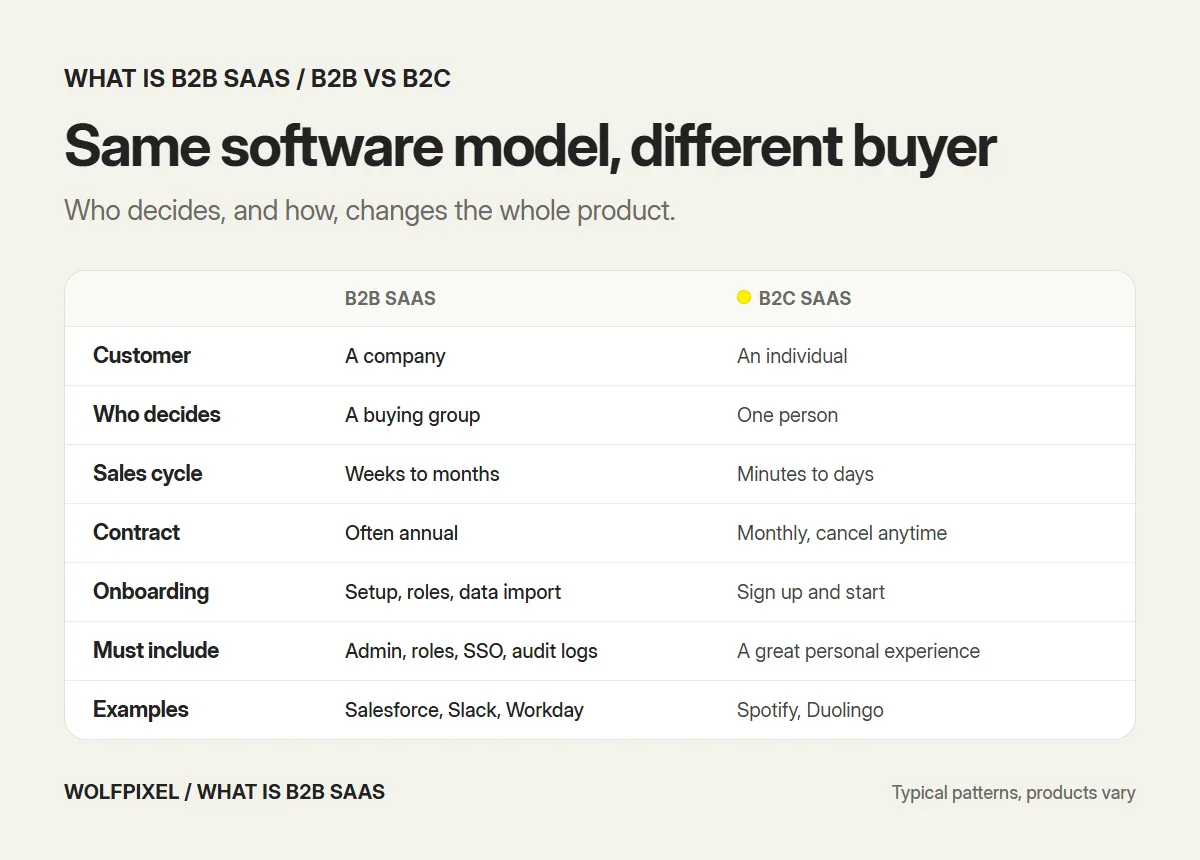
Some products sit in both columns. Canva and Slack started with individuals and small teams, then added team plans, admin controls and enterprise contracts. That move from B2C-style signup to B2B-style selling is common in SaaS today.
How the B2B SaaS model works
Subscription, not ownership
Customers rent access. They pay a recurring fee, usually monthly or annually, and lose access if they stop paying. For the vendor, revenue becomes predictable, but only if customers renew. That is why B2B SaaS companies obsess over retention.
One product, many customers
Most SaaS products are multi-tenant: one running system serves many customer companies, each with its own data kept separate. Microsoft’s architecture guidance notes that in B2B SaaS a tenant is usually a customer organization with many users. AWS goes further and calls SaaS more of a business model than an architecture strategy, which is a useful reminder that the model shapes everything else.
Continuous delivery
Because the vendor runs the software, every customer gets new features and fixes at the same time. There are no version upgrades to sell. The product is never finished, and neither is the design work.
Who buys B2B SaaS: the buying committee
In B2B, one signature usually sits on top of several opinions. These are the roles we design for on almost every B2B SaaS project, and what each one needs to see.
| Role | What they care about | What convinces them |
|---|---|---|
| Economic buyer | Budget, return on investment, risk | A clear business case and pricing they can defend |
| Champion | Solving their team’s problem, looking good internally | A trial or demo that proves value fast, plus material to share |
| IT and security | Security, compliance, integrations | SSO, data handling, audit logs, security documentation |
| Admin | Setup, permissions, ongoing management | A clear admin area with roles, user management and settings |
| End users | Getting their daily work done | A fast, clear interface for the tasks they repeat |
| Procurement | Contract terms and vendor risk | Standard terms, invoices, clear plans |
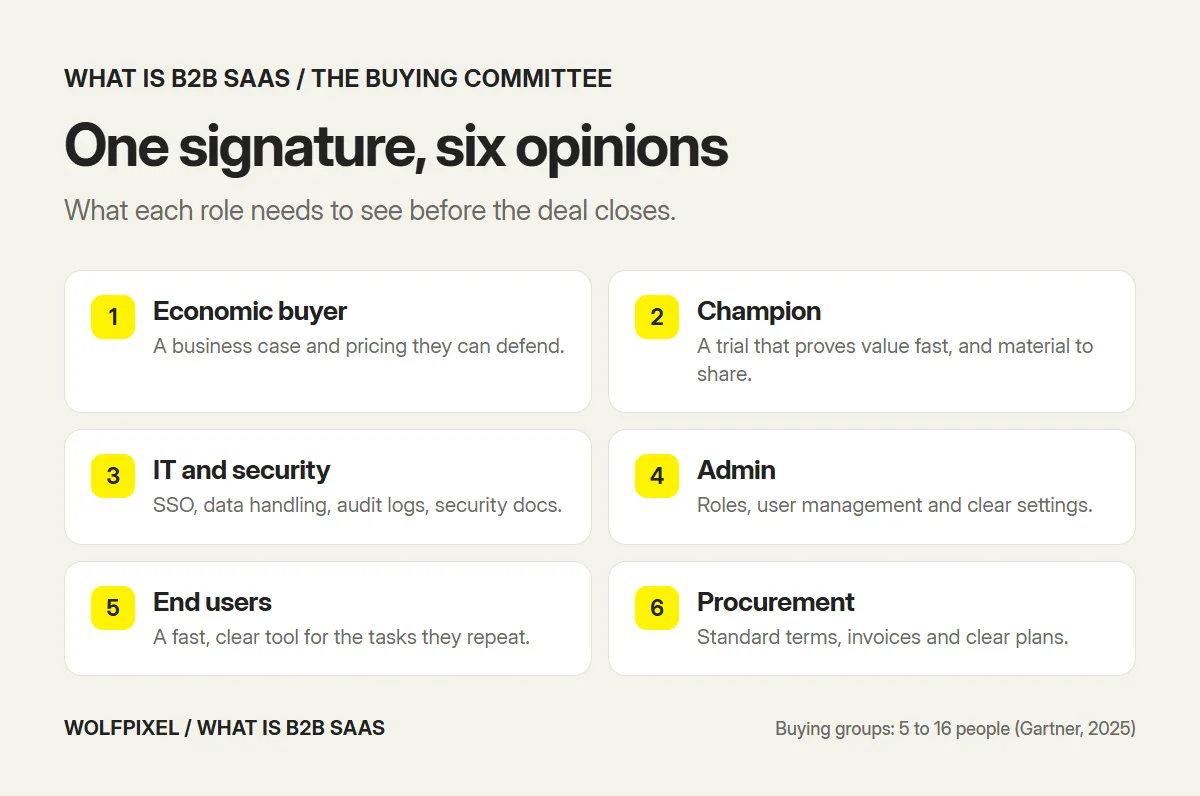
Gartner’s research shows how wide this group gets: in a 2025 survey of 632 B2B buyers, buying groups ranged from five to 16 people across as many as four functions. The exact group changes with company size and deal value, but the pattern holds: the more people a decision touches, the more the product and website have to answer questions for people who will never use it daily.
The user isn’t the buyer: what that means for the product
This is the part of B2B SaaS that shapes design most. A consumer app has to delight one person. A B2B product has to convince a buyer, pass a security review, let an admin set it up and still be the tool an employee is happy to open every morning.
In practice, a B2B SaaS product needs things a consumer product doesn’t:
- Roles and permissions, so admins control who sees and changes what.
- An admin area, separate from the daily workspace.
- Team onboarding, not just personal signup: invites, data import, setup checklists.
- Single sign-on and audit logs, because IT will ask.
- Reporting that a manager can take into a meeting.
We go deeper into the design side in our guide to B2B SaaS UX. The short version: design for each seat at the table, not just the end user.
Types of B2B SaaS: horizontal vs vertical
| Horizontal SaaS | Vertical SaaS | |
|---|---|---|
| Serves | One job across many industries | Many jobs within one industry |
| Examples | Slack (messaging), QuickBooks Online (accounting), Zendesk (support), Workday (HR) | Veeva (life sciences), Toast (restaurants), Procore (construction) |
| Market | Large, crowded | Smaller, deeper |
| Advantage | Huge addressable market | Industry-specific workflows competitors can’t copy quickly |
| Design challenge | Flexibility for many use cases | Matching how one industry actually works |
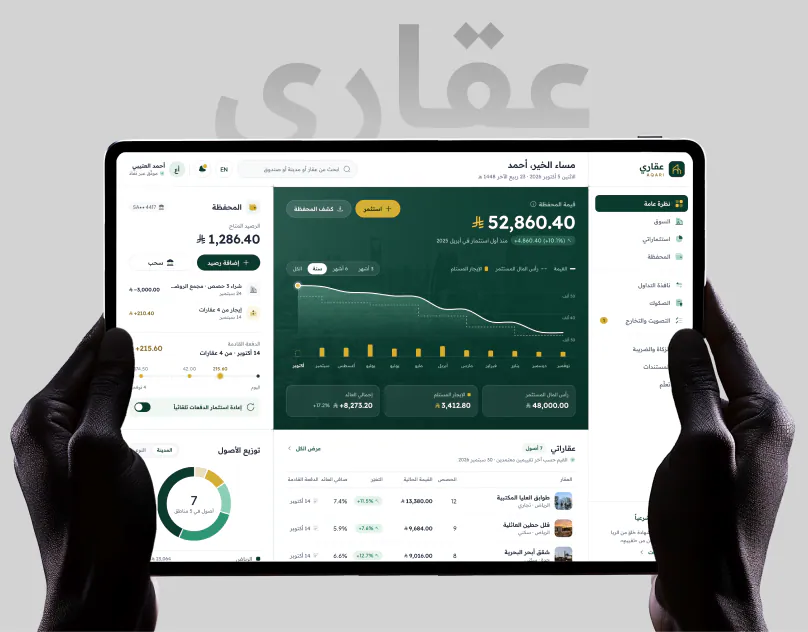
Many of the products we design are vertical SaaS, such as Emura for real estate management and HiveQ for HR, where the interface has to fit one industry’s workflow closely.
How B2B SaaS is priced
| Model | How it works | Well-known example |
|---|---|---|
| Per seat | A price per user, per month or year | Slack, Salesforce |
| Usage-based | Customers pay for what they use, such as messages, API calls or compute | Twilio, Snowflake |
| Tiered | Plans with more features at higher prices | HubSpot |
| Hybrid | A base subscription plus usage or add-ons | Many AI products |
| Freemium | A free plan that converts to paid as teams grow | Slack, Notion |
Prices change often, so check each vendor’s current pricing page before comparing numbers. The model matters more than the figure: per-seat pricing grows with team size, usage pricing grows with activity, and tiered pricing grows with feature needs. Your pricing page has to make the right model obvious, which we cover in our guide to SaaS pricing page design.
B2B SaaS metrics, defined
These are the numbers investors and operators use to judge a B2B SaaS business.
| Metric | What it measures | How to calculate it |
|---|---|---|
| MRR | Monthly recurring revenue | Sum of all active subscriptions’ monthly value |
| ARR | Annual recurring revenue | MRR × 12, or the sum of annual contract values |
| Logo churn | Share of customers who leave | Customers lost in a period ÷ customers at the start |
| Revenue churn | Share of revenue lost | MRR lost from cancellations and downgrades ÷ starting MRR |
| Net revenue retention (NRR) | Whether existing customers grow | (Starting MRR + expansion − churn − contraction) ÷ starting MRR |
| CAC | Cost to win one customer | Sales and marketing spend ÷ new customers won |
| LTV | Revenue a customer brings over time | Average revenue per customer × gross margin ÷ churn rate |
| CAC payback | Months to earn back acquisition cost | CAC ÷ (monthly revenue per customer × gross margin) |
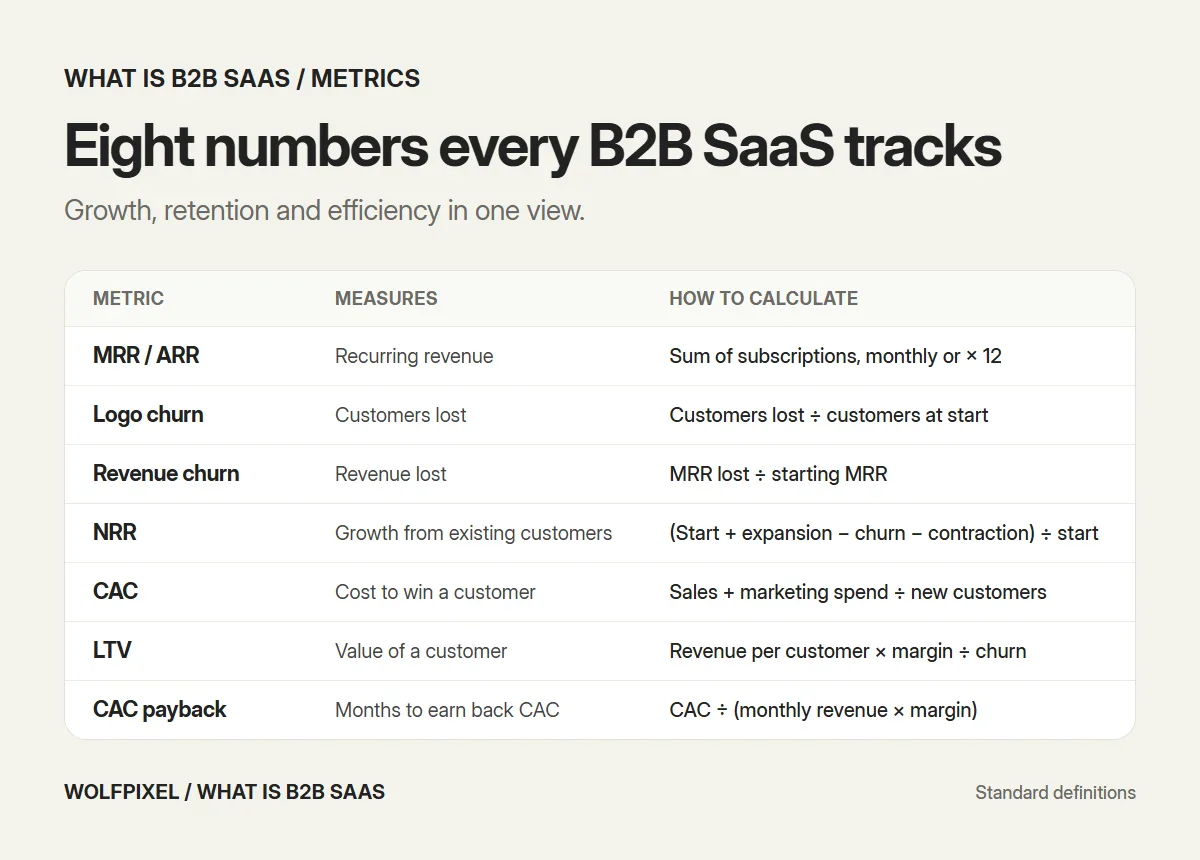
NRR above 100% means existing customers grow faster than others leave, which is why expansion matters so much in B2B. Design affects these numbers more than most teams expect: onboarding drives activation, and activation drives retention. Our guide on reducing SaaS churn covers that link.
What is the 3-3-2-2-2 rule (T2D3)?
The 3-3-2-2-2 rule is a growth path for B2B SaaS, better known as T2D3: triple, triple, double, double, double. It was described by Neeraj Agrawal of Battery Ventures in a 2015 TechCrunch article. Starting from about $2 million in ARR, a company triples revenue for two years ($6 million, then $18 million) and doubles it for three ($36 million, $72 million, then $144 million).
It is a benchmark for venture-backed companies, not a rule every SaaS business needs to follow. Plenty of healthy B2B SaaS companies grow more slowly and profitably.
Building B2B SaaS? Where design fits
If you are building a B2B SaaS product, the design work usually happens in three layers: the brand and website that win the buyer, the onboarding that gets a team set up, and the product the users live in every day. We design all three for SaaS companies, from first raise to Series B, and our SaaS product design service covers the product itself. For how a B2B brand earns its place on the shortlist, see our guide to B2B brand equity.
If you are earlier than that and planning the build, our guide to SaaS product development walks through the stages from idea to launch.
Sources and method
We reviewed every source below in November 2026.
- Zylo: 2026 SaaS Management Index, for the average of 305 SaaS applications per company.
- Microsoft Learn: tenancy models for multitenant solutions, for tenants as customer organizations in B2B SaaS.
- AWS: SaaS architecture fundamentals, for SaaS as a business model and multi-tenancy.
- TechCrunch: The SaaS travel adventure (2015), for the T2D3 growth path.
- Gartner press release, May 7, 2025, for buying group size.
Our own analysis
- The buying-committee table and the list of B2B product requirements.
- The pricing-model and metric tables, which use standard industry definitions.
B2B SaaS FAQs
What is B2B SaaS?
B2B SaaS (business-to-business software as a service) is software that a company hosts in the cloud and sells to other businesses on a subscription. Customers use it through a browser or app, and the vendor runs, secures and updates it for every customer at once.
What is a B2B SaaS example?
Salesforce (CRM), Slack (team messaging), HubSpot (marketing and sales), QuickBooks Online (accounting), Zendesk (customer support) and Workday (HR) are all B2B SaaS products. Each is sold to businesses on a subscription and used by their employees through the cloud.
Is Netflix a B2C SaaS?
Netflix is a consumer subscription service, so it is a common example of B2C rather than B2B. Strictly, it sells streamed media rather than business software, so it is usually called a subscription service rather than SaaS.
What is the difference between B2B SaaS and B2C SaaS?
B2B SaaS is sold to companies, usually by a group of decision makers, with longer sales cycles, higher contract values and features such as roles, permissions and admin controls. B2C SaaS is sold to individuals, who buy quickly on their own and usually pay less.
What is the 3-3-2-2-2 rule of SaaS?
It is the T2D3 growth path described by Neeraj Agrawal of Battery Ventures in 2015. Starting from about $2 million in annual recurring revenue, a company triples revenue for two years and then doubles it for three, reaching about $144 million.
How do B2B SaaS companies make money?
Mostly through recurring subscriptions, priced per user (seat), by usage, by feature tier or as a mix of these. Many also charge for onboarding, premium support or add-ons, and grow revenue by expanding within existing customers.
What metrics matter most for B2B SaaS?
The core metrics are monthly and annual recurring revenue (MRR and ARR), churn, net revenue retention, customer acquisition cost (CAC), customer lifetime value (LTV) and CAC payback period. Together they show whether growth is efficient and whether customers stay and expand.
What is the difference between horizontal and vertical B2B SaaS?
Horizontal SaaS solves one job for many industries, such as Slack for messaging or QuickBooks for accounting. Vertical SaaS serves one industry end to end, such as Veeva for life sciences or Toast for restaurants.
Why is B2B SaaS harder to design than consumer software?
Because the person who buys it is often not the person who uses it. The product has to convince a buyer, pass IT and security review, let admins set up roles and still be fast for the people who use it every day.
Building a B2B SaaS product?
Tell us who buys it and who uses it. A senior designer replies within 4 business hours with what we would design first and a fixed quote.

Was this article helpful?

Written by
Maniruzzaman Jubayer
Co-founder & COO | Product Design Specialist at Wolfpixel
Maniruzzaman Jubayer is Wolfpixel’s Co-founder & COO and a product design specialist with 7 years of experience. He personally oversees website, app, dashboard and digital product design at Wolfpixel, where most clients are B2B SaaS companies. This guide explains what B2B SaaS is, how the model works and how it shapes the product. Wolfpixel offers the SaaS design services mentioned in the article.
View all articles