


 16 min read
 Published
B2B brand equity is the added value your company gets from its brand when businesses decide whether to buy from you. Kevin Lane Keller defined customer-based brand equity as the differential effect of brand knowledge on consumer response to a brand’s marketing. In B2B, that “differential effect” has a price tag. It decides whether you are on the shortlist, whether you win the deal and whether you can hold your price.
I’m Masuder Rahaman, Founder & CEO of Wolfpixel and Brand Design Director, with 8+ years of experience. Most guides on this topic are written for large industrial or professional services firms. Wolfpixel works with SaaS companies and startups, so this guide shows what brand equity means for a company that is still building it, how to measure it without an enterprise research budget, and what design actually does to it.
The short answer: B2B brand equity is built from awareness, associations, perceived quality, trust and loyalty. It matters because most buyers arrive with a favorite already. Forrester found that 68% of B2B buyers already have a front-runner vendor in mind at the start of their purchase, and that vendor wins 80% of the time. Measure it with share of search, branded search, direct traffic, win rate, price realization and a simple buyer survey.
Key takeaways:
- Most of your future buyers aren’t buying today. Brand equity is how they remember you when they are.
- B2B buying is emotional too. Personal value, such as looking good to the boss, has twice the impact of business value in one large study.
- You can measure brand equity on a startup budget. Start with signals you already have in Search Console, analytics and your CRM.
- Design builds equity through distinctive assets and consistency, not through redesigns. Every unnecessary change resets recognition.
- For a SaaS company, the product is the brand’s most-used touchpoint. Equity is built or lost in the interface every day.
How we wrote this: we reviewed the pages ranking for this topic in November 2026, including The Brand Algorithm, Axxen, Inkbot Design, IE Insights, HBS Online and CI Design, and read the research behind them: Keller’s 1993 paper, Aaker’s model, the LinkedIn B2B Institute and IPA work by Les Binet and Peter Field, the CEB and Google “From Promotion to Emotion” study, and Forrester’s buyer research. Figures are linked to the original publisher. The measurement stack and the design guidance are our own recommendations. The full list is in Sources and method.
What is B2B brand equity?
Two definitions shape almost everything written on brand equity.
- Keller (1993): brand equity is the differential effect of brand knowledge on how customers respond to a brand’s marketing. Brand knowledge has two parts, brand awareness and brand image, which is the set of associations people hold.
- Aaker: brand equity is a set of brand assets and liabilities linked to a brand, its name and its symbol, grouped into five categories: brand loyalty, brand awareness, perceived quality, brand associations and other proprietary assets.
Put simply: if two vendors offer the same product at the same price, brand equity is the reason a buyer picks one of them, and the reason the winner can charge a little more next time.
In B2B, three things change the picture. The brand is usually the company, not a product. The decision is made by a buying group, so equity has to work on several people with different worries. And the brand is experienced through people and product: sales calls, onboarding, support and the interface customers use every day.
B2B vs B2C brand equity
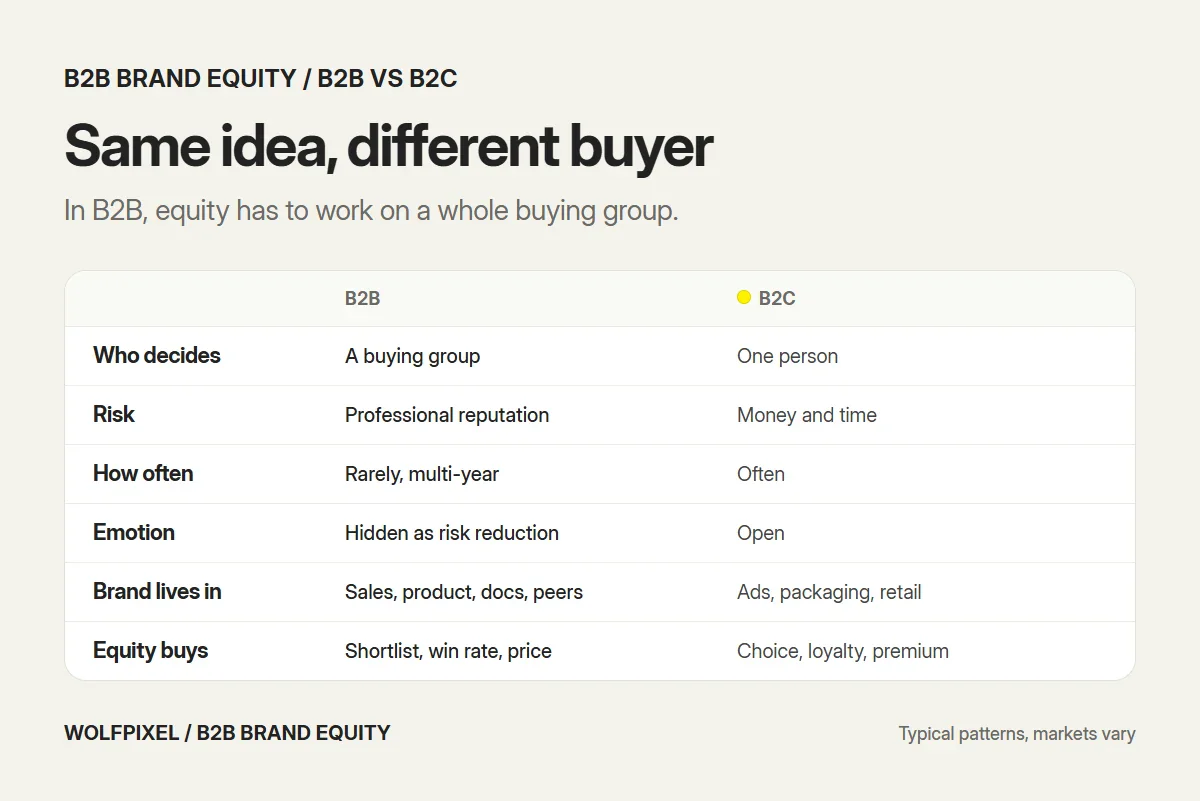
| B2B | B2C | |
|---|---|---|
| Who decides | A buying group, often with finance, IT and end users | Usually one person or a household |
| Risk | Professional: a bad choice can cost a job | Personal: usually money and time |
| How often they buy | Rarely, often on multi-year contracts | Often, sometimes weekly |
| Role of emotion | Large, but disguised as risk reduction and personal reputation | Openly part of the purchase |
| Where the brand lives | Sales, product, onboarding, documentation, peers | Ads, packaging, retail, social |
| What equity buys | A place on the shortlist, a higher win rate, less discounting | Choice at the shelf, loyalty, a price premium |
The biggest myth is that B2B buyers are purely rational. The CEB and Google study of 3,000 B2B buyers found that personal value has twice as much impact as business value on buyer behavior. Personal value means things like confidence, professional pride and not looking foolish in front of colleagues. A trusted brand reduces exactly that risk.
Why brand equity matters in B2B
The research points in one direction: most B2B deals are decided before the buyer talks to sales.
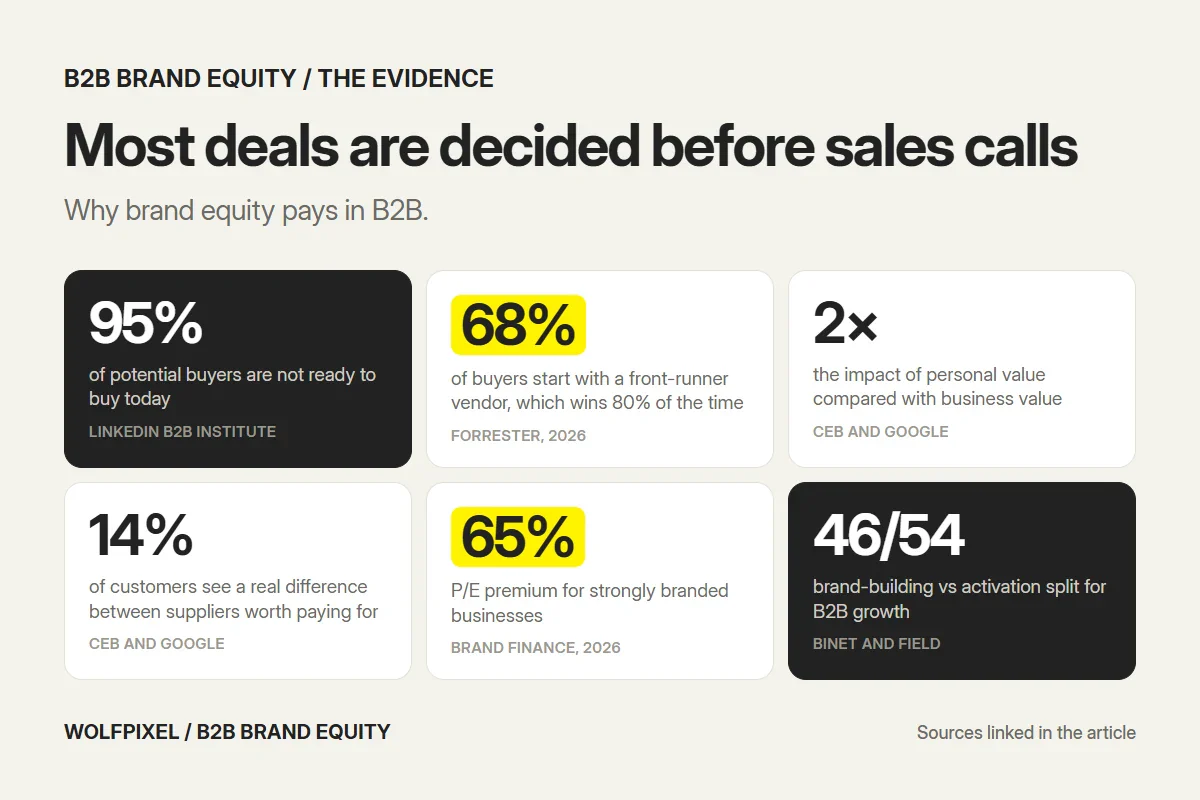
- Most buyers aren’t buying today. The LinkedIn B2B Institute’s 95-5 rule, based on Ehrenberg-Bass research, holds that 95% of your potential buyers aren’t ready to buy today. They will be in the market later, and brand equity decides whether they remember you then.
- The favorite usually wins. In Forrester’s research, 68% of B2B buyers had a front-runner vendor at the start of their purchase, and the front-runner won 80% of the time. Bain reports a similar pattern, saying around 90% of buyers purchase from their Day 1 list.
- Most suppliers look the same. The CEB and Google study found that only about 14% of customers perceive a real difference between suppliers and value it enough to pay for it. When products look alike, the brand is often the difference.
- Brand affects valuation. Brand Finance reports that companies with stronger branded businesses command a 65% premium in forward price-to-earnings ratios.
- Brand and activation both pay. Analysis by Les Binet and Peter Field for the LinkedIn B2B Institute found that B2B companies grow best by allocating 46% of budget to brand-building and 54% to activation. Most startups spend almost everything on activation.
For a startup, the practical takeaway is simple. Every lead you capture today was shaped by what the buyer already knew about you. Our guide to the B2B customer journey map shows where in that journey the brand does its work.
The components of B2B brand equity
Aaker’s five categories still work in B2B, with one addition that matters more than in consumer markets: trust in the company and its people.
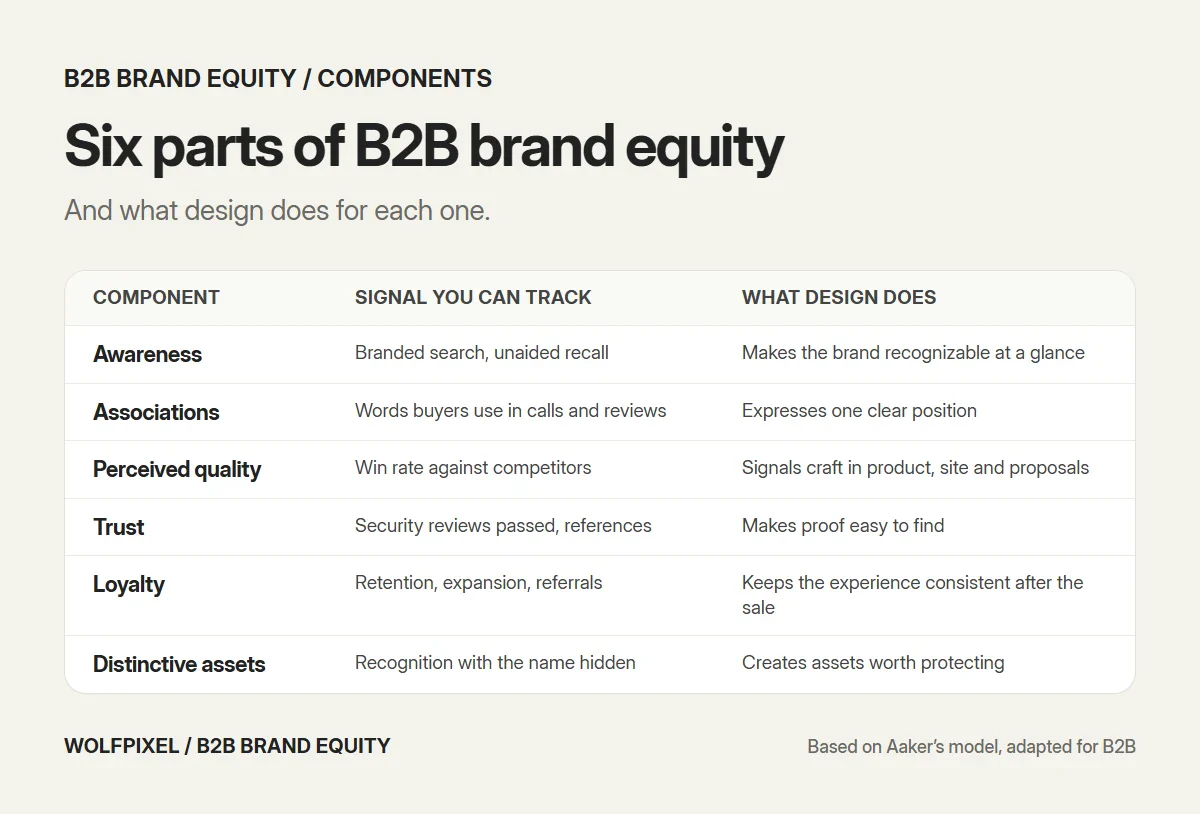
| Component | What it means in B2B | A signal you can track | What design does |
|---|---|---|---|
| Awareness | The buying group thinks of you when the need appears | Branded search, unaided recall in a survey | Makes the brand recognizable at a glance |
| Associations | What buyers believe you are best at | Words buyers use in calls and reviews | Expresses one clear position, not ten |
| Perceived quality | Buyers expect you to deliver | Win rate against competitors | Signals craft in the product, site and proposals |
| Trust | Confidence in the company and its people | Security reviews passed, references given | Makes proof easy to find: case studies, docs, security pages |
| Loyalty | Customers renew, expand and recommend | Net revenue retention, referrals | Keeps the experience consistent after the sale |
| Distinctive assets | Colors, symbols, names and characters that belong to you | Recognition with the name hidden | Creates assets worth protecting, then protects them |
Distinctive assets are the component design controls most directly. Salesforce introduced its Astro character in 2014 to make enterprise software feel friendly, and it still appears across the company’s products and events. An asset like that is only valuable because it has been used consistently for years.
How to measure B2B brand equity
Enterprise brands run tracking studies. A startup can get most of the signal from data it already has. This is the measurement stack we recommend, from cheapest to most effort.
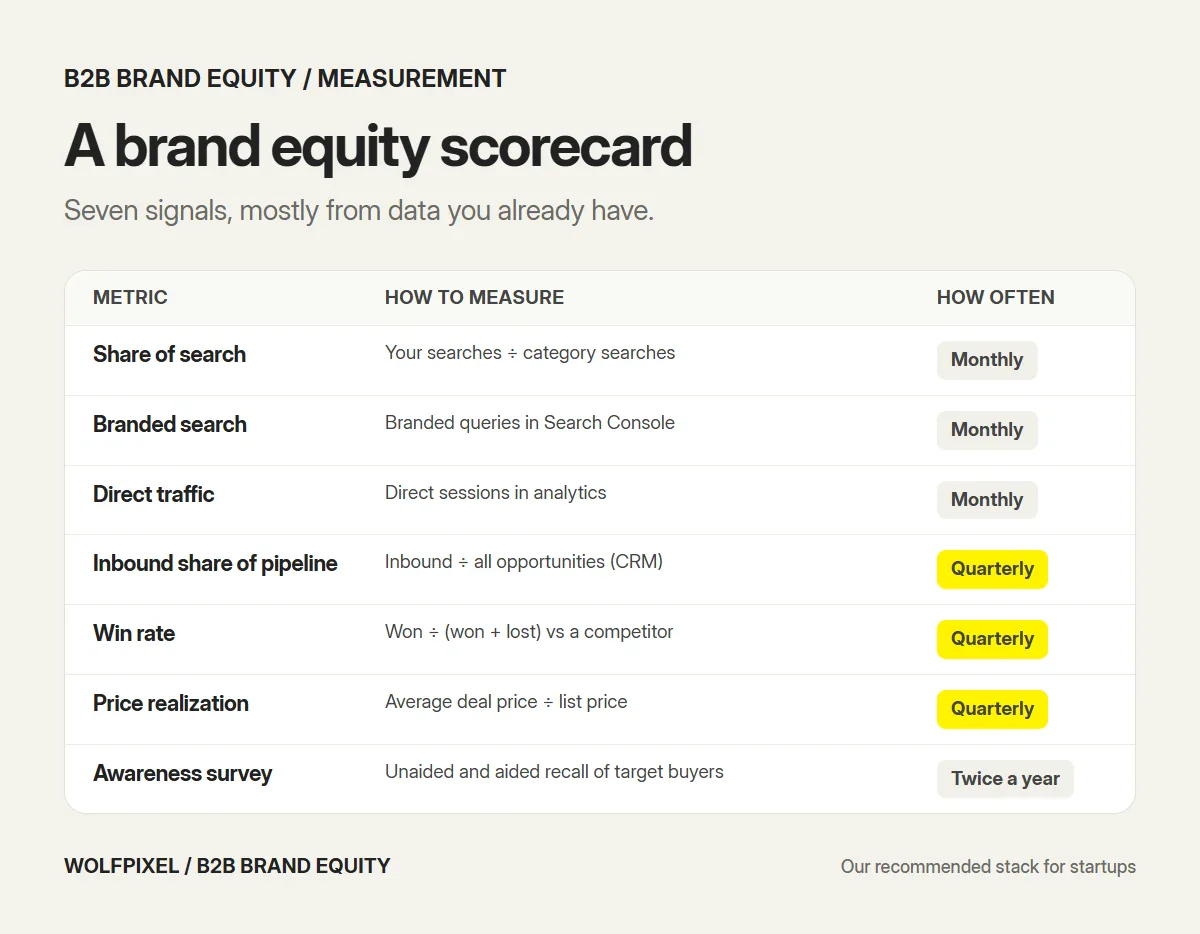
| Metric | What it tells you | How to measure | How often |
|---|---|---|---|
| Share of search | Your share of mental availability in the category | Your brand’s searches ÷ searches for all brands in the category, from Google Trends or a keyword tool | Monthly |
| Branded search volume | Whether more people look for you by name | Branded queries in Google Search Console | Monthly |
| Direct traffic | Visits from people who already know you | Direct sessions in your analytics, excluding your own team | Monthly |
| Inbound share of pipeline | Demand you didn’t have to chase | Opportunities that came inbound ÷ all opportunities, from your CRM | Quarterly |
| Win rate on competitive deals | Preference when buyers compare | Won ÷ (won + lost) where a named competitor was involved | Quarterly |
| Price realization | Whether you can hold your price | Average deal price ÷ list price | Quarterly |
| Awareness and associations | Who knows you and what they think you do | A short survey of target buyers, with unaided and aided recall | Twice a year |
A few notes on using these well:
- Share of search comes from Les Binet’s work with the IPA, which defines it as searches for a brand divided by searches for all brands in the category and found it predicts market share. The validation was done in consumer categories such as cars and energy, so in B2B treat it as a direction, not a forecast.
- Branded search is noisy for small brands. Watch the trend over several months, not single weeks.
- Surveys are the only way to measure associations directly. Keep them short and ask the same questions every time, so results are comparable. Our UX survey guide covers how to write unbiased questions and how many responses you need.
- Pick five, not fifteen. A small scorecard reviewed every quarter beats a large dashboard nobody opens.
How design builds B2B brand equity
Design doesn’t create brand equity on its own. A beautiful identity on a product nobody trusts is decoration. But design decides how quickly equity accumulates, because recognition only builds when people see the same thing again and again. These are the design decisions that matter most.
1. Position first, then design. Associations come from a clear position, so the identity has to express one idea. When we built the identity for Secuara, a cybersecurity company, the position was protection that feels calm rather than fear-driven, so we replaced the category’s usual black and red with a fresh green palette.
2. Create distinctive assets, then protect them. A color, a symbol, a name with a story. For Pivosis, a data infrastructure company, we created the name and the identity together, so the story of the name shows up in every visual choice. The work only pays off if the assets stay the same for years.
3. Make the system consistent enough to scale. Slack redesigned its logo in 2019 because the original was 11 different colors and relied on a precise 18-degree rotation, so it was easy to get wrong and every app button looked different. Inconsistency spends recognition you have already earned. Brand guidelines and a shared design system are what keep a growing team on-brand.
4. Treat the product as the brand’s main touchpoint. For a SaaS company, customers spend more time in the product than with any ad or sales rep. For Core.hr, an HR platform, we designed the brand identity, dashboards and mobile app as one system, so the brand people meet on the website is the one they use every day.
5. Design the proof. Trust is built on evidence. Case studies, security pages, documentation and customer logos are brand assets in B2B, and they deserve the same care as the homepage.
How to build B2B brand equity in 7 steps
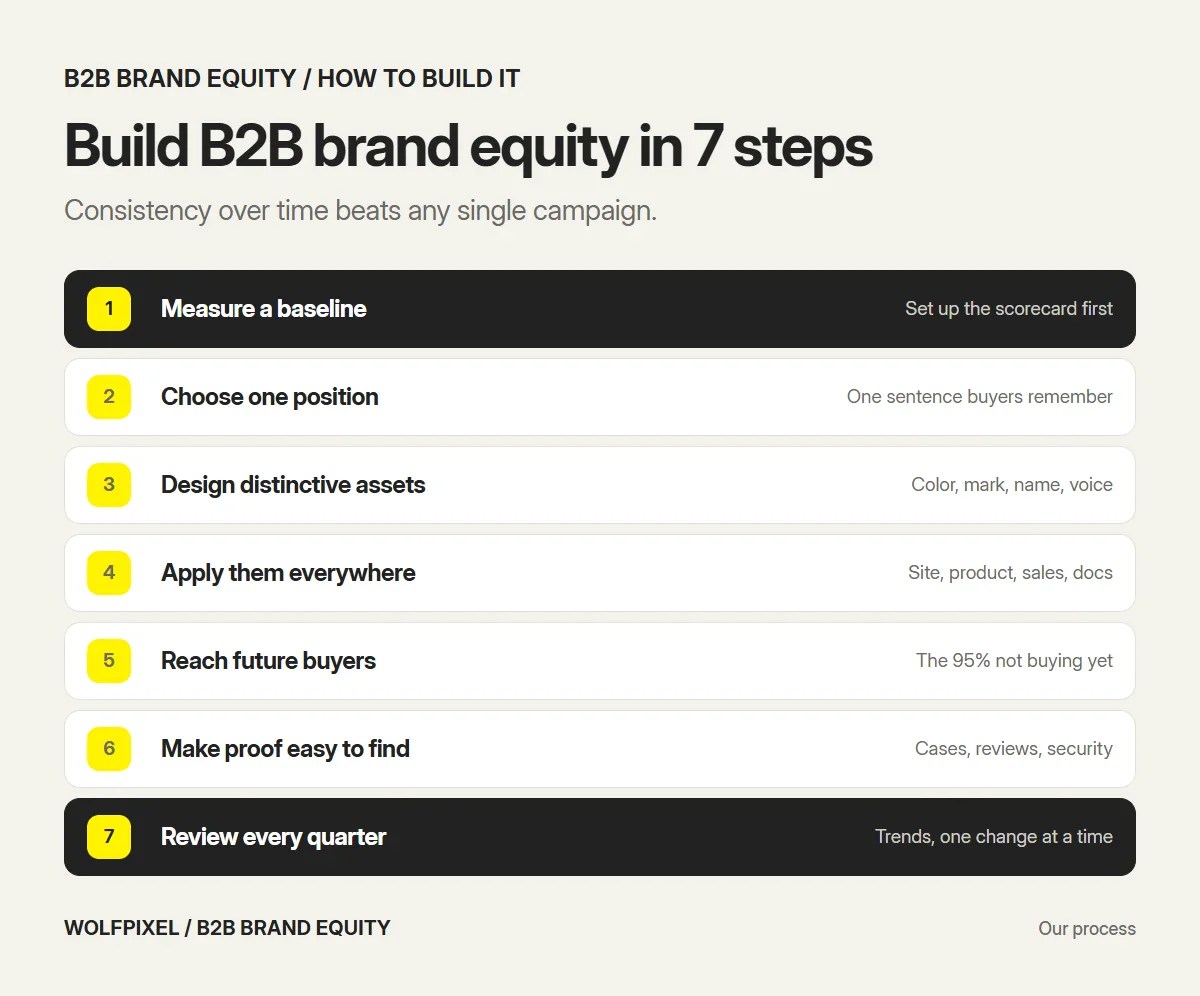
- Measure a baseline. Set up the scorecard above before you change anything, so you can see what works.
- Choose one position. Decide what you want the buying group to remember you for, in one sentence. Our guide to what B2B SaaS is covers how buying groups decide.
- Design distinctive assets. Build a brand identity with a few assets that can belong to you alone: a color, a mark, a name, a character or a way of speaking.
- Apply them everywhere, the same way. Website, product, sales deck, proposals, documentation and events. Consistency is where recognition comes from. Our B2B brand identity guide lists the touchpoints buyers actually judge.
- Reach future buyers, not only current ones. Spend part of the budget on content and channels that reach the 95% who aren’t buying yet, so you are remembered when they are.
- Make proof easy to find. Case studies, reviews, security information and clear pricing reduce the personal risk buyers worry about.
- Review the scorecard every quarter. Look at trends, not single numbers, and change one thing at a time.
Brand equity and rebranding
A rebrand is the moment brand equity is most at risk. Customers recognize colors, symbols and names, and a rebrand that throws them away resets that recognition to zero. The right sequence is to audit what buyers already recognize and trust, keep the assets worth keeping, then change the rest on purpose.
If you are weighing a rebrand, our guides to rebranding strategy and what a rebrand costs cover the decision and the budget. When the position still works and only the look is dated, a brand refresh protects more equity than a full rebrand.
Examples of strong B2B brands
Interbrand’s Best Global Brands ranking, published in October 2026, includes several B2B brands near the top:
| Brand | Rank | Brand value | Change from 2025 |
|---|---|---|---|
| Microsoft | 2 | $443.7 billion | Not stated on the brand page |
| Cisco | 11 | $57.0 billion | Up 17% |
| IBM | 18 | $43.8 billion | Up 11% |
| Salesforce | 37 | $20.5 billion | Up 7% |
These numbers are brand value, a financial estimate, not brand equity itself. But they show the end result of decades of consistent equity building: being the safe, obvious choice for a buying group. A startup won’t get there quickly, but it builds equity the same way, by being known for one clear thing and showing up the same way everywhere.
Sources and method
We reviewed every source below in November 2026.
- Keller, K. L. (1993), Conceptualizing, measuring, and managing customer-based brand equity, Journal of Marketing, for the definition of customer-based brand equity and brand knowledge.
- WARC: Aaker’s brand equity model (David A. Aaker, 2006), for the definition and the five categories.
- LinkedIn: Why you should follow the 95-5 rule (May 18, 2022), for the share of buyers out of market.
- LinkedIn: How B2B marketing really drives growth (October 16, 2019), for Binet and Field’s 46/54 brand and activation split.
- CEB and Google: From Promotion to Emotion (2013, third-party copy of the original PDF), for personal vs business value and perceived differences between suppliers.
- Forrester: Building preference is the key to winning B2B buyers (February 24, 2026), for front-runner vendors.
- Bain: Raising the odds on a deal (June 19, 2026), for buying from the Day 1 list.
- Brand Finance press release (April 30, 2026), for the valuation premium.
- IPA: Binet presents share of search (October 14, 2020), for the share of search definition and its predictive value.
- Slack: Say hello to our new logo (January 16, 2019), for the logo redesign.
- Salesforce: Meet the Trailhead characters (May 29, 2024), for the Astro character.
- Interbrand: Best Global Brands (October 2026), for brand values and ranks.
Our own recommendations
- The B2B component table, the measurement stack, the design guidance and the seven steps are our own, based on how we build brands at Wolfpixel. Project details come from our case studies.
B2B Brand Equity FAQs
What is B2B brand equity?
B2B brand equity is the added value a company gets from its brand when businesses buy from it. It shows up as being remembered when a need arises, being trusted enough to make the shortlist, winning more deals and holding prices. It comes from awareness, associations, perceived quality, trust and loyalty built over time.
How do you measure B2B brand equity?
Combine a few signals you can track every quarter. Share of search and branded search volume show mental availability, direct traffic and inbound pipeline show demand you did not pay for, win rate and price realization show preference, and a short survey of your target buyers measures awareness and associations.
What is the difference between brand equity and brand value?
Brand equity describes how people think and feel about a brand and how that changes what they do. Brand value is a financial estimate of what the brand is worth, such as the figures published by Interbrand or Brand Finance. Strong brand equity is what produces brand value.
What are examples of strong B2B brands?
Microsoft, Cisco, IBM and Salesforce are among the B2B brands in Interbrand’s Best Global Brands ranking. Microsoft ranks second with a brand value of $443.7 billion. Smaller B2B companies build equity the same way, by being known for one clear thing and showing up consistently.
What is the 95-5 rule in B2B marketing?
The 95-5 rule, from the Ehrenberg-Bass Institute and promoted by the LinkedIn B2B Institute, says that about 95% of potential B2B buyers are not in the market at any given time. Brand building reaches those future buyers so they remember you when they are ready, while sales activation captures the 5% who are buying now.
What is the rule of 7 in B2B?
The rule of 7 is an old marketing rule of thumb that a prospect needs to see or hear a message about seven times before acting. It is not backed by solid research, but the idea behind it holds. Buyers need repeated, consistent exposure to remember a brand, which is why consistency matters more than any single campaign.
Is Coca-Cola a B2B or B2C company?
Both. The Coca-Cola Company sells concentrates and syrups to bottling partners, which is a business-to-business relationship, while its brands are marketed to consumers. It is a reminder that brand equity built with end users can strengthen a company’s position with business partners too.
Can a startup have brand equity?
Yes. A startup builds brand equity from its first customers, its founders’ reputation, a clear position and a consistent identity. The equity is small at first, but early choices such as a distinctive name, a consistent visual system and a product that matches the brand decide how fast it grows.
Does a rebrand destroy brand equity?
It can if the rebrand throws away what buyers already recognize and trust. A good rebrand audits the existing equity first, keeps the assets worth keeping, such as a color, a symbol or a name, and changes the rest on purpose with a planned rollout.
Want a brand that buyers remember before they need you?
Tell us who buys from you and what you want them to remember. A senior designer replies within 4 business hours with a plan and a fixed quote.

Was this article helpful?

Written by
Masuder Rahaman
Founder & CEO | Brand Design Director at Wolfpixel
Masuder Rahaman is the Founder & CEO of Wolfpixel and the Brand Design Director with 8+ years of experience. He personally leads branding work at Wolfpixel. In this article, he explains what B2B brand equity is, how to measure it on a startup budget and how design choices build or waste it. Wolfpixel offers the brand identity services discussed in the article.
View all articles